
SHORT VERSION
Business systems for an electrical shop aren’t a policy binder and they aren’t software. They’re the rules that govern every handoff, when a job moves from the office to the field, the field to the counter, the counter back to the job. Most shops never built those on purpose. They accumulated as the shop grew, which works fine while the owner is in every loop and quietly bleeds money once he can’t be. That’s why growth adds revenue but not profit. You build the systems by fixing the handoff that leaks the most first, and by making the information required instead of optional, so it stops depending on anyone remembering.
Every time an electrical shop grows, the handoffs multiply. More trucks and more hands mean more jobs moving between the field and the office, and every one of those handoffs is a place work gets lost. That’s why growth adds revenue but not profit: the business systems underneath were never built, so volume just scales the leaks.
If you searched for this, you already know you need something built. The real question is what “it” is, and what building it looks like in a shop like yours.
What counts as a “system” in an electrical shop?
Not the electrical work. You’ve got that. A journeyman and a second-year apprentice can run a service call, troubleshoot it, and fix it without anyone writing a thing down, because the work itself is the part your people already know cold.
The system is everything around the work. How the call gets taken. What gets asked before a truck rolls. What has to come back off the job before it’s closed. When the invoice goes out, and whether the extras made it on.
A single service call touches the office, the field, the supply house, the customer, and accounting before it’s done. Every one of those is a handoff, and a handoff is just a place where information has to move from one person to the next without falling on the floor.
A system is the rule that makes it move. A habit is one person remembering to move it. That difference decides whether growth helps you or buries you.
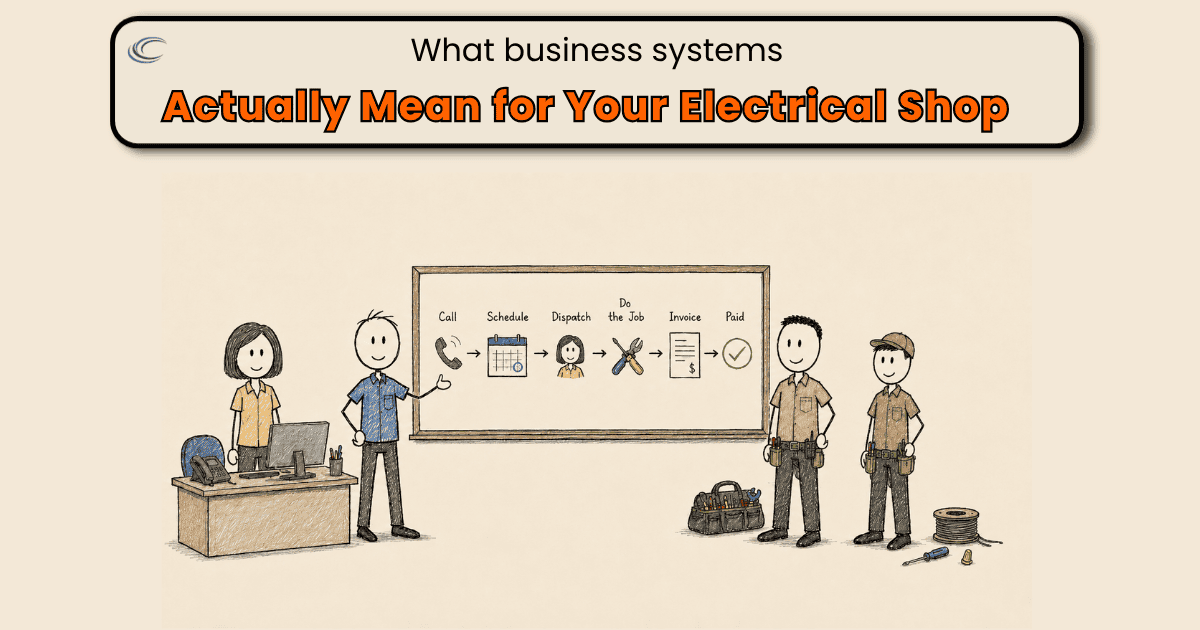
Why growing made it harder instead of easier
At two trucks, you don’t need much. You’re in every loop. You take the call, you know the customer, you remember the change order because you approved it, and if a job looks off you catch it before it’s invoiced. The shop runs on you, and at that size that works.
Then you add trucks and hands, and put a second person in the office. Every truck you add doesn’t just add work. It adds handoffs, and the handoffs are where the informal way quietly stops holding.
The scope change that never got written up, because writing it up was never a required step, just something people did when they remembered. The supply-house run charged to no job, because nothing forced a job number at the counter. The job that got done and never costed against what it was bid, because close-out ends when the customer’s happy, not when the numbers are in.
None of those cost you much once. They cost you every week, and growth runs more volume through every one of them. More jobs run through more handoffs, and every one is another place the same leaks open. The revenue climbs and the profit doesn’t, because you scaled the work and left the leaks alone. Shops your size lose somewhere between $100,000 and $500,000 a year this way, and none of it shows up as a line item.
Where the profit goes when you grow
It goes into the gaps between people. Not into anyone’s pocket, and not because anyone’s slacking. It leaks out at the handoffs nobody built a rule around, and it leaks faster the bigger you get.
That’s what makes growth feel like a trap. You did the thing you were supposed to do. You grew. And it got harder, because the informal systems that carried you at two trucks were never going to carry you at eight. They didn’t fail. They were never built to hold that much.
What building it actually looks like
Not a binder. Not a company-wide rollout where everyone gets a new procedure on Monday. That’s the version that fails, because it’s a stack of habits you’re asking people to remember, and a habit you have to remember isn’t a system.
You build it one handoff at a time, and you start with the one bleeding the most.
Pick the place where work most reliably falls on the floor. For a lot of shops it’s the close-out, where the extras and the job costs are supposed to land and usually don’t.
Then you make the information required, not optional. The job can’t close until the change order’s attached. The material can’t get bought without a job number. The invoice can’t go out until the extras are on it.
The test for whether you’ve built a system or just written down a habit is one question: does it still work if the person doing it forgets? If the job can’t advance without the information, it’s a system. If it advances and you’re hoping someone filled in the blank, it’s a habit in a system’s clothes, and it drifts back the first busy week.
Do that at the worst handoff. Then the next one. Systems that hold get built in order, not all at once, and they get built into how the work moves, so nobody has to carry them in their head. That’s the difference between a shop that gets more profitable as it grows and one that just gets busier.
FAQ
What’s the first business system an electrical shop should build?
Start where work falls on the floor most reliably, usually the close-out or the intake. Build a rule there that makes the information required before the job can move, not something people fill in when they get to it. Get one handoff holding before you touch the next.
Isn’t buying better software the same as building process?
No, and this is where a lot of money gets spent for nothing. Software is a place to put the process. If the process was never defined, the tool just becomes an expensive filing cabinet nobody agrees on how to use. You build the rules first, then set the software up to enforce them.
Why does my shop get harder to run every time it grows?
Because growth multiplies handoffs, and if those handoffs run on habit instead of built-in rules, every new job is another place work can get lost. At a small size you catch it yourself. Past a certain point you can’t be in every loop, and the informal way stops holding.
Should I hire an operations manager or fix the systems first?
A good ops manager runs systems. If the systems were never built, you’ve hired someone to hold it together with memory and habit, just a different person’s memory. Build the rules into the work first, and the right hire has something to run instead of something to rescue.