
SHORT VERSION
Put every unpaid invoice in one place with the date it went out and how many days past due it is. Put one person’s name on that list, written down, and give it a fixed hour on a fixed day every week. Then decide ahead of time what contact goes out at what point after the due date, so the follow-up happens on a schedule instead of when somebody remembers or when cash gets tight. What makes it feel like chasing is that most shops have the invoices and no list, so how old an invoice is only exists in somebody’s head.
You collect on past due invoices by working one list on the same day every week, with one person’s name written against it. Every unpaid invoice goes on that list with the date it went out and how many days it has been out. What contact happens at what point gets decided ahead of time, so the follow-up runs off the due date instead of off whether anybody got to it. What makes it feel like chasing is that most shops have the invoices and no list, so how old an invoice is only exists in somebody’s head.
Where the invoice goes after the truck leaves
A service call your electrician collected on at the door is finished. It’s everything else that stacks up. A panel swap that wrapped on a Thursday still has a permit open and a final inspection to pass, so the final invoice goes out a week and a half later to somebody who stopped thinking about the job when the power came back on. A tenant improvement bills in progress payments with change orders attached, and the general contractor is holding retainage on top of that. Property management work goes to a billing address that never saw the parking lot lights get fixed.
Once it goes out, an unpaid invoice doesn’t sit anywhere in particular. It’s in the accounting system next to all the paid ones, and how old it is only shows up if somebody goes looking for it.
A past due invoice and a stuck invoice look identical from the office. Some of them are simply unpaid. Others went out missing the thing the payer needs before they can process it: the purchase order number, the work order number, the not-to-exceed amount, the signed change order the added circuits were billed under, the before and after photos the property manager files against. Those aren’t late. They’re sitting on somebody’s desk waiting on information nobody knew was missing.
You find out which kind you’ve got the first time somebody makes contact. If nothing makes contact for a month, you find out in a month.
Why does the follow-up only seem to happen when cash gets tight?
Because nothing else starts it. There’s no set day when the unpaid invoices get worked, and no name attached to that job, so the thing that ends up starting it is the bank balance. That means the follow-up gets driven by how your month is going instead of by how old the invoice is. By the time one surfaces that way the customer has had the work for a while, and on commercial jobs the person who authorized it may not even be at that property anymore.
The list, and whose name is on it
The list is every unpaid invoice in one place: the date it went out, the terms it went out on, how many days past due it is, who made the last contact and when. Where it lives matters less than the fact that there’s only one of them. Two lists works out the same as none, because now somebody has to find out which one is current before anybody can work anything on it.
The name is one person who owns that list, written down where anybody can see it. Not you by default, and not whoever happens to have a slow morning. If it is going to be you, it still gets written down.
The day is fixed. An hour, the same morning every week. Put it on the calendar as a block of time, the same way a panel change gets a block of time on the board, so it also happens on the weeks when nothing is forcing it.
Decide the contacts once, in advance
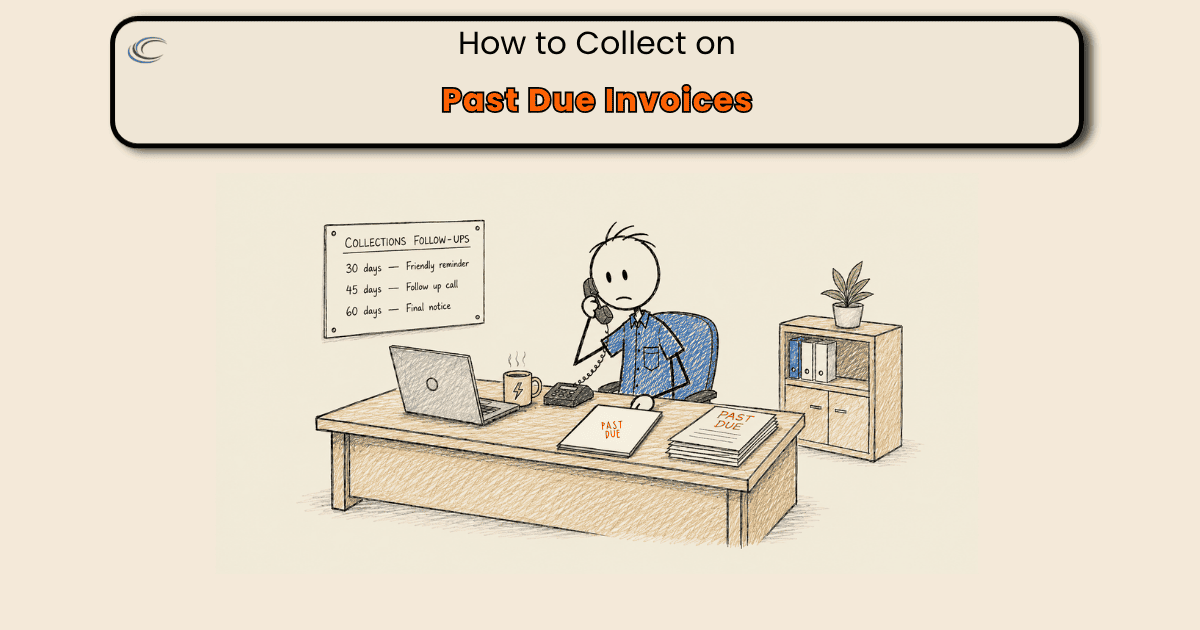
Write down what goes out and when, and let it run the same way for every customer. A reminder with the invoice attached the day after the due date. A phone call a set number of days after that. A second call from the same person. Then a call from you. The intervals are yours to pick, and the reason you pick them one time is so nobody is standing there on a Tuesday deciding whether this one has gone long enough yet.
When the steps are set in advance, the call stops being personal. Nobody decided that this particular customer gets leaned on. The invoice reached the number of days that has a phone call attached to it, so the phone call happened, and the person making it has a reason to be calling that has nothing to do with how they feel about the customer.
The last step needs dates on it too. A notice to owner and a lien both have deadlines, and those deadlines don’t move because the conversation is still friendly. Find out once what they are where you work, and put those dates on the list next to the invoice, so deciding whether to use them is something you do on purpose instead of something you find out later you already missed.
Where past due gets set in the first place
An invoice can only be past due against something. If the proposal didn’t state the deposit, the payment schedule, and the terms, net 30, net 60, due on completion, then there’s no date to measure from, and the customer’s idea of when it was due is as good as yours. The list can only work invoices that had a due date to begin with. That gets set on the proposal, before anybody pulls a permit or orders a panel.
Common questions
Should the owner be making the collection calls?
Not the routine ones. Give one person the job of working the unpaid invoices and making the scheduled calls, and keep the owner’s call for a late step rather than the first one. What matters more than who it is: it’s one name, written down, instead of whoever has time that week.
How often should past due invoices get worked?
A set hour on a set day, weekly. Weekly keeps each contact close to the due date it’s being measured from. If unpaid invoices only get looked at monthly, one can sit for weeks before anybody notices it’s out, and the longer it sits the harder the conversation is when it finally happens.
What about retainage a general contractor is holding?
Retainage is money the general contractor holds back until the job is complete, so it isn’t late the way an unpaid invoice is late. Keep it on the same list as everything else you’re owed, with a note saying what has to happen before it releases and the date you expect that by. Kept somewhere else, it turns into money nobody is watching for. Kept on the list with no release condition next to it, it looks overdue every single week when it isn’t.
The customer says they never got the invoice. What now?
Send it again to the billing contact with the purchase order or work order number and the signed authorization attached, and write down the date you resent it, so whoever picks it up next can see how long that clock has been running. If you’re hearing this more than once in a while, the billing contact and whatever numbers that payer requires are worth capturing when the job gets booked instead of when the invoice goes out.