
SHORT VERSION
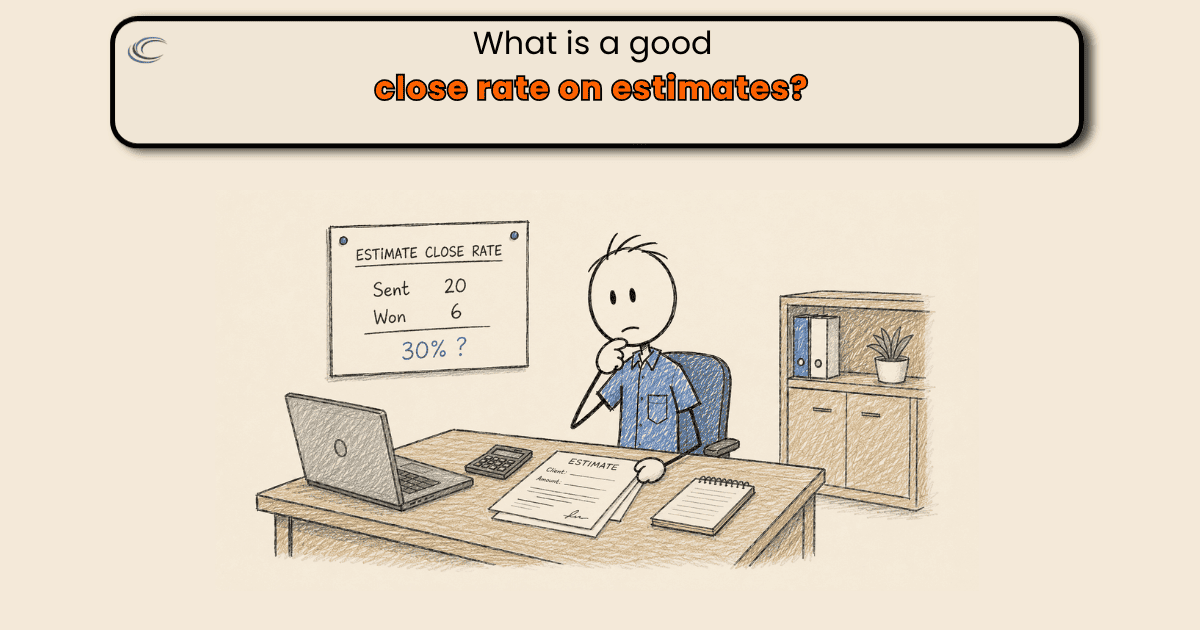
Take the estimates you won and divide them by the estimates you sent. Keep service estimates and quoted project work apart, because they get decided differently and a blended percentage tells you nothing about either. Most electrical shops cannot produce either number, because an estimate gets sent and then nothing ever records what happened to it. Put a decision date on every estimate the day it goes out and make somebody answer it on that date. Once the number exists, it points at one of two things: how many estimates you agree to run, or what happens to one after it leaves.
Here is the short answer. It is two numbers, one for service estimates and one for quoted project work, because they get decided in different ways on different timelines. And the reason it is hard to answer for your own shop is that you can count what went out and you cannot count what came back. The estimate gets created, priced, and sent. Nothing in the system ever asks what happened to it after that.
It is two numbers, not one
A service estimate gets priced in front of the customer, often on the same visit as the diagnosis, and it usually gets decided in a day or two. A bid on a kitchen remodel or a tenant improvement goes out while the customer is still waiting on fixture selections and talking to a designer, and it can sit for weeks.
Blend those into one percentage and you cannot tell which half of the business is losing.
Why doesn’t the software already tell you this?
Because sending the estimate is the last thing anything requires. The ones that get approved leave the list on their own, since an approved estimate turns into a work order and shows up on the board as real work. The ones that were never approved stay exactly where they were the day they went out, and nothing in the shop ever asks about them again.
You priced a service change in April. You know you priced it, because you can find the PDF. Whether the customer went with somebody cheaper, or is still waiting to talk to his wife, or called back in May and the job is already done, is not written down anywhere.
So the pile grows and there is no way to sort it. Counting it in December means opening documents one at a time and trying to remember.
An estimate is not finished when it is sent
Put a decision date on the estimate the day it goes out. Not an expiration for the customer, a date for you: this is when somebody in your shop has to say where it stands. On that date the estimate says won, lost, or carries a new date and a reason it moved. The date is what makes the estimate come back to somebody, instead of waiting on the customer to remember you.
Then the undecided ones have to be visible where people already look. If the only place an open estimate exists is a list nobody has a reason to open, it stays invisible no matter who is supposed to be watching it. The board that carries the week’s work should carry the estimates that have not been decided yet, with the date each one is due back sitting next to it.
That is the whole change. It costs one field on the estimate and one column on a board you already look at every morning.
Then the number tells you where to work
Once you can see it, a low close rate means one of two things, and they get handled in different places.
If the estimates are going out and nobody is going back to the customer, the problem sits between sending and deciding. The customer is not refusing. He is waiting, and nothing put him back in front of anybody.
If you are closing most of what you price and still losing days to it, you are running too many estimates, not losing them. That one gets handled before the truck rolls, in what the office knows about the job before you agree to go price it. Whether it is your kind of work, whether there is a real budget, whether the person you are meeting can say yes.
Both of them need the same thing first. Until every estimate says won or lost, you are guessing which one you have.
Questions owners ask about this
How do I calculate my close rate on estimates?
Estimates won divided by estimates sent over a set period, counted separately for service estimates and quoted project work. The math is not the hard part. Sent is easy to count and won is only countable if something recorded it.
Should I be charging for estimates?
That is a decision to make on purpose rather than drift into. Some shops charge a diagnostic or design fee on estimates that take real time to build and some do not, and either way works as long as the customer hears it when the appointment is booked and not when your guy is standing in the driveway. What costs you is unpriced estimating time spent on work that was never going to be yours.
How long should an estimate stay good for?
Put a date and a window on it, and set the window off your own supplier pricing rather than leaving it open-ended. An estimate with no expiration is one you have to re-price from scratch when it comes back, and you usually find that out after you have already told the customer the number still stands.
Do I need different software to track won and lost estimates?
Probably not, and the place to start is the estimate record you already use. Whatever it does or does not have, the number needs two things recorded: what the estimate ended up as, and the date somebody was supposed to find out. A spreadsheet the office keeps will produce the number if the system you have will not.