
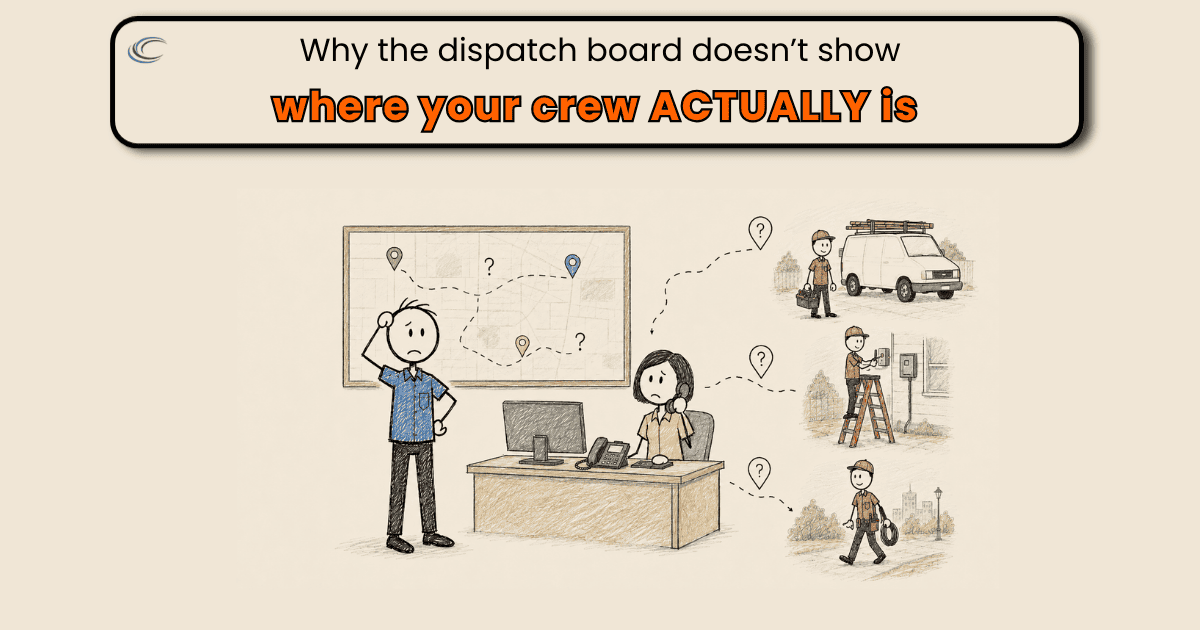
Your dispatch board can’t tell you where the crew actually is because it shows the plan you made this morning, not the day that actually happened. It froze when the trucks rolled out, and the real day started pulling away from it inside the first hour.
How the day drifts off the board
The board you’re looking at was built this morning. It’s who you assigned, in what order, with the windows you gave the customers. It was right at 7am.
Then the day starts. The panel swap you had blocked for the morning is still going after lunch, because pulling the old panel turned up circuit problems nobody could see until it was off.
A customer calls with no power and gets squeezed in. One of your guys finishes early and is sitting in a parking lot with nothing to do, while another is an hour deep into a job that was booked for twenty minutes. None of that is on the board, because nothing put it there.
It isn’t that nobody’s telling you where they are. The board only knows two things about any job: that it’s scheduled, and later, that it’s done. The whole middle of the day, the part where you actually need to know who’s where, has no state at all. So the board keeps showing you the morning while the real day moves on without it.
What has to be built
The board has to show the day as it’s happening, not as you drew it up. That’s three pieces.
1. Two states the work marks on its own: on site, and done.
You don’t need a live pin on every truck. You need to know the two things the morning plan can’t tell you: which jobs are running long, and who’s actually free. On site and done answer both. A job that went on site at eight and still hasn’t closed at eleven is your running-long flag. A job marked done is your free guy. That’s the whole question you started with, and two states cover it.
2. The status tied to a step already in the work.
This is the part that decides whether it holds. If keeping the status current is a separate chore on top of the job, it won’t happen on a busy Tuesday, and you’re back to a board that’s already wrong.
So it can’t be separate. The before photo he takes when he walks in marks him on site. Taking the signature at close marks it done.
The board moves because the work moved, not because somebody remembered to move the board.
3. Someone watching a board that flags its own gaps.
Once the board is current, a job still sitting on site an hour past its window shows up on its own, and whoever’s running dispatch can move the next call before the afternoon’s already gone.