
SHORT VERSION
The office chases the field for job information because the work gets finished but the record of it never does. What was done, what got used, what the customer approved, it’s in the electrician’s head at the end of the job, and there’s no structured place for it to land before he’s on to the next call. So the office pulls it out by phone, days later. Fix it at the close: build the information the back office needs into structured fields the electrician completes to finish the job, and don’t let a job close until they’re filled.
If the office spends its days chasing down what happened on each job, the information the crew has and the office needs, the problem isn’t that your guys are sitting on it. It’s that finishing the work and capturing the record of it were never made the same step.
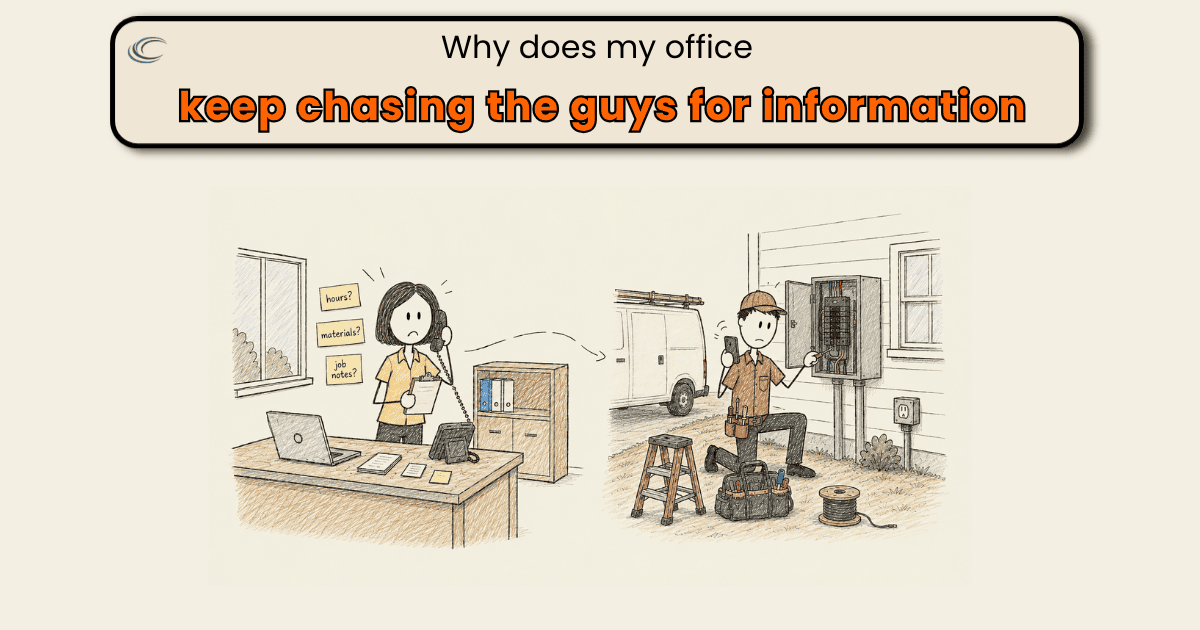
It feels like a paperwork problem. The job’s done, the office needs the details to invoice it, and the details are wherever the electrician left them. So somebody picks up the phone and pulls it out of him, one job at a time. He’s not withholding anything. The work got finished with nowhere to put the record of it.
What the office is actually chasing
Walk it back to the end of a job. The electrician diagnosed it, priced it, got the go-ahead, did the work, pulled some material off the truck, and left. Every one of those is something the office needs downstream.
What the customer approved, so the invoice matches what was agreed to. What material got used, so it gets billed and the truck gets restocked. What got recommended, so it becomes follow-up work instead of disappearing.
None of that is optional. It’s the job. But it lives in the electrician’s head at the end of the day, and the job note says “fixed outlet.” That’s true, and it’s useless to the person building the invoice. So the office calls to ask, and the electrician answers from memory about a job he did three days and a dozen calls ago.
Why won’t a reminder fix it?
You can tell everyone to write better notes. It holds for a week. The reason it drifts back is that the close is a blank box at the end of a long day, and a blank box gets one line. Nothing says what a finished job’s record has to contain, so it contains whatever there was time and memory for.
The information exists. Every electrician on your crew knows exactly what he did on every job. What’s missing is a place for it to land while it’s still in front of him, and something that says the job isn’t done until it’s there.
Make the record part of finishing the job
The fix isn’t a form to fill out later. It’s built into what “done” means. The work being finished isn’t the whole job. The job is finished when the work is done and the record of it is captured, and not before.
That means structured fields, not a blank box. The specific things the office needs, each with its own place to go: work performed in enough detail to bill it, material used off the truck, the authorization the customer gave, any follow-up worth quoting, the photos, the sign-off. Same set every job. The electrician fills them at the job, while the work is in front of him.
Then it’s a gate. A job can’t be marked complete until those fields are filled. The point isn’t to make the field do more paperwork. It’s that the record gets captured once, at the job, instead of rebuilt later across three phone calls and somebody’s memory. When it’s part of the close, the office stops chasing, because nothing left the job unfinished.
FAQ
Should the electrician handle this in the field, or the office?
The record gets captured in the field, while the electrician is still in front of the work: what he did, what he used, what got approved. The office turns that into the invoice. The part that has to happen at the job is the capture, because that’s the information that’s gone the moment he drives away.
We already have a notes field and it still comes back empty. What’s different?
A single blank box gets one line at the end of a long day, because nothing says what it has to contain. Structured fields for each thing the office needs, with the job unable to close until they’re filled, is a different mechanism. It doesn’t ask the electrician to remember an extra task. It makes the record part of closing the job.
Won’t capturing all this at every job slow the crew down?
The information gets assembled either way. The only question is whether it happens once, at the job, or gets rebuilt later across several calls and somebody’s memory of last week. Once is less total work, and it’s more accurate.