
SHORT VERSION
If a change moves forward before it’s priced and signed, the job gets built to whatever was assumed on site, not to what was actually agreed. The fix isn’t better manners about getting a signature. It’s a rule that work on the change doesn’t start until that signed price exists.
When a change order isn’t signed before the crew starts on it, the job gets built to whatever was assumed on site instead of what was actually agreed. That gap is where the fight at the end of the job comes from.
It happens on a job that’s already moving. Nobody stops the work to argue about paperwork.
Where the agreement actually gets made
A change comes up mid-job. Maybe the customer decides mid-rough-in they want the hot tub circuit added, and that means a panel that’s already down to two open spaces. Maybe the GC wants the walk-in cooler moved to the other wall, and that means pulling a circuit that was already roughed in and passed inspection. Somebody on site says yes, and the crew keeps going.
That yes is the only record of the change, for now. It lives in one person’s memory of a conversation on a Tuesday. Not in a price. Not in a document either side can point back to.
The work gets built to whatever that person remembers being asked for, not necessarily to what the customer pictured when they asked, and not to what it would have cost if anyone had priced the extra panel space or the reroute first.
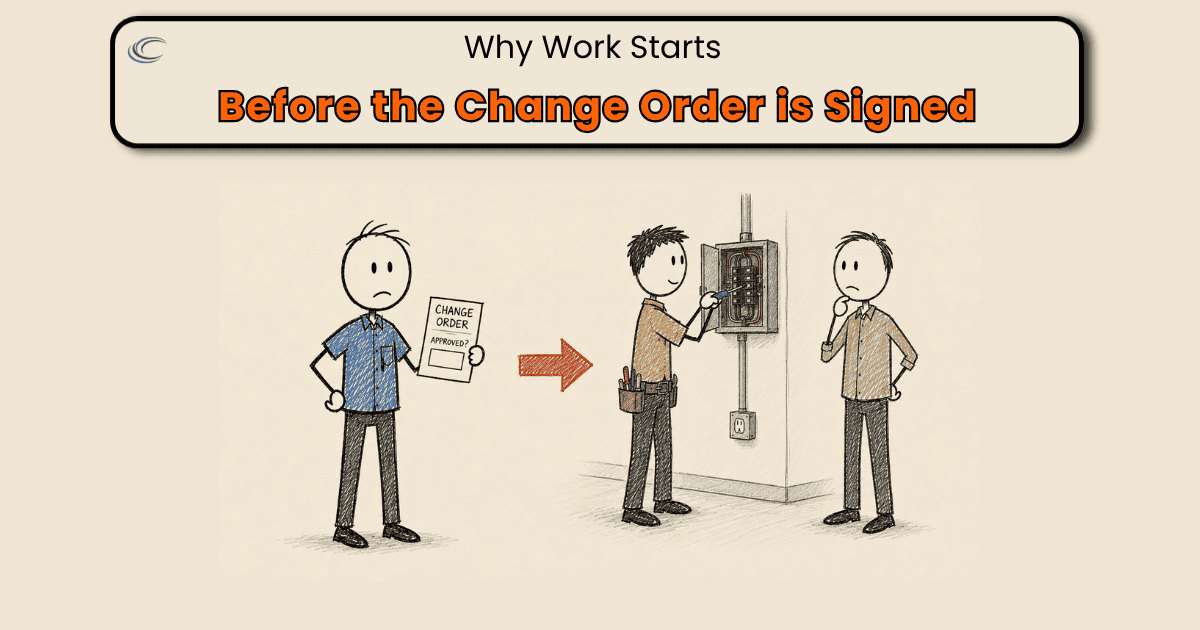
Why does the change order come after the work instead of before?
Because stopping isn’t free either. Pausing a job to chase a signature feels like it costs more than it saves, especially when the ask sounds small and the crew is already in the wall. A GC waving the crew forward and saying the paperwork will catch up later is a familiar version of the same pressure.
So the work moves. The documentation is supposed to catch up. It usually doesn’t, or it catches up different from what actually got built.
By the time anyone compares the finished work against what was priced and agreed, the job is done. There’s no signed record either side can point to. The disagreement comes down to memory instead of paperwork.
The job can be done right, on schedule, and the customer can still end up saying it isn’t what they wanted.
The rule that stops the guess
The fix isn’t reminding the crew to be more careful about getting sign-off. It’s a rule that a changed item doesn’t get built until the change is priced and signed, on the same paperwork the crew already carries into the job, not written up back at the shop after the fact.
That means when the ask comes up on site, the crew’s answer isn’t yes. It’s: here’s what that costs, sign here, and it starts once it’s signed. Material for the change doesn’t get ordered and time doesn’t get logged against it until that record exists. The job keeps moving. The change just doesn’t move ahead of its own paperwork.
That’s the difference. The mismatch gets caught and priced before the crew touches it, not chased down after the wall’s already closed.
Do we need a signed change order for every small change?
Size isn’t what decides it. What decides it is whether the customer’s expectation and the crew’s plan match. A change with no price and no signature gets misremembered just as easily whether it’s one added circuit or a full room.
What if the GC says just keep going and we’ll handle the paperwork later?
The work on that specific item still waits on the signed price, even if it only takes a few minutes to get. That protects the crew and the GC both when the final invoice gets questioned.
Whose job is it to get the change order signed, the office or the crew?
It has to happen where the change comes up, which is usually the field. Waiting for it to reach the office after the crew is back at the shop is the same as not having a rule at all.