
SHORT VERSION
A healthy callback rate is one your shop can actually produce. Most can’t, because the return trip gets entered as its own service call and its hours never post against the work that caused it. Before a percentage means anything, the close on that return trip has to require the original job number and a reason, so the cost shows up on the job that created it. Then you can see which work sends you back and what going back is costing you.
A healthy callback rate is one your shop can actually produce. Most can’t. The second trip gets entered as its own service call with its own job number, so its hours and its material sit on that new number and never touch the work that sent you back there. The original job still reports the margin it reported the day it closed. There’s nothing to compare against anybody’s benchmark, because there’s nothing counting.
Where the link never gets made
The customer calls. It’s an address you were at three weeks ago, and she says the fan is doing it again. The office takes it the way it takes every call: name, address, phone, what’s wrong.
The call opens with nothing on it that points back to the earlier job. Nothing at the booking asks the question, and nothing at the close asks it either. The return gets scheduled, worked, and marked complete exactly like a first-time service call. There’s no point in that job where the connection to the original one is required, so it doesn’t get made.
Warranty work runs the same path. It comes in as a service call, gets scheduled as a service call, and closes as a service call with no charge on it.
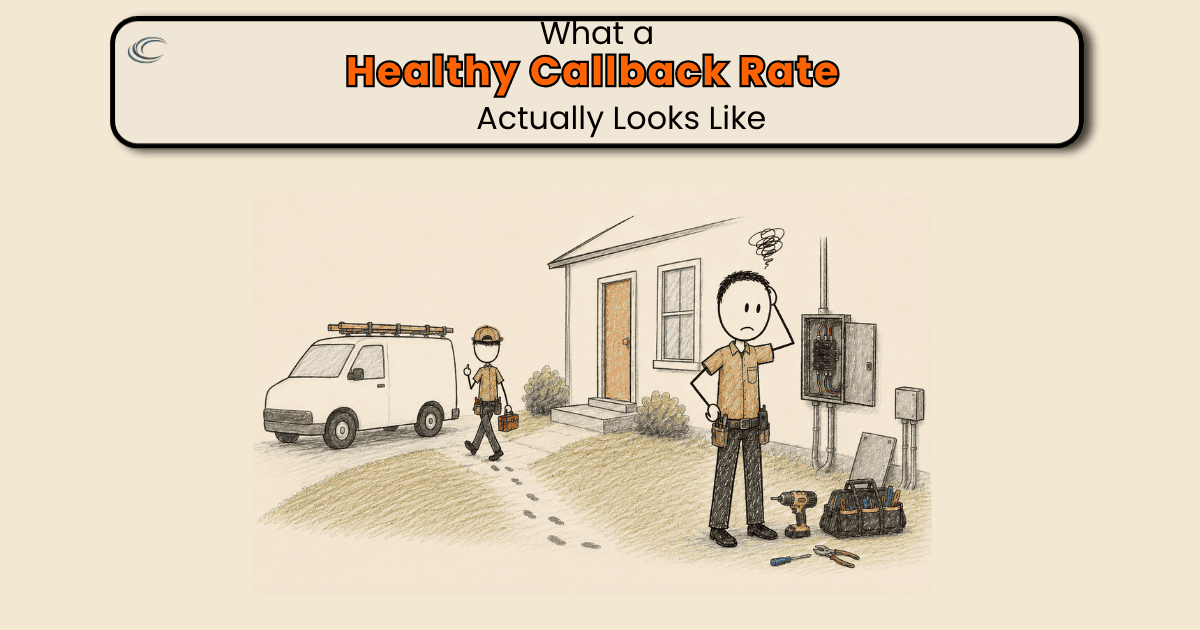
Where the cost of going back actually lands
Two hours of a man’s day and a truck went out to that address. Those hours are on the books somewhere, and it isn’t the job that produced them. Either they’re sitting on a job number with no revenue against it, or they got written off at the end of the month with nothing tying them to any job at all.
Meanwhile the original job still reports what it reported. The panel swap that came in under budget is still under budget, and the return six weeks later to chase a circuit that got missed in the relabeling is a separate line on a separate job. Two entries, both accurate, and neither one tells you the job cost more than the estimate.
The second thing you lose is the pattern. When every return is its own job, you can’t sort them. You can’t see that most of them come off one kind of work, or off jobs quoted from a phone description, or off jobs where the work grew past the estimate and nothing in the job required that to get written down.
What counts as one
There’s a definition problem sitting underneath the counting problem.
A trip back to a fixture that failed under warranty is a callback. A trip back because the customer found a second problem after you left is a different thing. A trip back to finish something that was never in the original scope is a third. Coded together, all three look identical, and the number ends up measuring three unrelated things at once.
You don’t need the industry’s definition. You need one sentence that says what your shop counts.
Build the answer into the close on the return trip
Write the definition down first. Something on the order of: any trip back to work we performed inside a set window that we don’t bill the customer for. Draw the line wherever it fits how you actually work, then leave it there.
Then put it on the close. A return trip can’t be marked complete until it carries the original job number and a reason picked from a fixed list: warranty, new problem found, out of scope. Both required, both on the same screen the man closes the job from. He’s the one who knows. The office taking the call at seven in the morning usually doesn’t, and by the time anybody at a desk could sort it out, the trip is already three days behind them.
When those two answers exist, the hours, the drive time, and the truck stock post to the job that sent you back. The panel swap that took a return trip shows up with the return trip’s hours in it, and it lands where it actually landed against the estimate.
Three months of closing them that way and you can pull the rate, and you can pull it by reason and by kind of work. That’s the point where a percentage is worth talking about.
Questions owners ask about this
What is a good callback rate for an electrical contractor?
Anybody who hands you a number without knowing how your shop enters a return trip is guessing. The rate only means something once every return is charged back to the job that caused it, and once the job itself decides which returns count. Get that in place, track your own rate for a quarter, and use that as the baseline.
Should warranty work be billed as a new service call?
It shouldn’t be opened as one. The trip is real work with real hours on it, and those hours belong on the original job so that job’s profit reflects what it actually took. Opened fresh, the job that generated the work never absorbs the cost of it, and the shop never sees which jobs get expensive after they close.
Does a high callback rate mean the work is bad?
No, and that’s why the reason has to be captured alongside the number. A part that failed, a second problem the customer noticed after you left, and work that was never in the scope are three different situations with three different fixes. A rate that lumps them together tells you almost nothing.
Can my software track callbacks against the original job?
That’s the question to go ask about whatever you’re running. What you’re looking for is whether one job can be linked to a previous job, whether you can make that link required before the job closes, and whether hours and material on the second one will report against the first. If it can’t do all three, the link has to live somewhere job costing actually reads, and you want to know that before you start counting.