
SHORT VERSION
When everything in the shop depends on you, it isn’t a crew problem. The answers to the questions only you can answer live in your head and nowhere in your system, so the moment you’re out, every one of those questions has to find you. The fix isn’t a manual. Take the handful of decisions that route through you every week, the price on the odd job, the billing rules on the commercial account, the history on the repeat customer, and put each one in the record the work already passes through: the pricebook, the customer record, the job notes. Then the next question hits the record instead of your phone.
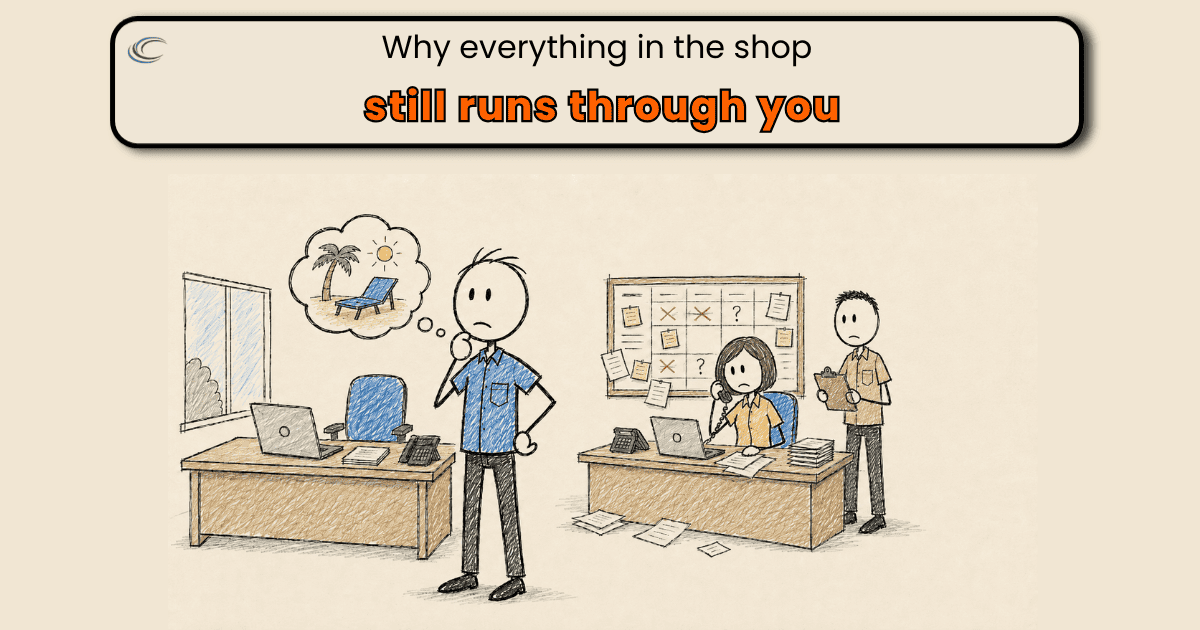
When everything depends on you, it isn’t because the crew forgot how to run a job the day you left. It’s that the answers to a dozen recurring questions live in one place, your head, with nowhere else for anyone to look.
What actually stops when you’re out
Not the work. Your guys can pull wire and troubleshoot a circuit whether you’re at the counter or off for the week. What stops is everything that runs on a decision only you know how to make.
The commercial account that gets billed a certain way, with a PO number and a not-to-exceed nobody ever wrote down. The repeat customer whose last three visits you carry in your head, so when he calls in, your lead is starting from zero. The odd job that gets priced off the top of your head because it never made it into the pricebook. The return trip that should go out as a warranty callback, not a fresh invoice, because you’re the only one who remembers it’s your own work.
A call comes in on a job you ran last spring. The customer expects whoever shows up to know the panel and the history. Your journeyman opens the record, finds nothing in it, and now he’s either calling you on your day off or walking in cold.
None of that is a skills gap. Every one of those answers already exists. It just exists in exactly one head, and there’s no field, no note, no record where anyone else can reach it.
Do you just need to write it all down?
That’s the usual advice. Document everything. Build the manual, get the business out of your head and onto paper. Most owners who try it end up with a binder nobody opens, because a manual is a separate thing you have to remember to go read, and the day is too busy to go read anything.
A binder on a shelf has the same problem your memory does. Nobody’s looking in it when the question actually comes up. The issue was never that you’re missing a manual. It’s that the answers live nowhere the work already goes.
Put the answer where the work already passes
So don’t set out to document the business. Move the recurring answers into the records the work already touches, so the next person hits the answer instead of hitting you.
Start with the questions that came at you the last time you were gone, or the ones you know would. Each one points to a spot in your system that should already hold the answer and doesn’t.
The price you keep in your head for the non-standard job belongs in the pricebook, so your lead quotes it from the book instead of texting you. The billing rules on the commercial account, the PO, the not-to-exceed, the right contact, go on the customer record, where whoever books the work can read them off the account. Put the repeat customer’s history in the job notes so the next visit starts where the last one ended. And the line between a warranty callback and a billable trip belongs on the job type, so nobody has to guess on your behalf.
You’re not building a manual. You’re filling the empty fields in the system you already pay for.
Do that for the ten or so questions that actually route through you, and the record answers the next one before it reaches your phone.
A few questions owners ask
Should I hire an operations manager before I fix this?
A manager doesn’t fix a business that lives in your head. He inherits the same problem, now with a middleman, because every answer he needs still routes through you. Put the recurring answers into the records first. Then a manager has something to run, instead of a new phone line back to you.
Where do I start if the whole business is in my head?
Don’t start with the whole business. Start with the questions that came at you the last time you took a day or a week off. Each one is a decision that needs a home in your system. Fix that handful first. It covers most of what actually slips.
Will my guys actually use the records once they’re filled in?
They will when the answer is where the work already is. Nobody opens a binder mid-job, but everybody’s already in the pricebook, the customer record, and the job notes. Put the answer in the tool they’re using anyway and it gets used.