
SHORT VERSION
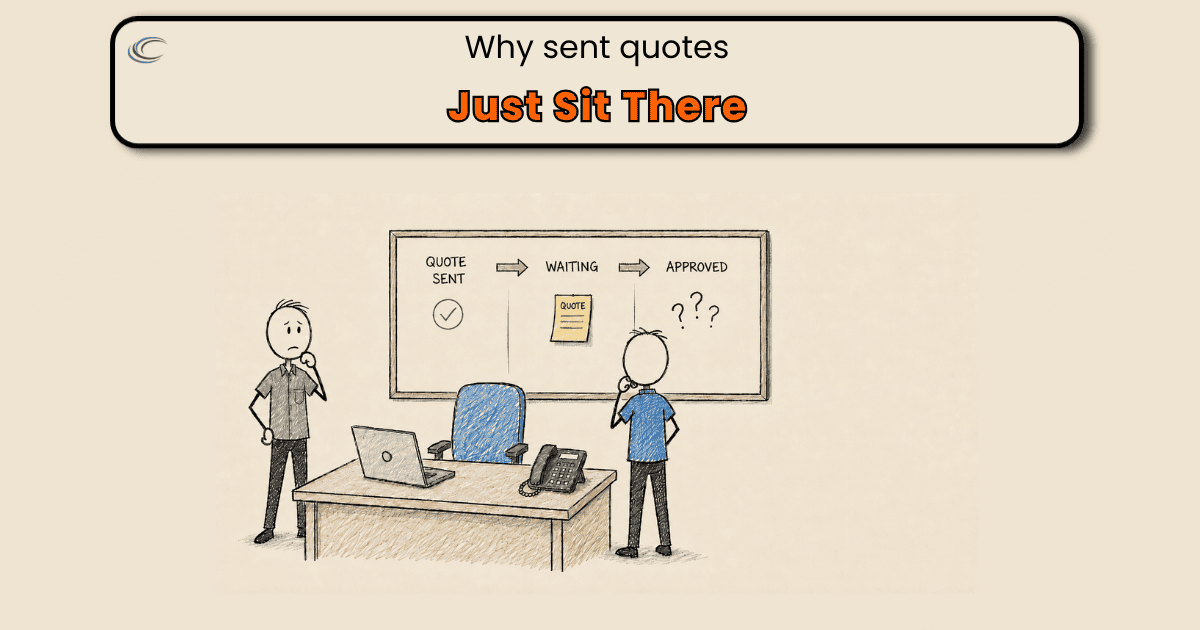
A quote that goes out and doesn’t get answered isn’t a lost sale yet. It’s an open loop with nobody watching it. Unsold quotes go cold because a sent quote lands in an inbox, and watching the inbox isn’t anyone’s job. The fix is to make every quote a tracked item the moment it leaves: a status, a follow-up date, and one person who owns the list. Then the second touch happens because the system surfaces it, not because someone remembered.
A quote goes out, and nothing follows up on it. Not because anyone dropped it, but because a sent quote lands in an inbox, and watching that inbox isn’t anyone’s actual job.
So it sits. The customer, who’s comparing you against two other shops, figures you’ll call if you want the work. You figure they’ll call if they want the quote.
Both of you wait. The job goes to whichever shop made the second call.
Where does a sent quote actually go?
Think about the last panel change you quoted. You or one of your guys drove out, looked at the panel, and emailed the proposal. The second that email left, the quote stopped existing anywhere anyone looks.
It’s in a sent folder. It’s in the customer’s inbox, buried under a coupon and a school email.
It’s not on a list. It’s not on a calendar. Nothing about it says “check back Thursday.”
Now multiply that by every quote you sent last month. Some of them would have closed with one phone call. You’ll never know which ones, because they were never anywhere you could see them as a group.
That’s the cost, and it never shows up on a report. You didn’t lose that job on price or on quality. You lost it because the other shop called back and you didn’t.
“I’ll just remember to follow up” isn’t a system
Every owner’s first fix is to try harder. Keep a mental note. Check the open quotes on Friday. It works for a couple of weeks, until you hit a stretch where two service calls turn into all-day jobs, a commercial project runs long, and Friday’s gone before you look up.
A follow-up that depends on a good week isn’t built into anything. It’s a habit sitting on top of a schedule that’s already full, and the first busy stretch knocks it off. Then the quotes pile back up in the inbox where nobody can see them.
The point isn’t that you need more discipline. It’s that the follow-up was never given a place to live. Right now it lives in your memory, and your memory is already running dispatch.
Give the quote somewhere to land
The quote has to become a tracked thing the moment it leaves, not a PDF in an outbox. Whatever you already run, your field-service software, a CRM, even a shared board, can hold a simple list of open quotes. Every quote that goes out gets added to it with two things attached: the date you’ll follow up, and the name of the person who owns that follow-up.
That’s the build. The date is what makes the second touch happen. When Thursday comes around, the quote shows up on someone’s list, and the call gets made because it’s on the list, not because anyone happened to remember it.
Two things make it hold. The follow-up date gets set the moment the quote is sent, by the person sending it, not tacked on later when someone finds time. Later doesn’t come.
And after a few days of quiet, the follow-up is a phone call, not another email. The email is already sitting there unread. The call is the thing the other shop is doing and you aren’t.
The call earns its keep twice over on the bigger quoted jobs. On a panel upgrade or a service change, the customer who went quiet often didn’t pick another shop. He got nervous about a day without power, and a short call to walk him through how the shutdown actually goes clears the thing that stalled it. An email never surfaces that.
Then close the loop. Every quote on that list eventually gets marked won or lost. Not for neatness. Because the first time all your open quotes sit in one place, you can see your real close rate: how many you send, how many turn into jobs, how many just went quiet. Right now that whole set is scattered across a sent folder where you can’t count it.
FAQ
How soon should I follow up after sending a quote?
Within a few days, while the job is still fresh for the customer and before the other bids land. The exact number matters less than having a date attached to every quote, so the follow-up happens instead of waiting on a free Friday.
Should the office follow up on quotes, or the person who wrote it?
Either can work. What matters is that one name is attached to each quote so it’s clear whose list it’s on. The office often has the time and the phone habit. The person who wrote it has the context. Pick one per quote and make it explicit, so it never falls into the gap between them.
Why do so many of my quotes never close?
Some were never going to. But a chunk of them go quiet not because the customer said no, but because nobody made a second call and the customer went with whoever did. You can’t tell the two apart until every quote is tracked and marked won or lost.
How do I know my quote close rate?
You can’t, until sent quotes live somewhere as a group instead of scattered across a sent folder. Once every quote gets logged and closed out won or lost, the close rate is just counting. Most owners are surprised by the number the first time they see it.