
SHORT VERSION
Pick the job you run most often. Sit with whoever on your crew runs it best and have him walk it start to finish while you write down what he says. That’s your first SOP. Put it on the job in the field software your guys already open, so it’s there with the address and the notes instead of in a binder. Put one name on it, and give the crew somewhere to send a correction when the job proves the document wrong.
You don’t start by writing anything. Creating SOPs for an electrical contractor’s business starts with the guy who already runs the job the way you’d want it run, not with a blank document at your desk. Pick the one job you do more than any other, walk it with him, and write down what he tells you. Then put the written version on the job in the software your guys already open in the field. That’s your first standard operating procedure, and every one after it gets built the same way.
The job to write first
Not the hardest one. The one you run most. For most residential shops that’s the service call, start to finish, from what the office collects on the phone through the invoice going out.
Start with the job you run most often, because that’s where the same job getting run a different way on every truck costs you the most.
Two service changes in the same month. One crew labels the panel while they’re reconnecting circuits and photographs the schedule before anything goes back on. The other one labels at the end and the photo never happens.
Both jobs pass final. Six months later a callback comes in on one of them, and the office is looking at a job record with no panel schedule in it.
Both of those crews learned it from somebody. Neither one is doing the work wrong. There’s just no written version anywhere that says which one of those is how the shop does it.
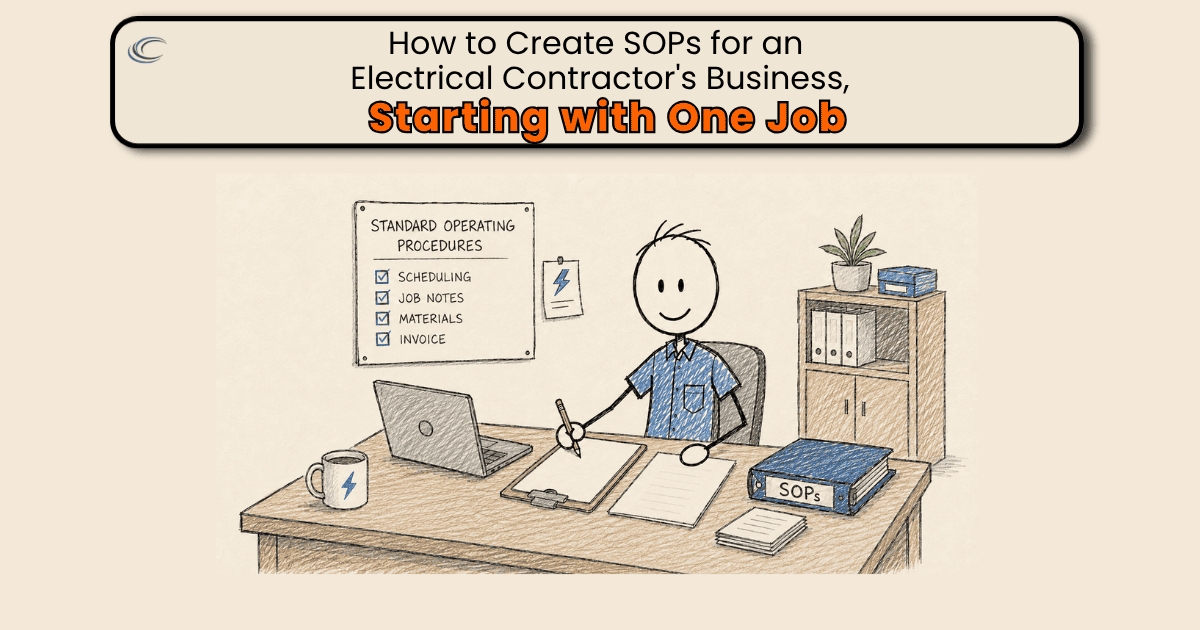
Where the real version already lives
Somebody in your shop already runs that job in the right order. He has a sequence he follows, and he’s followed it for years. It was never written down and it was never taught, which means it belongs to him and to nobody else.
So your job isn’t to invent a process. It’s to take dictation.
Sit down with him for an hour. “You’re pulling up to the house. What’s the first thing you do.” Then keep asking what’s next until he’s off the job and the paperwork is in.
Write what he actually says, including the parts that sound too obvious to be worth writing. Those are usually the parts a second-year apprentice has never been told.
Why does the binder version never get opened?
Because it’s somewhere the work isn’t. A man in a crawlspace with a meter in his hand is not going to a shared drive. That’s not about discipline. Nothing in his day routes him past that folder.
The written version that gets used is the one that’s on the job. Your field service software already holds forms, and it already puts the job on your guys’ phones. That’s where the written version goes, on the job itself, so he opens it in the same place he opens the address and the notes.
How do I keep an SOP from going stale?
The job changes and the document doesn’t. You pick up more light-commercial work, and now there’s a purchase order number and a not-to-exceed amount sitting in the middle of a call that used to be a homeowner paying at the door. The version you wrote in March doesn’t mention either one, so the crew works around it, and after enough of that nobody opens it.
Two things get built in at the time you write it. Every SOP has one name on it, the person who owns that job type and the document that goes with it. And there’s a route from the field back to that name: a field on the job close-out for anything that didn’t match what the document said, going straight to the person who owns it. Not an email and not a conversation in the yard.
Then write the next job. Highest volume first, one at a time.
Common questions
How many SOPs do I actually need?
Fewer than you’d think to start. A residential service shop covers most of its work with the service call from phone to invoice, the panel swap or service upgrade, and the path from estimate to signed proposal. Write one, run it for a month, write the next.
Should I write them myself?
You write them down. You don’t write them from scratch. The content comes from whoever on your crew runs that job the way you want it run, and your part is deciding which version becomes the shop’s version.
Where should SOPs live?
On the job, in the field software your guys already open, so the written version is there with the address and the notes. A printed binder or a folder on a shared drive sits somewhere nobody’s day takes them.
What happens when a job doesn’t match what the SOP says?
One person has to own that document, and there has to be a way for the correction to reach him from the field on the close-out. If it has to travel by memory to a conversation later in the week, it won’t get there.