
Why a new hire takes weeks to get up to speed
Key takeaway: A new hire takes weeks to get up to speed because the way your shop runs was never written down. It lives in your head and in the heads of the people who already know it, so a new hand can only learn it by pulling it out of them one question at a time. The fix isn’t a better hire or a longer ramp. It’s writing down how you run the few jobs you do most, built as a normal part of closing those jobs out, so the next new hand learns from the record instead of from whoever’s free.
When a new hire takes weeks to get up to speed, it’s easy to figure the hire is the problem. Usually he isn’t. A capable apprentice can spend three or four weeks slow and unsure, not because he’s slow, but because there’s nothing for him to learn from except whoever happens to have a minute. Everything about how your shop runs is in your head, or in the head of somebody who’s been there years, so he has to pull it out of you a question at a time. The hire isn’t what’s slow. The way you run the shop was never written down, so there’s nothing for him to read.
The slow part is everything that was never written down
The slow part of a new hand’s first two weeks isn’t the electrical work. He knows how to pull wire and make up a box. What slows him down is everything around the work: how your shop books a call, what goes on the truck before he rolls, how a job gets closed so the office isn’t chasing him three days later.
None of that is written down. It’s in your head, and in the head of the office person who’s been with you six years. So the new guy learns it the only way that’s open to him, by interrupting somebody who already knows.
Three weeks in, he’s still asking which panel brand you stock, where the job photos go, whether the invoice gets built in the field or back at the office. Every question he asks costs two people, not one. He loses the minute asking, and whoever he asked loses the minute answering plus the thread of whatever they were doing. Run that all week and you’ve got a new hire who feels slow and a crew that feels interrupted.
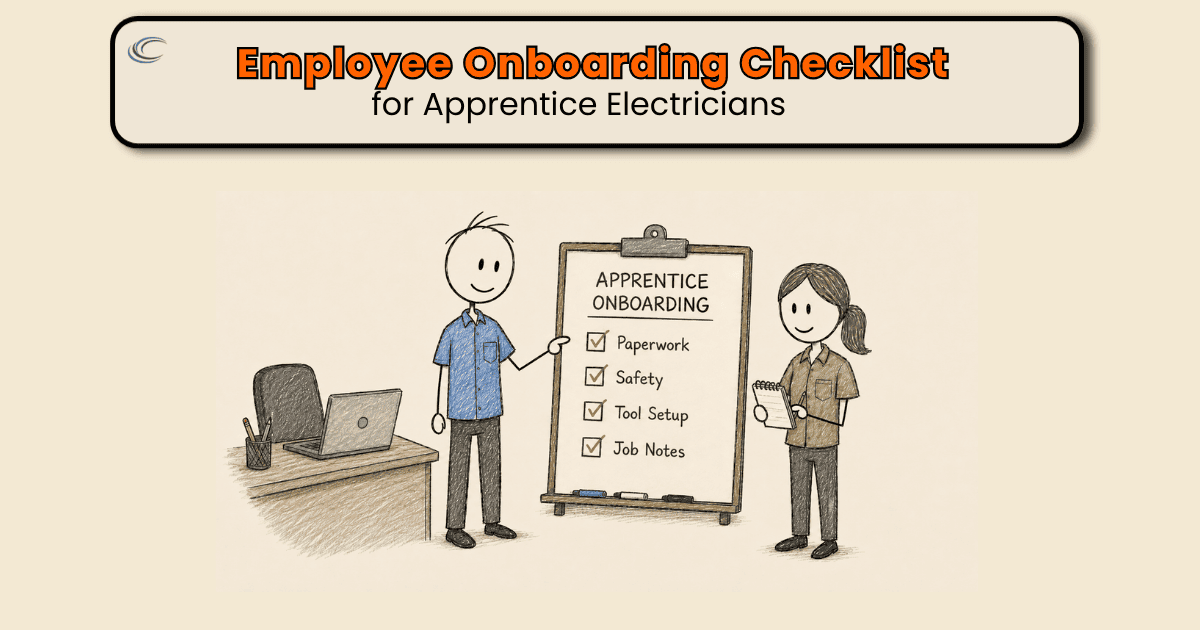
Why every new hire’s training routes back to you
The part that wears on an owner is that the way you want things done only lives in one place, which is your head. So those questions route to you. You’re on a job, or you’re quoting, or you’re finally sitting down to look at the month, and the phone goes because the new guy hit something nobody told him about.
The knowledge lives in your head, so the training runs through your head. You can’t hire your way out of it either, because the next person you bring on has nothing to learn from. Every new hand starts from zero, and every new hand’s ramp-up lands back on you.
So the real cost isn’t that this one apprentice is slow for a month. It’s that every new hire’s first weeks run through you, and they will until the training lives on paper instead of in your head.
The fix is a record, not a handbook
Not a thicker handbook. Not a policy binder that takes a weekend to write and never gets opened. Nobody reads that, and you don’t have a weekend anyway.
What a new hand needs is a plain record of how your shop runs the handful of jobs it does most. Not how electrical work gets done, he knows that, but how you do it, in your shop.
You already have all of it. It’s just trapped in the people who know it. The work is getting it out of their heads and onto something a new hand can read on his own.
So what goes on paper?
Take one of your normal jobs, start to finish. The record needs to hold all of this.
Before he rolls:
- Where the day’s jobs live and how he pulls up his own
- How to read a call before he leaves: where the notes, the photos, and the job history are, so he knows what he’s walking into
- What the truck carries for the jobs you run most, and how he flags low stock so it gets recorded instead of bought on a personal card and never matched to the job
On site:
- Who’s allowed to authorize the work, and how he confirms it before he starts, not off a verbal “go ahead”
- What gets photographed before he touches anything, and where those photos go
- How a price gets presented and where the customer’s approval gets captured
Closing it out:
- What has to be true before a job counts as done: after-photos, the material he used written down, the note the office needs to build the invoice, the signature
- How the material he pulled gets tied back to this job so it lands on the bill
- Where recommended follow-up work gets logged so it doesn’t get forgotten
- How a callback gets connected to the original job instead of opened as a fresh call
None of that is electrical. All of it is how your shop specifically runs, and right now the only copy is in the people who already know it.
Build it out of the jobs you’re already running. You don’t write the record in one sitting. You fold the capture into the close, the same as the after-photos and the sign-off.
The first time you run one of these jobs the way you want it after you start, writing down how you ran it is part of finishing it. Do that across the five or six jobs that fill most of your week, and the record builds a job at a time, without a separate project ever landing on your calendar.
Then a new hire’s first day starts with reading how you actually work, instead of guessing and interrupting until he’s pieced it together. He still asks questions, just the handful that genuinely need you, not the ones already answered somewhere nobody wrote down.
FAQ
How long should it take a new apprentice to get productive?
Faster than it does in most shops, and the difference is almost never the person. When there’s a written record of how your shop runs the jobs it runs most, a capable new hand gets useful in days instead of weeks, because he can read it instead of pulling it out of whoever’s nearby. The slow ramp you’re used to is a symptom of nothing being written down, not of who you hired.
Should I write a full handbook before my next hire?
No. A big handbook is a weekend you don’t have, and it mostly goes unread. What actually moves the needle is a plain record of how your shop does its five or six most common jobs, built a piece at a time as you close those jobs out. That gets used, because it answers the questions a new hand actually has on day one.
Why does every new hire’s training end up on me?
Because the way you want things done only exists in your head, so that’s where the questions route. It’s not that your crew won’t train people. It’s that the most important part of the training was never written down anywhere they could point to. Once it’s on paper, the new hand reads it and the questions that reach you drop to the ones that genuinely need you.
What’s the difference between onboarding and just having someone shadow a senior guy?
Shadowing teaches whatever that day happened to include, and it ties up your best hand while it does. A written record teaches the same thing every time, in the same order, without costing you a productive person for two weeks. Shadowing still has its place. It just shouldn’t be the only way your shop hands down how it works.