
SHORT VERSION
Follow up on estimates by deciding the follow-up before the estimate goes out. An estimate doesn’t count as sent until it carries one person’s name and a date for the next contact, both required. It stays open until somebody marks it won or lost with a reason written on it. Most shops have no list of open estimates at all, which is why the only ones that close are the ones the customer chased.
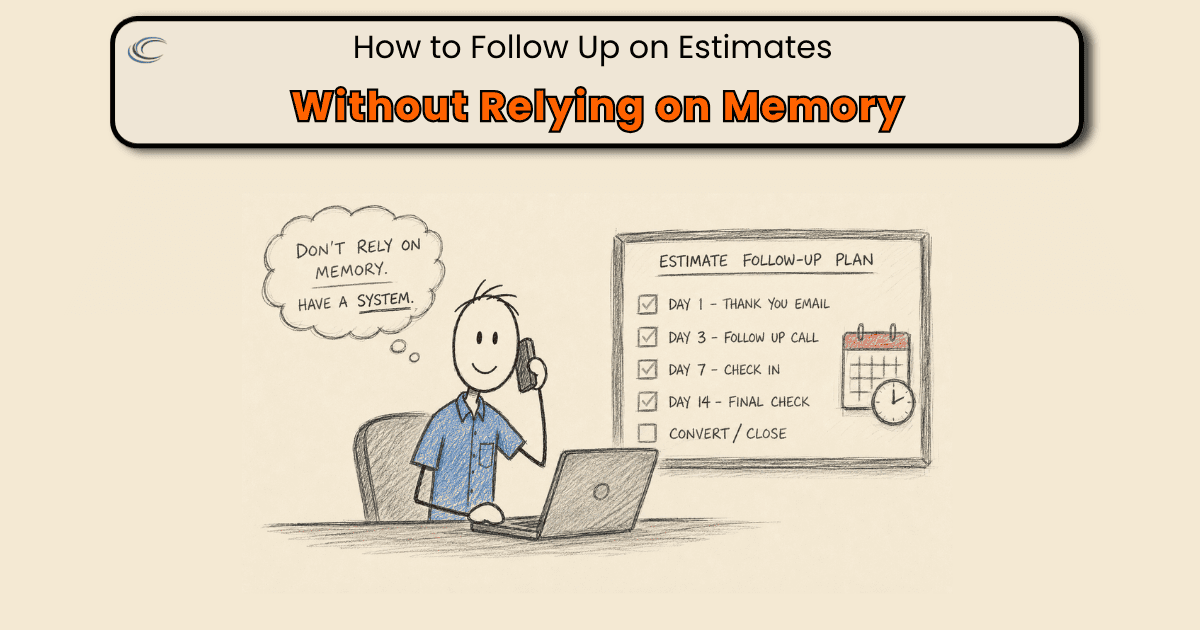
The way to follow up on estimates is to decide the follow-up before the estimate goes out. When it leaves, something has to record that it left, put one person’s name on it, and set the date somebody makes contact again. Most shops don’t have that, so sent estimates disappear the minute they leave. There’s no list of open estimates to work from, which means follow-up depends on somebody remembering, and remembering is not a system.
What happens to an estimate after it’s sent?
Nothing, in most shops. The number gets built, the estimate goes out by email or gets handed to the customer at the kitchen table, and after that there’s no record anywhere in the business saying this one is still waiting on an answer. A sent estimate isn’t a job yet, so it doesn’t live where the jobs live. It lives in a sent folder, and a sent folder is not a list anybody can work.
Your journeyman is on a lighting call and finds a subpanel that has to be dealt with. He writes it up as recommended work before he leaves. That’s real money, and the customer half agreed to it standing in the garage. It goes out that night, into the same place everything else goes.
There’s no list of open estimates because nothing in the shop ever marked one as open.
Which ones come back on their own
The ones where the customer already decided. He calls, he says let’s do it, and that estimate closes itself.
Everything else needed one more contact. A service upgrade he was going to do after the tax refund. A price he wanted to talk through with his wife. A tenant improvement sitting on a landlord’s desk. None of those are nos. They’re quiet, and there is nothing in the shop that tells the difference between quiet and no.
Right now the only follow-up happening is the customer’s.
Where the follow-up actually gets built
Deciding to be better about follow-up doesn’t survive a busy week. This gets fixed at the moment the estimate leaves, because that’s the only moment somebody is already looking at it.
Two things go on the estimate before it goes out. A name and a date.
The name is one person who makes the next contact. Not the office, not the shop. One person on that estimate, so there is never a version of this where two people each think the other one has it.
The date is when that contact happens, and it gets picked right then, while the details are still in somebody’s head. A customer waiting on a refund check gets a different date than a general contractor who needs a number by Friday.
Then make it so the estimate can’t go out until both of them are filled in. That’s the part that makes it hold. If the date is required, every estimate has one, and now the shop has a list that sorts itself and a date that arrives on somebody’s calendar with a name next to it.
If your field service software will let you make a field required before an estimate can be marked sent, that’s where the requirement goes. If it won’t, put the requirement somewhere that can actually stop an estimate from leaving. Estimates go out from one desk, and the person who sends them writes the name and the date on the list first. Getting on the list is how an estimate goes out.
Nothing closes by getting old
An estimate ends when somebody wins it or somebody loses it. Getting old isn’t one of them.
Losing has to be a decision a person makes, with the reason written on the record. He went with a cheaper number. He’s not doing it this year. He’s waiting on the remodel. A reason on the record is what separates a lost estimate from one nobody ever got back to.
That reason is also the only way you find out whether you’re losing on price or losing because nobody made contact a second time. Those are two different problems and they don’t have the same fix.
Common questions
How long should I wait before following up on an estimate?
The interval matters less than picking it before the estimate goes out. Whoever built the number knows what the customer said and what he’s waiting on, so that’s the moment to set the date. A date picked later, by somebody who wasn’t in the conversation, is a guess.
Should the office follow up on estimates, or the person who quoted it?
Either works. What doesn’t work is “the shop.” One name goes on the estimate so there’s no handoff where two people each assume the other one has it.
Do I need software to track open estimates?
What you need is something that stops an estimate from going out before it has a name and a date on it. Software can do that by making both fields required. Without software, estimates all go out from one desk, and the person sending them writes the row first, so getting on the list is how an estimate leaves.
What do I do about all the estimates already sitting out there?
Pull them into one list, put a name and a date on each one, and work it down. Then the requirement starts on everything that goes out from here, so you don’t end up with a second stack of estimates nobody is tracking.