
SHORT VERSION
One long job doesn’t wreck the afternoon because your guy was slow. It wrecks it because the board was built as if every job runs exactly to its slot, and some jobs, troubleshooting especially, can’t be timed until your guy is on site. When the day has no room in it, one job running over makes everyone after it late. Better estimates won’t get you out of it, because a troubleshoot can’t be timed in advance. What holds the day together is a board that expects the unpredictable jobs and leaves room behind them.
One job runs long and the rest of the day slides. That’s not your guy being slow, it’s a board built as if every job runs exactly to plan.
Why does one long job put the whole day behind?
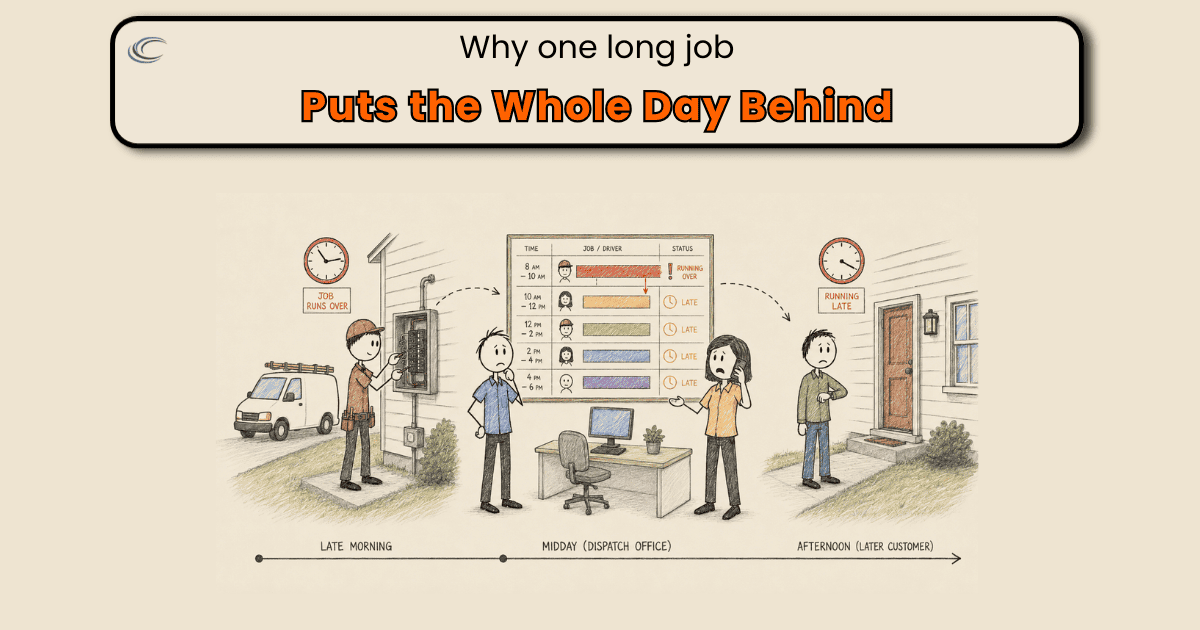
Look at how the day gets built. Jobs go on the board back to back, each one in a slot that assumes it takes exactly as long as the slot says. A 10:00, an 11:30, a 1:00, a 3:00. On paper it’s a full, clean day.
Then the 10:00 runs long. Now the 11:30 starts at 12:15, the 1:00 becomes a 1:45, and by mid-afternoon the office is calling customers to push them back. One job ran over, and every customer after it paid for it.
Nothing on that board was built to absorb a job running long. There’s no room in it, so the first surprise of the day doesn’t stay contained to one job. It rolls downhill onto every customer behind it.
It only feels like the schedule changes on its own. It was built with no slack, so the first long job took the whole afternoon with it.
Why better estimates won’t fix it
The obvious answer is to estimate the jobs better. Book more time for the big ones. That helps on the jobs you can see coming, a scheduled panel swap with the load calc already done, a quoted install where you know the scope going in.
But a lot of your day isn’t that. A troubleshoot takes as long as it takes, and you can’t know how long until your guy is standing at the panel.
“Breaker keeps tripping” might be a failed breaker and a fifteen-minute swap. Or the breaker’s doing its job, there’s a fault out on the circuit, and now he’s pulling devices one room at a time to find it.
Same call on the board. Wildly different day.
That’s the part a better estimate can’t reach. You are not going to estimate your way out of a job whose length is unknowable the moment you book it. The uncertainty is real, it’s baked into service work, and papering over it with a tighter number just moves the same problem to next week.
The 10:00 comes in as “half the house lost power.” Booked as an hour. Your guy gets there and it’s a burned connection at the meter base, which means a coordination call with the utility, and he’s tied up past noon. The 11:30 and the 1:00 never had a chance.
Build the board for the jobs you can’t predict
The fix is a board that already expects the jobs it can’t call in advance. You build the room in before you need it.
That starts with sorting the work by how knowable it is, not just by how long it should take. A quoted install is predictable. A troubleshoot is not. The predictable jobs can sit close together. The unpredictable ones need room behind them, because some real share of them are going to run over, and that’s not a failure, it’s the nature of the work.
So the unpredictable jobs get a buffer behind them on the board, room you’re planning to sometimes need, not slack you hope stays empty. And you stop stacking two unknowable jobs back to back, because when the first one runs long there’s nothing behind it but another job you can’t predict, and you’re behind before lunch.
How much room? Base it on what actually happens, not the best case. If troubleshoots run past their slot on a real share of days, the board should already know that number and build around it, off your own weeks, not a round number that feels safe.
Jobs are going to run long, and some of them can’t be called in advance. The board’s job is to have room for that, so one long morning doesn’t turn into a late afternoon for everyone behind it.
FAQ
Should I just add buffer time between every job?
No, and if you do you’ll bleed capacity for no reason. The predictable jobs, a quoted install, a scheduled panel swap, can sit close together. The room goes behind the jobs you can’t call in advance, mostly troubleshooting, because those are the ones that run over. Buffer everything and you’re paying for slack you don’t need.
Why does my day fall apart even when I estimate the jobs right?
Because some jobs can’t be estimated. You can nail every quoted install and still lose the afternoon to one “breaker keeps tripping” that turned into a two-hour chase. The answer isn’t a better number on that job, it’s room behind it on the board.
Isn’t leaving room on the board just giving up billable hours?
It feels that way until you count what a blown afternoon costs. One long job with no room behind it pushes three or four customers, and some of them remember it. Used-up buffer means the day held. Unused buffer means you got a clean day, which is fine too.
Should troubleshooting jobs be scheduled differently than installs?
Yes, that’s the whole idea. An install has a known scope, so you can book it tight. A troubleshoot has an unknown scope by definition, so it needs room after it and shouldn’t be stacked against another troubleshoot. Sorting the board by how knowable the work is, not just how long it should take, is what keeps the unpredictable jobs from taking down the predictable ones.