
SHORT VERSION
Double-booking isn’t a counting problem or a crew problem. It happens when the schedule lives in more than one place and more than one person can assign work, so two people fill the same slot without seeing each other, while a real job on the other side of town never lands on anyone’s board. The fix is one schedule everyone dispatches from, owned by one person, with a standing rule that no job gets worked unless it’s on the board and no job gets booked without going on it right then.
Double-booked mornings aren’t a counting mistake. They happen because the schedule lives in more than one place, and when more than one person can book work, two of them eventually fill the same slot while a job across town sits with nobody assigned.
Where the second truck comes from
Most double-bookings start before the morning they show up. They start with a schedule that isn’t in one place.
The board is in the software. But a job also came in as a text straight to one of your guys. Another got promised over the phone and written on a sticky note by the counter. A fourth is in your head, because you took the call yourself driving home.
Four ways to book a job, and none of them can see the other three. So the slot that reads open in the software gets filled again, and now two trucks are pointed at the same address.
A customer books the breaker call online, then calls the shop an hour later and books it again, and the two never meet. Both get worked. A journeyman pulls up while another one’s already at the panel.
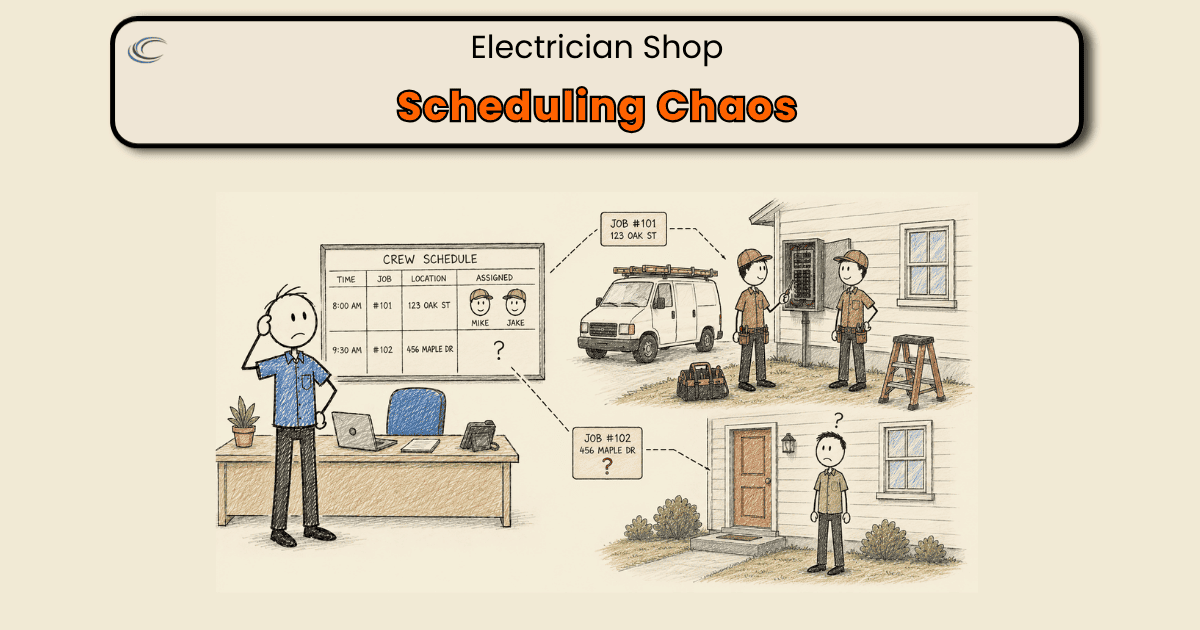
Why the other job has nobody on it
Same break, other direction. A job that never lands on the shared board is invisible, and invisible work doesn’t get a truck.
An emergency call comes in and gets worked into the day, but the job it bumped doesn’t get formally moved. It just falls off. A service change gets pushed a week by phone, and the new date lives in that one conversation and nowhere else. Monday comes and nobody’s assigned, because as far as the board knows, there was never a job there.
So who actually owns the board?
The real break is one level down. When two people can both assign work and neither one has the final say, two of them will eventually place the same slot. It’s not a discipline problem. It’s built into having more than one schedule.
If the office can book, and you can book, and a lead can text a guy to swing by on his way home, you’ve got three schedulers and no schedule. Every one of them is doing their job. Nobody’s careless. There’s just no single place all of it has to agree before a truck rolls, so it doesn’t agree.
One board, and one person who owns it
The fix is one board every job has to land on, and one person who owns putting it there. Not a sharper calendar. Not a longer morning meeting.
One schedule, and it’s the only one that counts. Not the software plus texts plus memory. If it isn’t on the board, it isn’t happening. If it’s happening, it’s on the board.
One person owns assigning to it. Others can request, flag, and push. Only one hand actually places the work.
And one rule holds the whole thing up: nothing gets worked that isn’t on the board, and nothing gets booked without going on the board right then. Not after the call. During it. The verbal promise, the text, the sticky note, they all route through the one place before they count as real.
With one board and one owner, a slot can’t read open to the office and taken by a lead at the same time. There’s no second version of the schedule for the second truck to come from.
FAQ
Should I buy scheduling software to fix double-booking?
Software helps only if it becomes the one board everyone actually uses. If jobs still get promised by text and phone and never entered, the software is just a fourth place the schedule lives. The tool doesn’t fix it. Making it the one board everyone actually uses does.
Who should own the dispatch board, me or the office?
One person, and usually not the owner once you’re past a few trucks. What matters more than who is that only one hand places work on the board. Two people assigning with no final say is where collisions come from.
How do I stop emergency calls from blowing up the day’s schedule?
The emergency isn’t really the problem. The problem is that when it bumps another job, that job often doesn’t get formally moved, it just drops off. Build the move into the same action: when the emergency goes on the board, the job it displaces gets re-placed right then, not later.
Why do jobs keep disappearing from the schedule?
Usually because they were booked somewhere other than the board, a phone call, a text, a memory, and never entered. A job that only lives in a conversation isn’t on the schedule. If it isn’t on the one board, it’s invisible, and invisible work doesn’t get a truck.