
If your cash flow is worst when the shop is slammed, the money isn’t missing. It’s finished work that hasn’t turned into a sent invoice yet. Every one of those jobs is waiting on something small: material nobody recorded, extra work nobody priced, an approval nobody captured. A busy week puts jobs into that pile faster than they come out of it.
Where the money actually stops
The work is done and the money is earned. But an invoice needs specifics that a finished job doesn’t automatically produce. What failed, what got installed, what came off the truck, who authorized it and for how much, what the extra work was worth.
Those things end up in different places. Some on a phone. Some on a receipt in the door pocket. Some in a conversation in a driveway that nobody wrote down, because there was nowhere to write it down.
The office builds the invoice out of whatever the job record happens to hold, and nothing ever required the record to hold any of it. So the invoice goes out short, or it goes out late, or it sits in a pile of jobs waiting on one more answer.
On light-commercial work the gap is wider. That invoice also needs a purchase order number, a work order number, sometimes a not-to-exceed amount, and often a billing contact who was never on site. If those weren’t collected when the call came in, the invoice goes out and comes straight back. Now you’re waiting on net terms that never started counting.
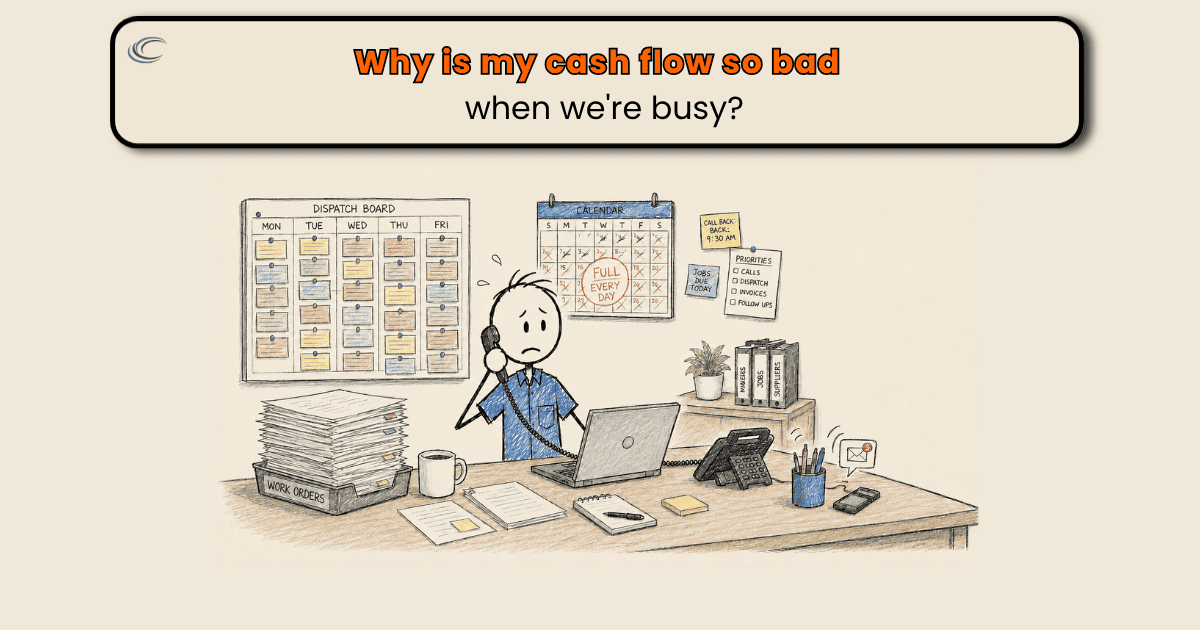
Why does a busy month make it worse?
In a slow week the gap is still there. It just doesn’t hurt, because there are three jobs in it and somebody has an afternoon to sort them out.
In a busy week everybody is doing the work. Nobody is doing the assembling. The number of jobs waiting to become invoices goes up, and the time it takes to clear each one goes up with it, because a Tuesday service call is much harder to reconstruct on Friday than it was on Tuesday.
Your cash arrives on the schedule of the paperwork, not the schedule of the electrical work.
Make “complete” mean billable
Right now, complete means the power is on and the truck is loaded. That’s the definition the whole shop runs on, and it’s why the money lags the work by weeks.
Change what the word means. A job is complete when it can be invoiced without anybody asking a follow-up question. That’s a status in whatever system you’re running, and it doesn’t become available until the job carries what the invoice needs.
What has to be on the job before it can close:
- Material used, picked off a list, not typed from memory later
- Written or electronic authorization with the amount on it, from whoever can actually approve
- Any extra work, priced and approved on its own, not folded into the original number
- Billing contact, purchase order number, or work order number on commercial and property-management work
- What was found, what was done, and the photos
If your system can make a field required, that’s where this lives. If it can’t, it’s a close-out form that has to be on the job before the status changes, and the invoice gets built from the form.
Either way the invoice is finished before the electrician leaves the driveway, and the office isn’t reconstructing a Tuesday from a text message on Friday afternoon.
The other half of it is what happens to the jobs that can’t close. A job where the customer’s written approval never came through isn’t done, and it shouldn’t be sitting in the same pile as done. It stays open on the board, next to the live work, because that’s what it is. Somebody sees it the next morning instead of at the end of the month when the numbers come up short.
Questions owners ask about this
Is this a collections problem or an invoicing problem?
If invoices are going out on time and customers aren’t paying, that’s collections. If the money is late because the invoice went out a week or two after the work was finished, that’s invoicing, and calling the customer about it won’t get back the days you already lost before it was sent. The way to tell is to pick five finished jobs at random and look at the date the work was done against the date the invoice was sent.
Can I fix this without buying new software?
Yes. The mechanism is a required close-out that the invoice gets built from, and a paper or PDF form does that job. What matters is that the job isn’t considered finished until the form is on it, so the information gets captured while somebody is still standing at the panel instead of remembered three days later.
How do I stop material from going out unbilled?
Give the field a list to pick from instead of a blank box to fill in. Truck stock that gets used and never recorded is invisible twice: it’s missing off the invoice and missing off the restock, so the same job costs you the material and the trip to replace it.
Should I hire someone to handle billing?
Another person can move the pile faster, but they’ll still be building each invoice out of information that was never captured on the job, and now you’re paying someone to go find it. Fix what the job record has to hold first. Then decide whether the volume actually needs another set of hands.