
The cracks that are always there
Every shop carries a handful of small gaps. A scheduling handoff between the office and the field that depends on someone remembering to make a call. A newer tech who’s solid on rough-in but still checks in on load calcs. A job history that lives in one CSR’s head instead of the job file.
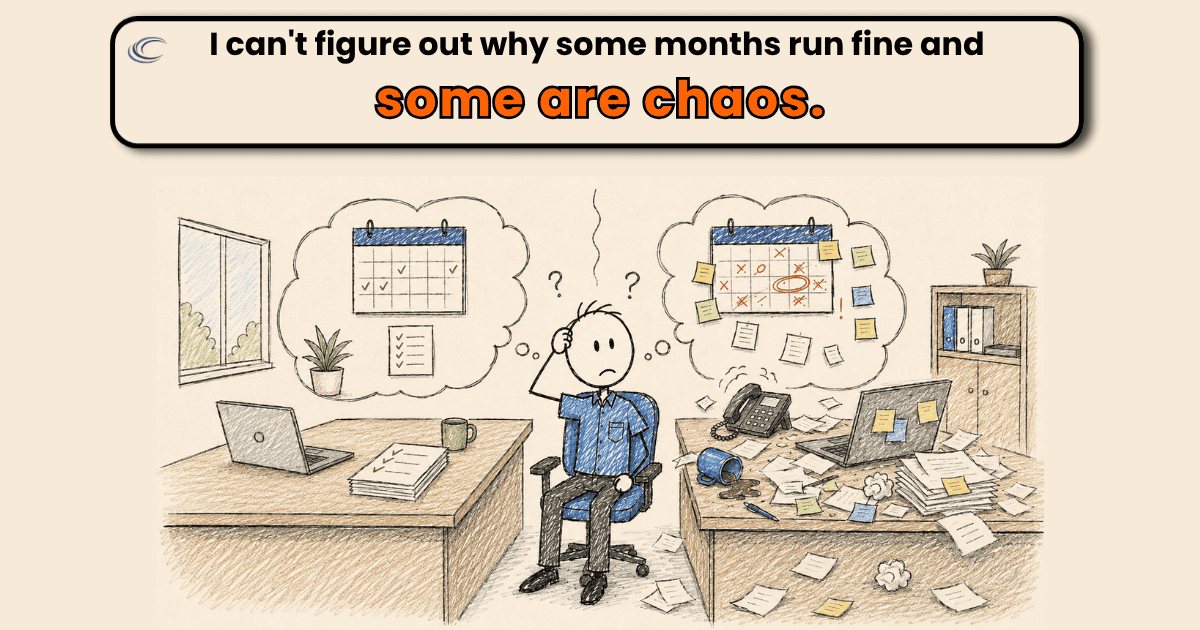
In a slow month, only one of those gets tested at a time. The apprentice asks a question, and the lead electrician’s right there to answer it. The CSR reschedules one job, and she remembers which customer is which. Nothing lines up, so nothing breaks. It looks like the shop is running fine. The cracks just weren’t under load.
What actually happens in a bad month
Then volume goes up, and the same gaps get tested at the same time. Two techs are out instead of zero. Three panel upgrades need rescheduling instead of one. A change order gets passed from a lead electrician to the office as a text message, the way it always has, except this time the CSR is juggling four other calls and it slips through.
That’s how a customer ends up calling twice about a panel upgrade that should’ve been a routine reschedule. Nobody dropped the ball on purpose. The system that usually holds, a phone call here, a memory there, just didn’t have any slack left to absorb it.
Where the pileup actually starts
The information wasn’t missing. It lived in one person’s head, or one text thread, instead of the job file where anyone could find it. That works fine until two jobs need that person’s attention at the same time, and one of them loses.
This is true across the shop, not just dispatch. It’s true for warranty callbacks that live in a tech’s memory instead of a written history. It’s true for load calcs that get double-checked out of habit instead of a documented process. None of it was built to fail. It was just never built to hold more than one thing at once.
What the slow bleed costs even in a calm month
That panel upgrade, rescheduled twice, one confused customer call, one wasted trip, ran somewhere around $450 in truck time and a technician’s afternoon that could’ve gone to a billable job. It never shows up on a monthly report. Nobody sits down and logs “lost $450 this week to a missed handoff.” It just becomes one more thing nobody had time to look into.
Multiply that by the months it happens more than once, and it’s real money leaking out through a hundred small gaps instead of one big one. The bad months just make it visible. The calm ones hide the same leak.
By the end of that week in March, nothing about the shop had actually gotten worse. Nobody worked harder than they had in January. The cracks were just all open at the same time.
The problems weren’t random. They were waiting for a month busy enough to find them all at once.