
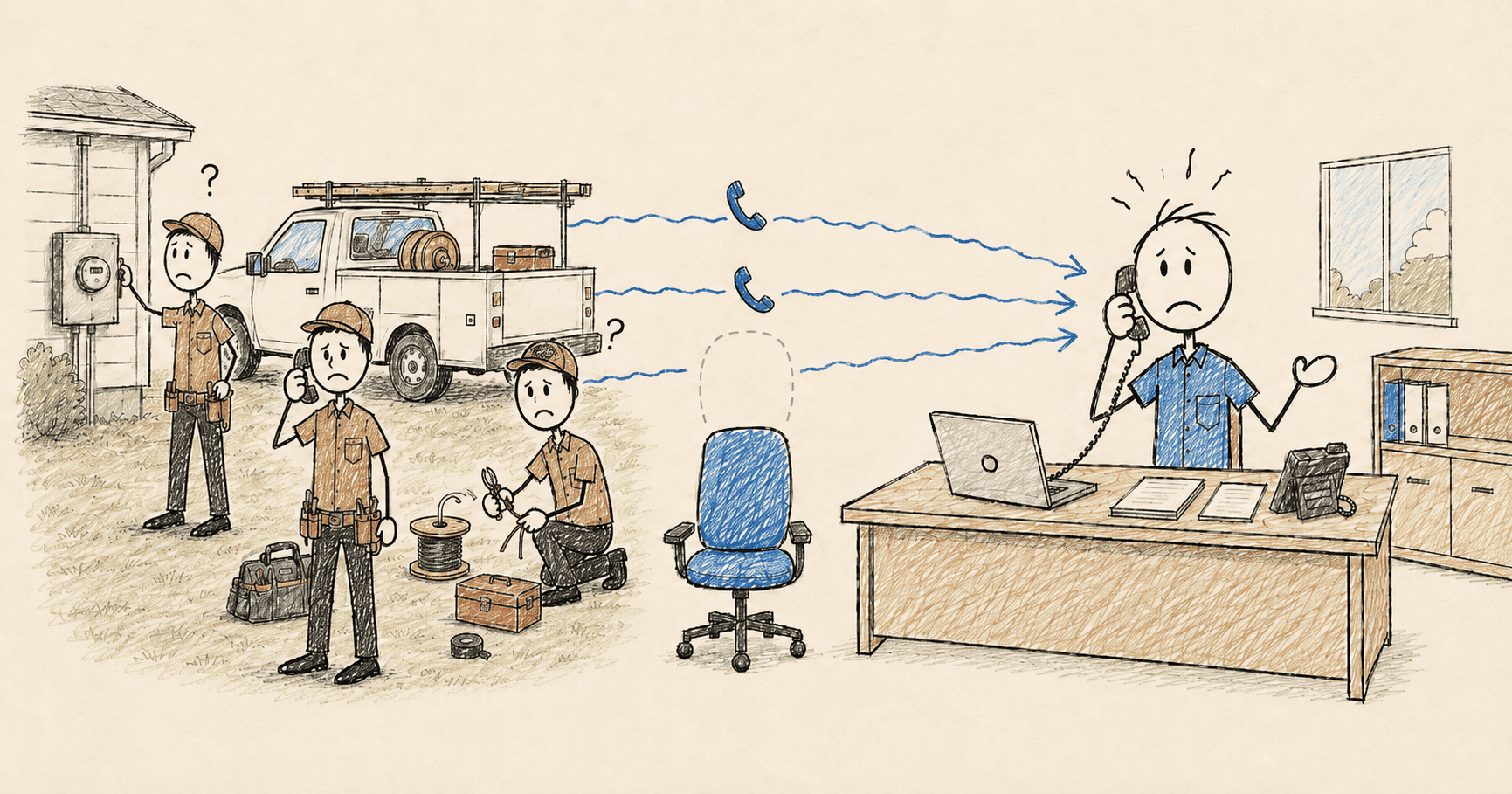
Hiring an operations manager does not put a layer between you and the field. The layer isn’t a person, it’s a set of decisions nobody has written down yet, and until they exist on paper the new hire just becomes a second phone that calls your phone.
A person can only run a day that’s already been defined. Drop a good operations manager into a shop where the day is decided in your head, and inside two weeks he’s forwarding you the same questions your journeymen were calling you about. He’s not failing. There’s nothing for him to run.
Why every call from the field still ends up on your phone
Look at what actually comes at you on a Tuesday. Not the big stuff. The small stuff.
The service call booked as a receptacle not working turns into a panel that’s obsolete and full. Your guy is going to be there another two hours, minimum.
So the day just changed. Somebody has to decide whether he holds that job or comes back, what happens to the two o’clock, and who tells that customer. Three questions, and all three come to you, because there is nowhere else for them to go.
Same on the project side. A rough-in runs long because the framing wasn’t ready. Somebody has to decide whether to pull a hand off it and send him to the other job or eat the afternoon.
None of this is on the board. The board says who’s where. It doesn’t say who decides what happens when the day changes, and the day always changes.
So the field calls you. Not because they’re not thinking. Because you’re the only place the answer exists.
What an operations manager would actually fix, and what he wouldn’t
He’d fix the decisions that are already defined. Move a call, hold a truck, reschedule a customer, get a purchase order started. Real relief, and worth paying for.
What he can’t fix is an undefined decision. If nobody has written down who can push a customer to tomorrow, the operations manager doesn’t know either. He asks you. If nobody has written down what happens when a job runs past its window, he asks you. Every question with no rule behind it still routes to the one head that has the rule in it.
That’s the honest answer to the question you’re searching. Define the day first, and a hire runs it. Hire first, and you’re still the one deciding, one step further back.
What has to be built
Three things, and they live on the board, not in somebody’s memory.
1. A named owner of the board, every day.
Not a title. A name on the schedule, for that day, who has the authority to move jobs and tell a customer we’re coming tomorrow instead.
Right now nobody has been given that authority, so it stays with you. The office person answering the phones may already be doing most of it. She’s just asking permission each time, because nobody ever said she had it.
2. A written limit on what the field can change without asking.
Your journeyman with fifteen years on the tools and your second-year apprentice should not be working from the same limit. Write it by rank: how long a man can extend a job on his own, and when it goes to whoever owns the board.
Put it where the job lives, in the field-service software, not in a policy binder nobody opens.
3. A standing rule for a job that runs long.
The most common change to the day, and the one with no rule. Write what happens: at what point the field flags it, who they flag, what job moves first, and who calls the customer.
One paragraph, on the board where the day is actually run.
Build those three and the day has an owner, a limit, and a rule for the thing that goes wrong most. That’s the layer. Then you can look at hiring, and you’ll be hiring someone to run it instead of someone to ask you about it.