
SHORT VERSION
Most owners searching for an operations consultant for their electrical shop are trying to stop the same problems from coming back. Advice alone won’t do it, and neither will another piece of software. What does is getting the whole operation out of your head and onto paper, seeing where the work actually gets lost, and building the missing pieces into how the day runs. The first move isn’t hiring anyone. It’s mapping one job, end to end.
If you’re looking for an operations consultant for your electrical shop, here’s what you’re actually after: the same problems, gone for good instead of back next week. You don’t get there with advice, and you don’t get there with software nobody set up right.
So before you hire anyone, know what the different kinds of help they actually do, and where each one stops.
What you’re really shopping for
You didn’t wake up wanting a consultant. You woke up tired of the same problems. The scheduling one that keeps coming back. The software you bought that nobody uses the way it was sold to you. The job that slipped because two people each thought the other one had it. You’ve tried fixing these. You had the conversation, bought the tool, maybe hired someone for it. And here they are again, same problem, different week.
That’s not your crew failing you. It’s that the work was never built to run without you. It lives in heads, in texts, in handoffs nobody officially owns. When the work runs on memory instead of a system, the same problems come back no matter how good your people are.
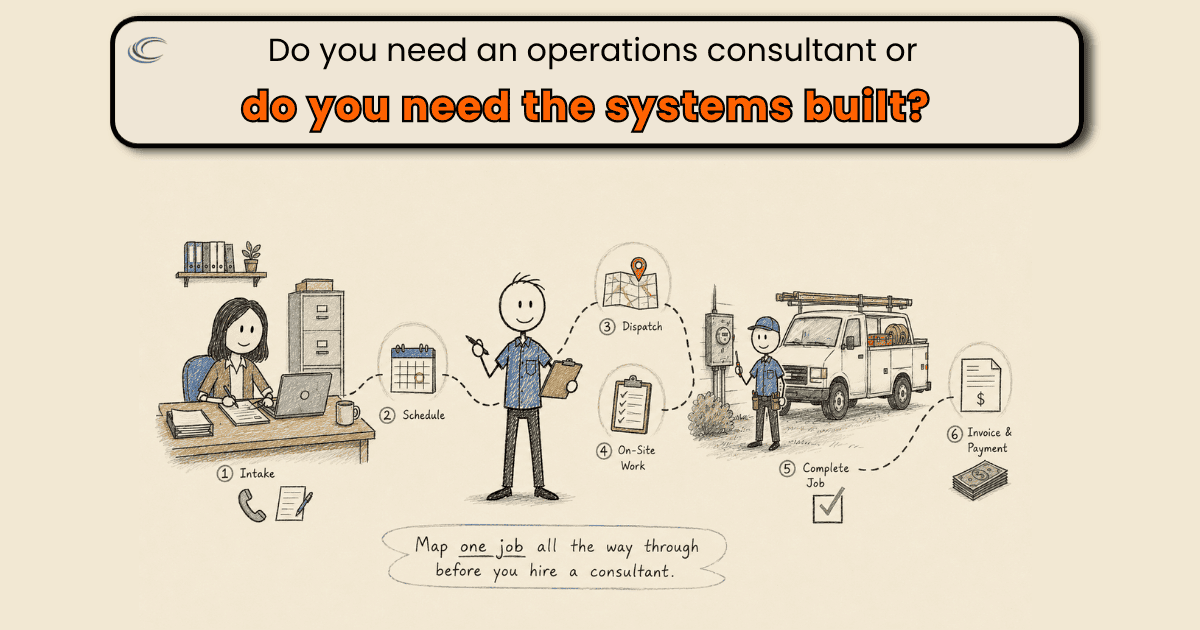
Where the work actually gets lost
The electrical part is rarely the problem. Your people can do the work. The business loses control in the handoffs, the moments where a job passes from the office to the field, from the field back to the office, from the finished job to the invoice.
A call comes in as “breaker keeps tripping.” Nobody asks what brand the panel is, because there’s no field on the intake that asks for it. So your electrician finds out standing in a laundry room, forty minutes from the counter, holding a breaker that doesn’t fit. That’s not a diagnosis problem. It’s an intake that was never built to catch the one thing that decided the whole call.
Multiply that by every handoff. The photos that stay on someone’s phone. The material used off the truck that never makes it onto the invoice. The recommended work mentioned once and never followed up. None of it is dramatic. It’s just constant, and constant is where the money goes.
What a consultant does, and where it stops
Here’s the honest landscape, because most of the category stops short of the thing you need.
A business coach will tell you what to build, then leave you to build it, at night, after the day you already didn’t have time for. A software company will sell you the platform and run the same onboarding they’d run for a plumbing shop, without configuring it to how your jobs actually move. A general consultant knows business frameworks but not your trade, and you’ll feel it in the first meeting when they try to run your shop like a dentist’s office.
None of them are useless. A coach can set direction. The software can be the right tool once it’s set up right. But each one hands you a piece and leaves the assembly to you. The part that actually stops the problems, mapping what’s breaking and building the fix into the daily work, is the part most of the category skips.
Start with one job on paper
You don’t need to hire anyone to take the first step. And taking it will tell you more about what kind of help you actually need than any sales call will.
Pick one job type. A service call, a panel swap, a small remodel, whatever runs most often. Follow one all the way through, from the phone ringing to the payment landing, and write down every point where the job has to pass from one person to another. The office takes the call and hands it to dispatch. Dispatch hands it to the field. The field hands the result back to the office. The office turns it into an invoice.
At each handoff, ask one thing: what has to be true for this to move cleanly, and is anything actually making sure it’s true? Not a person remembering. A field on a form. A step that can’t be skipped. A place the information has to go.
Most owners have never seen their business laid out like this. Once you do, the pattern stops looking like a run of bad luck and starts looking like a set of gaps you can close. That map is what real help builds from. It’s also how you tell, fast, whether the person you’re about to hire is going to build it with you or just hand you a plan and wish you luck.
FAQ
Do I need an operations consultant or an operations manager?
An operations manager runs the day once there’s a system to run. If the system was never built, a manager inherits the same chaos plus a bigger payroll. Map and build how the work moves first. Then decide whether you need someone to run it.
What does an operations consultant for an electrical contractor actually do?
Most of them map your problems and hand you recommendations. The useful ones go further: they build the fixes into your daily work, configure your software to how your jobs actually move, and train the crew on it. The words sound the same, so ask which one you’re getting before you pay.
Can’t I just fix my operations myself?
You can, and mapping one job end to end is the place to start. What stops most owners isn’t ability. It’s that the day never slows down long enough to build while you’re also running everything. That’s the real reason it’s stayed broken this long.
Will a consultant set up my ServiceTitan or Housecall Pro the right way?
Some will, most won’t. Generic onboarding gets you a login and default settings, not a setup that matches how your jobs actually move. If configuring the software to your workflow isn’t spelled out as part of the deal, assume it isn’t included.