SHORT VERSION
The work only one person knows how to do isn’t at risk because he might quit. It’s at risk because the how lives nowhere but his head, and nothing about the job ever pulls it out. You don’t fix that by sitting him down to write it all down before he leaves. You fix it by running that work through a shared record the next time it happens, so doing the job captures the knowledge and the next hand follows the record instead of the man.
If one person is the only one who knows how to do it, the danger isn’t that he’s irreplaceable. It’s that the process only ever lived in his head, because nothing in the way the work runs ever made him put it anywhere else.
Why does it end up in one head?
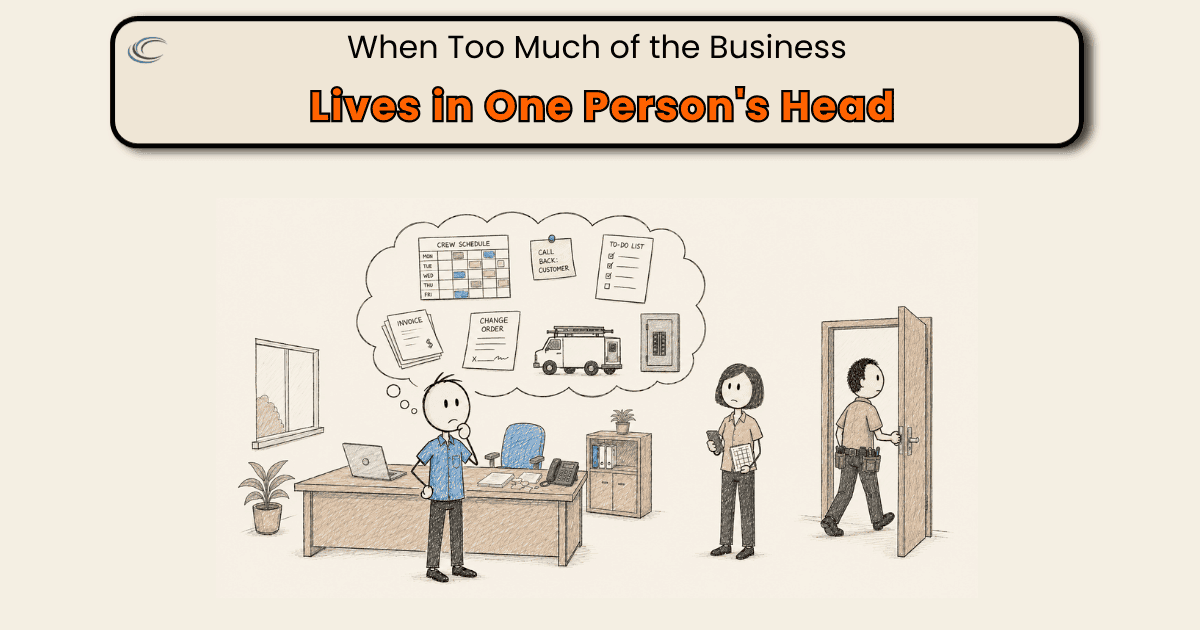
Look at how the knowledge got there. Your estimator builds a bid in his own spreadsheet, the one he set up years ago, with the logic in his head and none of it on the page. The guy who runs the board knows which of your electricians to send to which customer, knows the property manager who won’t let anyone roll without a PO number, knows the account that pays in ninety days no matter what the invoice says.
None of that is written down, and not because he’s guarding it. The work never routed through anything that would catch it. He does the job, the job gets done, and the how stays where it started.
It’s the default. Knowledge sits in the person who uses it, and nothing in most shops pulls it out.
Why “just have him write it down” doesn’t hold
So the owner sees the risk and reaches for the obvious move: sit the guy down and have him document everything before he leaves. It almost never holds, and it’s worth knowing why before you spend two weeks on it.
A one-time download is a giant task nobody has time for, so it gets done thin or not at all. What does get written goes stale the first time the process changes, because updating it isn’t part of anyone’s job.
And even a perfect binder is still a binder. It sits in a drawer, and the next hand never opens it, because reading it isn’t built into how he learns the work either. You moved the knowledge once, and it kept changing after you did.
Where the knowledge actually has to live
The fix is a change to where the work happens.
Pick the one or two processes that only live in a single head. Estimating. The board. Whatever it is in your shop. The next time that work runs, run it through a shared, structured place instead of a private spreadsheet and a good memory.
The estimate gets built in a real template, in the system, where the logic shows in the fields instead of sitting in one man’s head. The dispatch decision leaves a line in the job record: who got sent, and why. The customer who pays slow gets a note on his record, not a fact your office guy carries around in his.
The point is that doing the work fills the record. You’re not stacking a documentation task on top of the job. You’re making the job leave a trail as it moves, so the record becomes the thing the next person follows. The process lives in the system, not in the person.
Then the rule that keeps it that way. No process the business depends on is allowed to live only in someone’s head or someone’s personal file. If it matters and only one person can run it, it doesn’t have a home yet. Give it one.
FAQ
Should I have my estimator document everything before he leaves?
A one-time download rarely holds. It’s a big task nobody has time for, it goes stale as soon as the process changes, and the binder sits in a drawer. Better to run his next few bids through a shared template in the system, so the logic ends up in the record as he works, not in a document he wrote once.
How do I protect the business if my one key guy quits?
Find the process that only lives in his head and give it a home in the system. Route that work through a shared record so it leaves a trail every time it runs. Once the how lives in the record instead of the man, losing him stops taking the process with it.
Isn’t cross-training the fix for this?
Cross-training only sticks if there’s something to train from. If the process only lives in one head, there’s nothing to hand the next person. Capture the work in a shared record first, and the second set of hands becomes easy to build.