
You can’t put anyone between you and the crews until there’s a defined role for them to hold. Right now that layer is empty, so the board and every field call route straight to you, no matter how good your people are.
You’ve probably tried to fix this already. You put an office person on the phone. Maybe you pulled one of your best hands off the truck to help run things. And the calls kept coming to you anyway. The hire wasn’t the problem. Answering the phone and running the board are two different jobs, and you only filled one.
Why does every decision still route to you?
A CSR books work. She takes the call, gets the address, puts it on the schedule. That part leaves your plate fine.
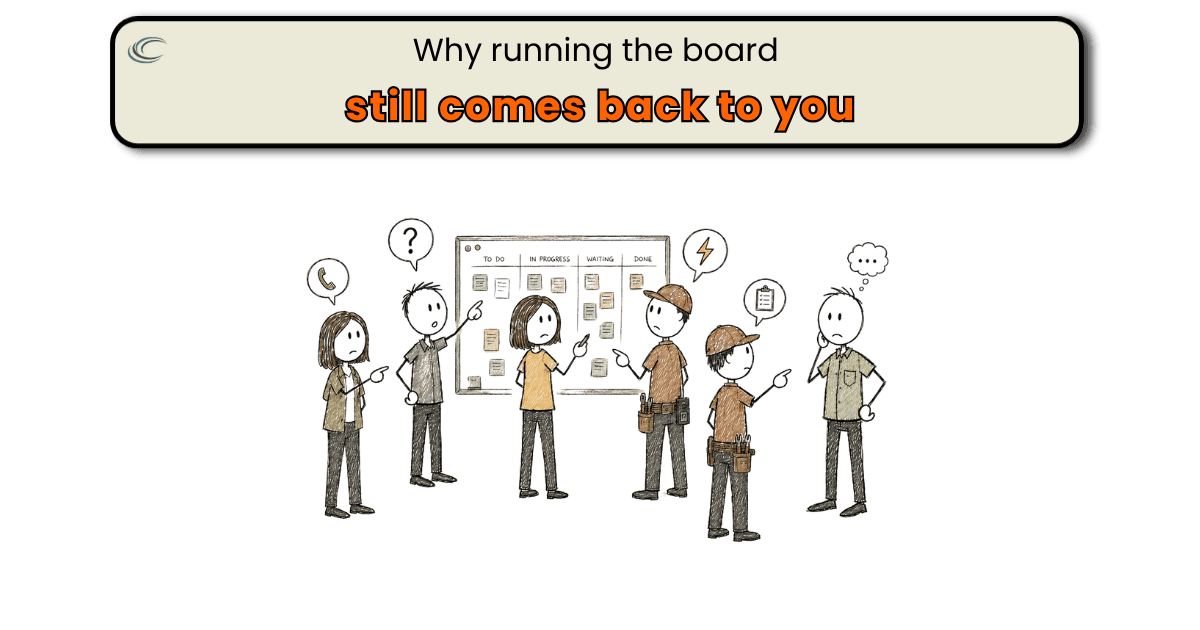
The board is a different animal. Which crew gets pulled for the emergency, which job slips, who can run the panel change on Thursday, that’s judgment, and it lives in your head. The history with the customer who always swears the quote covered more is in there too. So is the read on which of your guys can go solo and which one still needs a journeyman watching his work.
None of that is written down anywhere. So even a sharp person put on the board can’t run it without calling you, because everything they’d need to make the call is still with you.
That’s the real trap. You didn’t fail to hand it off. There was nothing built to hand it off into.
Take a normal Tuesday. A lead calls from a jobsite because the customer wants to add two circuits, and nobody but you can approve the change or price it. An hour later the CSR calls because an emergency came in and she doesn’t know which crew to bump. Neither call needed you specifically. They needed someone with the authority to decide, and you’re the only one who has it.
What has to be built
A second hire won’t fix this on its own. What’s missing is a role with enough authority that the field calls it instead of you, and the rules that let it hold.
1. One role that owns the board.
This is the person the field calls when the day changes, the one who moves jobs, decides who goes where, and takes the questions from the jobsite. Could be a dispatcher. Could be a foreman you bring inside. Could be the office person you already have, if the next two pieces exist. What matters is that the field has one place to call that isn’t you.
2. Written rules for what that role can decide alone.
This is the piece almost nobody builds, and it’s the whole thing. Put it on paper. Reschedule inside the same day, dispatch a standard service call, waive a trip charge up to a number you set, approve a change on site up to a dollar limit you pick. Then the short list that still comes to you: a change over that limit, a customer disputing scope, a job about to blow its window. Without those rules on paper, everything escalates to you by default, because “ask the owner” is the only safe move anyone has.
3. The board out of your head and into something the role can read.
The schedule, which of your guys can run which kind of work, the customers with history, the standing notes on jobs in progress. If it only lives in your memory, the role can’t run without you, and you’re back on the phone. A role can only hold what’s been written down.
Build all three and the field has one place to call that isn’t you. Build only the first, and the calls route to you the same as they did before you hired anyone.