
SHORT VERSION
A job’s cost is made in four places: labor hours, material bought for the job, material used off the truck, and work added after the price was set. Each one has to get a job number attached at the moment it happens, by the person it happens to. The job costing report doesn’t calculate anything. It adds up what got attached. If the time entry only holds a day, and material gets bought before a job number exists, the report comes back empty no matter what you paid for the software.
You track job costs at the moment the cost happens, not at the end of the job. A job’s cost is four separate things: the hours somebody worked, the material bought for that job, the material that came off the truck, and the work that got added after the price was set. Each one has a moment where it gets a job number attached to it or it doesn’t, and that moment is usually somebody standing at a counter or sitting in a truck at 4:30. The report at the end can only add up what got attached along the way, which is why it comes back empty.
What a job’s cost is actually made of
The hours are the biggest piece. Not just the time on site. The drive, the shop time before he rolled, the forty minutes at the counter waiting on a will-call that wasn’t pulled yet.
Then there’s what got bought for the job. That one at least leaves a receipt. Whether the receipt says which job it was for is a different question.
Truck stock is the quiet one. The breakers, the devices, the connectors, the cable that came off the truck were all bought weeks ago, so installing them doesn’t look like spending money. It’s already paid for. It still belongs to the job.
And then there’s the work that got added after you priced it. The homeowner walks the remodel while the walls are still open and asks for another receptacle in the garage. Real time, real material, and if it never turned into a change order it lands inside the original budget and makes the job look like it ran long.
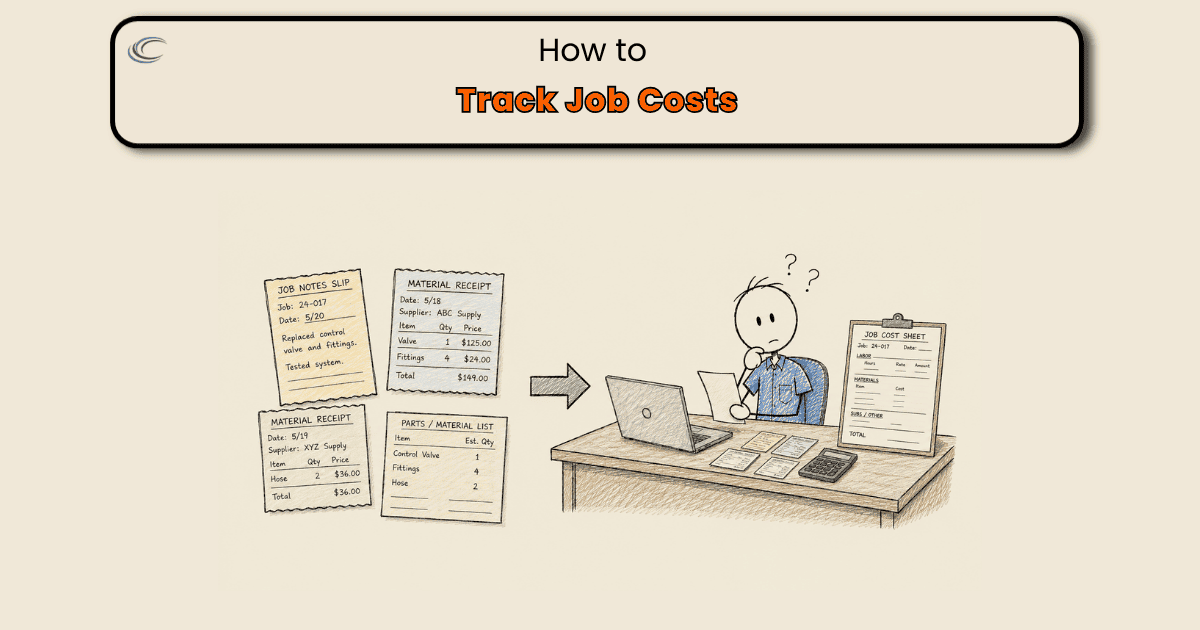
Why doesn’t the cost make it back to the job?
At the counter, either a job number exists or it doesn’t. If nobody assigned one, the connection between that material and that job lives in one man’s memory until Thursday, and by Thursday he’s been on four other jobs.
Time works the same way. If the only thing a time entry can hold is the day, then a man who touched three jobs turns in one honest number that can’t be split back apart.
Truck stock never lands anywhere because there’s no point in the day where anybody is asked what came off the truck. The material list on the job has a place for what was purchased and nothing for what was already riding around. So the cost stays in overhead.
Added work has the same gap. Pricing it from the field means a call to the office, and the office is on the next thing. When documenting the extra work is harder than doing it, it gets done for free.
The job number goes on where the cost is created
One rule holds all of this up. The person who creates the cost attaches the job number at the moment they create it, and nothing gets reconstructed later by somebody trying to remember a week.
For hours, that means the time entry can’t be saved without a job on it. One man, three jobs, three entries. The drive and the counter trip go on the job they were for, because they were for a job.
For anything purchased, the job number gets issued before the buy, not after the receipt shows up. That’s the piece that has to move first. A job number or a purchase order handed out at dispatch is the only thing that makes a receipt worth anything when it surfaces four days later.
For truck stock, what came off the truck gets recorded on the job at the same time the work gets documented, on the same screen, because that’s the only moment anybody is looking at both at once. Restocking then reads off that record instead of somebody walking the shelves guessing.
For added work, there has to be a way to open a change order from the field in about a minute. Not a phone call. If it takes longer to price the extra work than to do it, the money never follows the work.
Then the job can’t be closed until those are on it. Not a reminder. A condition of closing, so an incomplete job is visible while somebody can still remember Tuesday.
What the number tells you once it’s there
With the pieces attached, the report is a real comparison. What you priced against what it took, on that job, with the hours and the material behind it. Then it’s the same comparison across a kind of work.
You find out the panel swaps carry themselves and the remodels for one particular GC don’t, or the other way around. Either way it’s a fact instead of a feeling.
Common questions
Do I need new software to track job costs?
Usually not. What you need is for every hour and every purchase to be able to hold a job number at the moment it’s created, and for that same job number to exist in accounting. A lot of that capability is already sitting unused in a system the shop is paying for. If time entry genuinely can’t hold a job, or purchases can’t be assigned to one, that’s the piece that has to change.
How does truck stock get onto a job?
It goes on the job’s material list at the same moment the work gets documented, because that is the only point in the day where somebody has that job open and knows what came off the truck. Miss it there and it doesn’t get caught later, since nobody can walk a truck a week out and say which breaker went where. Restocking reads off that record instead of a guess at the supply house.
Should drive time and supply house time go on the job?
Yes. Those are paid hours and they happened because of that job. If they land in a general bucket, the job with the long drive and the special order looks identical to the one down the street with everything on the truck, and you’ll price them the same next time.
Can I go back and cost jobs that already closed?
Not accurately. The hours are a weekly total, the material is a card statement, and rebuilding it from memory gives you a number you can’t act on. Start with the jobs that are open right now. The real comparisons start showing up as those close.