
Why everything still comes back to you
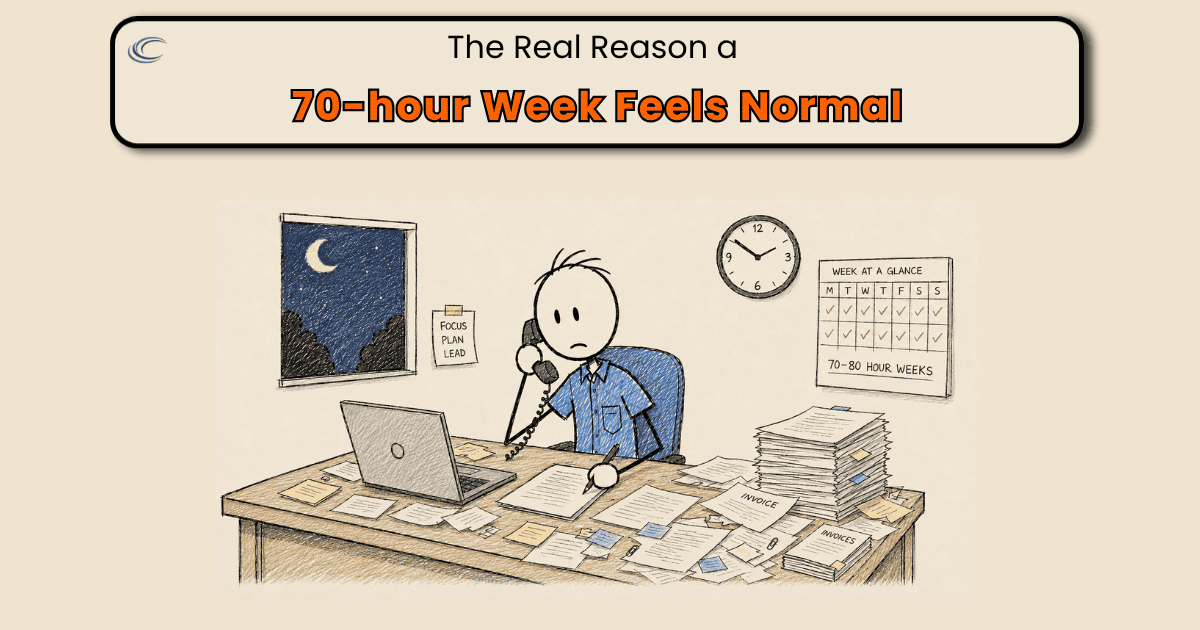
Most 70 to 80 hour weeks are not one bottleneck. Every job has three or four moments where somebody in the field needs your yes to keep moving, and none of those moments have ever been handed to anybody else. A price change is one of them. It is not the only one.
Why does it land on you every time?
A material’s not on the truck and something close will work instead. A room’s not ready for trim because drywall isn’t finished, and the crew doesn’t know whether to shift to punch work on another job or wait around. A wall’s already open and there’s a two-minute add nobody quoted. None of these are big decisions on their own. But if nobody besides you has ever been told what they’re allowed to decide, all of them route to you by default.
That default is invisible until you count it. It’s not that the shop handed you a bad system. Nothing was handed to anyone. The rule was just never written down, so the fallback rule became “call the owner.”
Say the drywall crew runs a day behind and your guys show up to a room that isn’t ready. Whether they move to another part of the job or sit and wait is a call somebody on-site could make without you, if anyone had ever told them they could. But if that’s never been decided, it becomes a text, a wait, and a callback, even though nothing about the decision needed you specifically.
Multiply that by every job running, every day. The hours don’t come from one big category of decision. They come from being the only name attached to all of them.
What actually needs to move
The fix is a short list, the kind that fits on one page, of the few decision types that come up on almost every job: a price add under some dollar line, a material substitution when the exact part isn’t available, a sequencing call for when a job stalls waiting on someone else, a minor scope change that doesn’t touch the estimate. For each one, write down the boundary and put a name on it that isn’t yours.
Below the boundary, that person decides and keeps working. Above it, it still comes to you, same as now. The list is short on purpose. It only needs to cover what actually repeats, not everything that could theoretically happen on a job.
The problem was never that your people can’t be trusted with a decision. It’s that no decision was ever formally theirs to make.
FAQ
Won’t handing off decisions mean I lose visibility into what’s happening on jobs?
No. If the boundary is written down, you still see everything above it, and you can review what fell below it after the fact. You’re choosing where the line sits, not giving up the line.
What if I don’t trust my crew to make even small calls yet?
Start the boundaries low. A $50 material swap and a straightforward sequencing call are low-risk places to begin. You can move the line as you see how it holds.
Isn’t this basically the same thing as delegating more?
Not exactly. Delegating usually means telling someone to “use their judgment.” This is narrower: a specific decision type, a specific limit, a specific name. That’s what makes it something you can actually hand off instead of just hoping it works out.