
SHORT VERSION
When one emergency call throws off your whole day, the emergency isn’t the cause. The board was built full, back to back, with no slack to take the call and no set rule for what moves when it lands. So the it gets done by hand, under pressure, and every job behind the emergency slides. Build the board with a hold for the call you know is coming, and a written rule for what gets moved and who tells the customer. Then one emergency stays one problem instead of a wrecked afternoon.
One emergency call and the rest of the day falls apart, and the emergency is rarely what wrecked it. The board was built wall to wall, so the call has nowhere to go, and the jobs behind it get reshuffled by hand, with no plan for where they land.
Where the day actually breaks
The call itself takes an hour, maybe two. That’s not what costs you the afternoon. What costs you is what happens to the jobs already on the board.
The board got built assuming the day goes as planned. Every electrician has a full slate, back to back, with drive time barely counted. There’s no open hour anywhere. So when the emergency comes in, there’s no slot to drop it into. Someone grabs the nearest available electrician and sends him.
Now his afternoon has to go somewhere, and there’s no rule for where. So whoever’s on the board reseats it by hand, live, while the phone keeps ringing. One job slides to tomorrow. Two get pushed onto a journeyman who was already booked solid. The customers waiting on those jobs hear nothing until they call in asking where their electrician is.
That’s the cascade. Not one disruption. A dozen small decisions, all made under pressure, none of them planned for.
The call lands at 11. By noon you’ve pulled an electrician off his route, bumped a panel change to Thursday, and told two homeowners “sometime this afternoon” because nobody can say better than that. By 3 the office is answering calls it has no answer for.
None of that is a dispatch mistake. Whoever’s running the board is making the best call they can with no room to work in and no rule to follow. Hand the same board to anyone and the same day happens, because the problem is how the board was built, not the person moving the pieces.
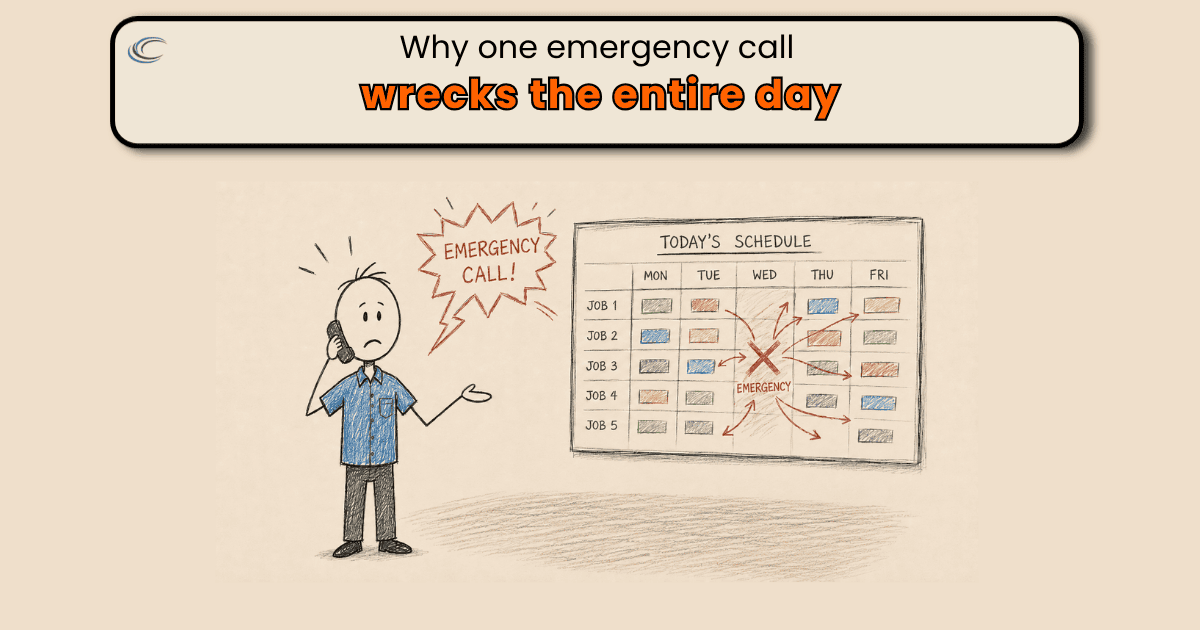
How do you keep one emergency call from wrecking the schedule?
You build the board so the emergency has somewhere to go before it ever comes in.
You already know roughly how many emergency calls you get in a week. It isn’t zero, and it isn’t really a surprise. It only feels like one because the board was built as if it wouldn’t happen.
Two things change about how the board gets made.
A standing hold on the board. Open capacity, sized to how many emergency calls you actually average, left unbooked on purpose. When one comes in, it drops into a slot that was already there instead of shoving a real job off. Holding that time looks like leaving money on the table, but the held hour is the cheapest one on the board, because the alternative is a slid job, a bumped customer, and an afternoon of the office chasing its tail.
A written move rule. The answer to what moves when a call jumps the line, decided once, ahead of time, instead of in the moment. Which job slides. Who it moves to. And who calls that customer, before the customer calls you. When the rule is the same every time, moving jobs takes a minute, and nobody downstream is left guessing.
The emergency still comes in. It just stops taking the rest of the day down with it, because the board was built to take the hit.
FAQ
How much time should I hold open for emergency calls?
Start with what you actually average. Pull the last few weeks, count the true emergencies, and hold about that much open across the crew. If you’re not sure, hold one block a day and adjust as the real numbers come in. The point isn’t a perfect number. It’s that the room exists before the call does.
Should I put one electrician on emergency calls full time?
In a shop your size, usually not a person, a slot. Pinning one electrician to emergencies wastes him on the days none come in. A hold spread across the board gives you the same coverage without parking a good electrician on standby. If your emergency volume is heavy and steady, a dedicated run can pay off, but most shops do better holding capacity than holding a person.
What do I do when I’m fully booked and an emergency comes in anyway?
Follow the move rule you set ahead of time instead of inventing one on the spot. Decide now which job slides first, who it moves to, and who calls the affected customer. A same-day job moved with a heads-up is a minor inconvenience. The same job moved silently is how you lose the customer.
Isn’t holding open time just lost revenue?
It’s cheaper than the version where you don’t. An unbooked hour you planned for costs you one hour. An emergency with no slot costs you a reshuffled afternoon, jobs pushed to another day, and customers waiting with no word. The held time is insurance against the expensive version.