
SHORT VERSION
If the shop slips the week you’re gone, it’s not your crew and it’s not the work. The dispatch board runs on decisions only you know how to make: who’s right for which job, what a job actually needs, what bumps what when an emergency lands. You make those calls in seconds because you’ve made them ten thousand times, so you’ve never written them down. That’s why they route back to you. The fix is to catch the rules you’re already running in your head and put them on the board, one at a time, starting with which of your guys can run which work.
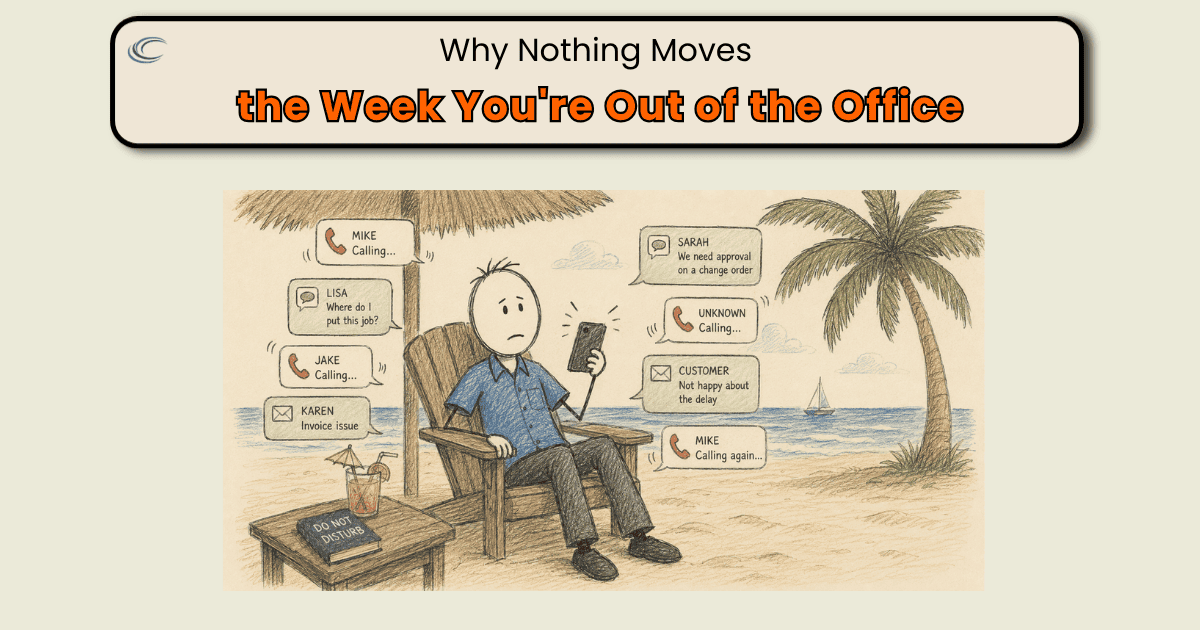
If your business can’t run a week without you, the problem isn’t your crew and it isn’t the work. It’s that the decisions you make at the dispatch board every day live in your head, and the week you’re gone, nobody else has them.
Where the week actually falls apart
The board doesn’t stall because nobody can schedule. Anyone can put a name next to a job. It stalls because scheduling this work well takes judgment, and the judgment is all yours.
Watch what you do every morning without thinking about it. A call comes in for a panel swap. You know in two seconds it’s a half day, it needs two hands, and it needs the van with the taller ladder. You know not to send the second-year on it alone. You know it shouldn’t get stacked next to the job on the far side of the county, because that’s half a day of one man staring at a windshield. You don’t decide any of that. You just know it.
Now you’re out for a week, and whoever’s covering the board is looking at the same call with none of it. The panel swap goes on the schedule like a service call. One guy, two-hour window. He shows up, sees it’s a half-day two-hand job, and it reschedules. A rescheduled panel upgrade runs $300 to $600 in wasted truck time and lost revenue, and that’s before the customer who took the day off starts calling around.
Then a call comes in about sparking at a panel at 10am. That’s a drop-everything call, and you’d know in a second what to move for it. Whoever’s covering doesn’t. So either the emergency waits behind two routine service calls, or a good customer gets bumped with no phone call and books someone else next time.
None of that is the office coming up short. They’re running the same board you run, with none of the rules you’ve spent fifteen years building. The rules were never the problem. The problem is they only live in one place.
Get the rules out of your head, one at a time
You can’t write down fifteen years of judgment in a weekend, and you shouldn’t try. A hundred-page manual nobody opens is just your head on paper, and it stalls the board the same way.
Start smaller. For one week, every time you make a call at the board that nobody else could have made, write down the rule you were actually running. Not the decision. The rule underneath it.
The one to start with is almost always who can run what. Right now “send the right guy” is a judgment you make one job at a time. Turn it into something the board carries: each of your guys, what they can run solo, what they need a second hand for, what they’re not ready for yet. Once that lives on the board instead of in your head, whoever’s covering isn’t guessing who’s ready for a service change. They’re reading it.
Then what a job actually needs before it’s booked. The time, the second hand, the ladder, the equipment. Tie it to the job type, not to whoever happens to be scheduling that day. A panel swap should carry its own requirements the moment it hits the board, so nobody has to know what you know to schedule it right.
Then the bump rule. What’s a drop-everything call, what can slide a day, and who gets a phone call when it slides. Written down once, it’s a rule anyone can run. In your head, it’s a reason you can’t leave for a week.
You’re not documenting the whole business. You’re moving the few decisions the whole board depends on out of the one place nobody else can reach.
Common questions
Should I hire someone to run the board when I’m out?
Eventually, maybe. But hiring someone before the board’s rules are written down just hands the guessing to a new person. They’ll make the same calls you’d make, except without your years of judgment, so they’ll make them wrong until they build their own. Write down the rules first. Then whoever runs the board, hire or not, is running your logic instead of inventing theirs.
How do I take a week off without everything slipping?
Start before you leave, and start small. Pick the three or four decisions the board can’t run without you: who’s right for which job, what each job actually needs, what bumps what. Get those onto the board as rules someone else can read. You’re not documenting the whole business. You’re covering the handful of calls that only you can make right now.
Can ServiceTitan or Jobber just handle the scheduling for me?
The software can hold the rules, but it can’t invent them. It’ll carry which of your guys runs which work, what a job type needs, and how urgent a call is, but only if someone tells it. That’s the part most shops skip. The tool gets bought, nobody sets it up to match how the work actually runs, and it schedules no better than a paper board. The rules are the fix. The software is just where they live.