
SHORT VERSION
New hires take weeks to get productive because how your shop runs isn’t written down anywhere. It lives in the heads of your longest-tenured guys, so a new person learns it by shadowing someone who already has a full day of work. Write the operational path down once, in the software your crew already uses, and a new hire follows the process instead of chasing people for answers.
New guys take weeks to get up to speed because almost nothing about how your shop actually runs is written down. Everything a new hire needs to know, where the job info goes, how your software is set up, what a finished job looks like here, lives in the heads of the people who’ve been with you the longest. So every new person has to pull it out of somebody one question at a time.
The work isn’t what’s slowing him down
If you hired a journeyman, he can already troubleshoot a circuit and make up a box. That part was never the holdup. What he doesn’t know is how your shop runs, and none of that is the actual work.
He doesn’t know which fields your office needs filled on a service call before it can get billed. He doesn’t know where the before photos go, or that material off the truck has to get logged to the job or it never makes it onto the invoice. He doesn’t know that a panel change here starts with a call to the office, or that “closed out” means six specific things and not four. That’s the knowledge that takes weeks, and none of it is the trade.
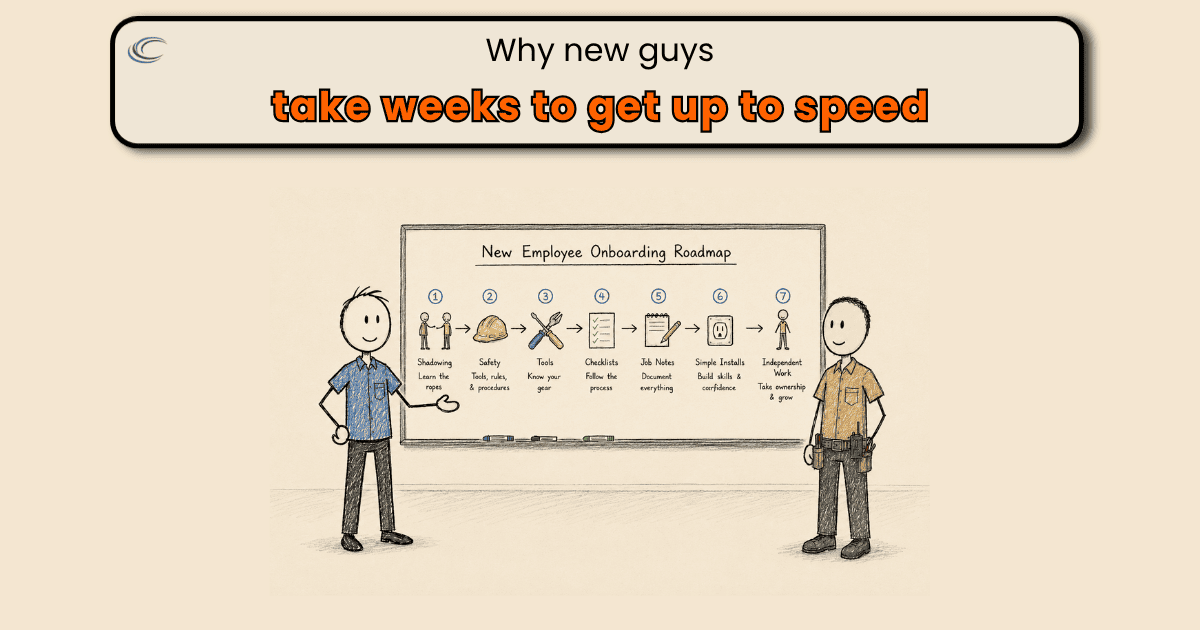
Where the weeks actually go
Right now the new guy learns all of that by standing next to someone. He rides along, he watches, he asks, and slowly it sinks in. The person teaching him has a full day of his own.
So the answers come in pieces, between jobs, when your lead has a second. A new hire hits a question on a Tuesday, the guy who knows is forty minutes out on a service call, and the new guy either guesses or waits. Do that across every part of the job he’s never seen and you get weeks. Not because he’s slow. Because there’s no place to look except another person’s memory.
And when that person is out sick or quits, the knowledge goes with him. The next new hire starts from zero, and so does the one after that.
Why does every new hire start from scratch?
Because the way your shop runs was never written down, so there’s nothing to hand a new person. It exists only as “how we do it here,” carried around in the heads of four or five guys. Nobody ever built the step where that gets captured. There was never a reason to. The work got done, the knowledge stayed in the room, and it held up fine until you had to bring someone new into that room and get them productive fast.
That’s the missing piece: a written record of how the work actually moves through your shop, so a new hire follows a process instead of pulling answers out of people one at a time.
Write down the path, not the trade
You’re not writing a manual on how to be an electrician. He’s got that. You’re writing down how a job moves through your shop, start to finish, the real version.
How the call comes in and what has to be on it. Where the field logs its info, and what has to be true before a job can close. It’s all shop process. The trade was never the holdup.
Write it the way it actually happens, not the way it’s supposed to. If your guys have a workaround that keeps things moving, that workaround is the process, and that’s what goes on paper. A clean document that describes a shop you don’t have is worse than nothing.
Then put it where the work already lives. If your crew runs the day out of ServiceTitan, Housecall Pro, or Jobber, the process belongs in there, as the job template, the required fields, the checklist that has to be done before a job closes. A binder in the office dies in a month. A required field doesn’t. When the path is built into the tool, following it isn’t one more thing the new guy has to remember. It’s just how the job gets done, and he’s doing it right on day three instead of week three.
That also takes the knowledge out of one person’s head. When your lead is out, the new hire still has somewhere to look. When someone leaves, they don’t walk off with the operating manual, because it isn’t in their head anymore.
Common questions
Should I have my best electrician train the new hire, or write the process down first?
Both, in that order, and only once. The first time, have your lead walk a new person through the job while someone writes down what he actually does. After that, the writeup does the teaching and your lead gets his day back. Right now you’re paying your best guy to teach the same thing over and over.
How long should it take a new hire to get productive?
It depends on the person, but if it’s consistently taking weeks, the holdup usually isn’t the person. It’s that there’s nothing for him to follow, so his speed is capped by how often he can interrupt someone who knows.
We’re slammed. Where do we even start writing this down?
Start with the one job type you run most, a standard service call, and write only the path it takes through your shop. One documented workflow a new hire can actually follow beats a full manual you never finish.
Do onboarding checklists actually work, or do they just get ignored?
A checklist sitting in a binder gets ignored. A checklist built into the software as fields that have to be filled before a job closes doesn’t, because the work can’t move forward without it. The difference is whether following it is optional.