
SHORT VERSION
The field and the office fall out of sync when there’s no shared job record. What happened on a job lives in a text, a voicemail, or one guy’s memory, so the office can’t see it and ends up calling to ask. Give both sides one job record they write to and read from, and make writing to it part of finishing the work, and the gap closes.
Communication between the field and the office breaks down when the job record lives in a text thread or one guy’s head instead of one place both sides can see. When it isn’t written down where the office can find it, the office has to call and ask, and you become the relay between the two.
Where the information actually gets lost
Information moves between the field and the office all day, in both directions. The office sends out the address, the complaint, the gate code, the note that the panel’s obsolete. The field sends back what they found, what they did, what came off the truck, what still needs doing.
Almost none of it moves through the job record. It moves through a phone call, a text, a voicemail, a photo sitting on somebody’s phone.
The call goes out as “breaker keeps tripping.” Your guy finds a subpanel that never made it onto the intake, handles what he can, and texts you a photo because that’s the fastest way to tell somebody. Six weeks later the customer calls about that subpanel, the office pulls up the job, and there’s nothing there. The photo’s on a phone that’s out on another call.
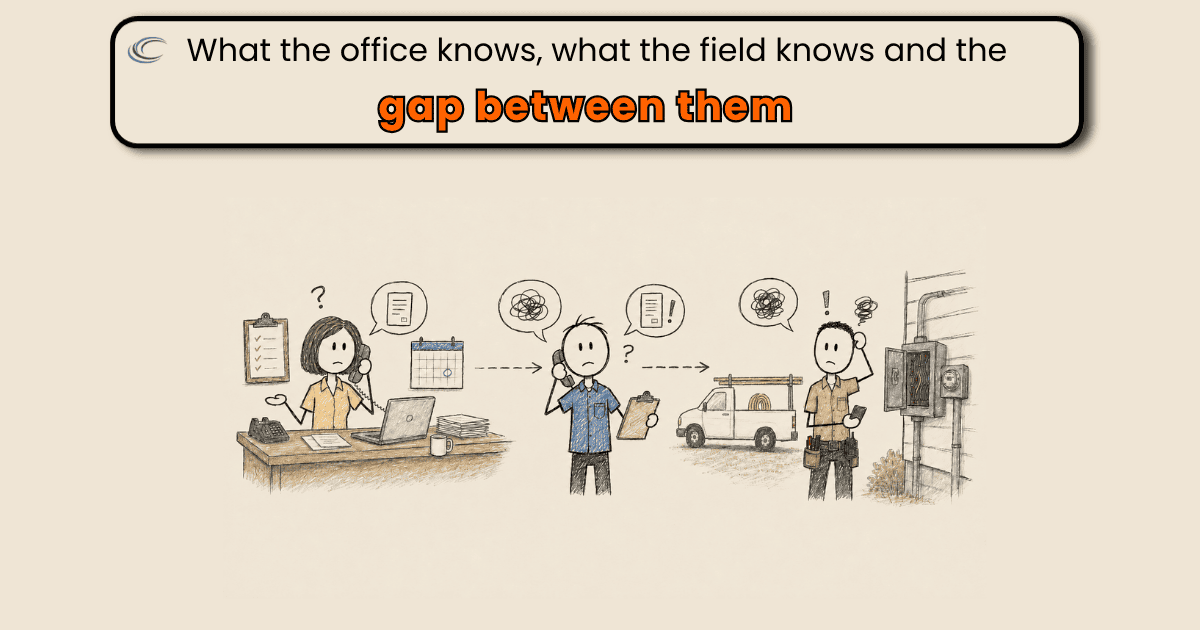
The information existed. Somebody knew it. It just lived in a channel the office can’t open. That’s the whole sync problem, and it isn’t that people didn’t communicate. They communicated into channels the office can’t go back and read.
Right now, you’re the sync
When there’s no shared record, somebody has to be the one who knows everything. That’s you. The office calls you to find out what the field did. The field calls you to find out what the office told the customer. You’re holding both halves of every job in your head and connecting them by phone.
That’s not you failing to let go. It’s that the business has no way to move information between the field and the office except through the person who talks to both. Build the record and that stops being your job.
Why won’t more communication fix it?
The instinct is to add more of it. A morning huddle, an end-of-day call, a group thread everybody’s supposed to check.
It never closes the gap. You’re adding conversations, and a conversation disappears the second it’s over. Double the talking and the office is still calling the field at four o’clock to find out what happened on the last call. The gap closes when the information lands in one place and stays there, where either side can go look without picking up the phone.
One place, and the write-up is part of the job
The fix is one job record both sides write to and read from, so neither one has to call the other to find out what’s on it.
That takes two things. The record has to be one place, not four. Right now the dispatch details are in the scheduling software, the found conditions are in a text, the photos are on a phone, and the outstanding work is in somebody’s memory. Scattered like that, there’s nothing to sync to.
Everything about a job goes on the job, in the one system both sides open.
And writing to it has to be part of finishing the work, not something your guy does later from the truck if there’s time. A job isn’t closed when the breaker’s back on. It’s closed when the record says what was found, what was done, what came off the truck, and what still needs doing. Make that the definition of a closed job and the information stops living in texts, because there’s no way to close out without it and nowhere else for it to go.
Then the office can see what happened without picking up the phone, and nobody has to relay it through you.
A few questions owners ask about this
How do I make sure job information gets back to the office?
Put it in one job record instead of a text or a phone call, and make updating that record part of closing the job, not a separate task for later. When the write-up is how a job gets marked done, what was found and what was done can’t stay stuck in the field.
Should I buy new software to fix this, or is it a process problem?
Software only helps if it becomes the one place both the field and the office work from. If you add a tool but the details still live in texts and photos on phones, nothing actually changed. Decide where everything about a job lives first, then pick the tool that holds it.
Why is the office always calling the field to ask what happened on a job?
Because the answer isn’t written anywhere the office can look. When what happened lives in one guy’s memory or a text thread, the only way to get it is to call and ask. A shared job record ends the calls.
What should be on the job record so the office isn’t chasing it?
What was found, what was done, what material came off the truck, what still needs doing, and the photos, all attached to that job. If those are on the record, the office isn’t guessing and isn’t calling. If they’re missing, the job isn’t really closed.