
SHORT VERSION
Drive time gets decided at the board, not on the road. When the day gets built around who’s free instead of who’s near the next job, the crew crisscrosses town and loses hours nobody ever flags. The fix is to sequence the day by area before the trucks roll, and hand each new call to whoever’s already close, so the driving never gets built into the day in the first place.
Your crew’s drive time gets decided at the board, before anyone turns a key. When the day gets built around who’s free instead of who’s near the next job, half of it turns into driving, and nothing your guys do in the field wins it back.
That’s the part that’s easy to miss. The driving feels like a road problem, so that’s where you look for the fix. But by the time a guy is on the road, the route is already set. The decision that put him there got made hours earlier, at the board, when the day got sequenced.
Where the day gets built wrong
Most boards get built one call at a time, in the order the phone rings. A call comes in, the office hands it to whoever’s open, and it lands on the schedule. Do that all morning and you haven’t built a route. You’ve built a list. A list ignores the map.
So the east-side call and the west-side call sit next to each other on one guy’s day because they came in twenty minutes apart, not because they’re anywhere near each other. He runs the first one, then drives across town for the second, past two other jobs that belong to two other guys who are also driving across town in the other direction.
Then an emergency lands. Panel’s dead on the far side of town, customer’s calling, and it goes to whoever picks up first. Now a guy who was three stops deep on a clean east-side run is headed forty minutes west, and the two calls he had left get pushed to tomorrow. The insert didn’t just cost his drive. It blew up the back half of his day and started tomorrow behind.
None of that is a crew problem. Every one of those guys drove exactly where the board sent them.
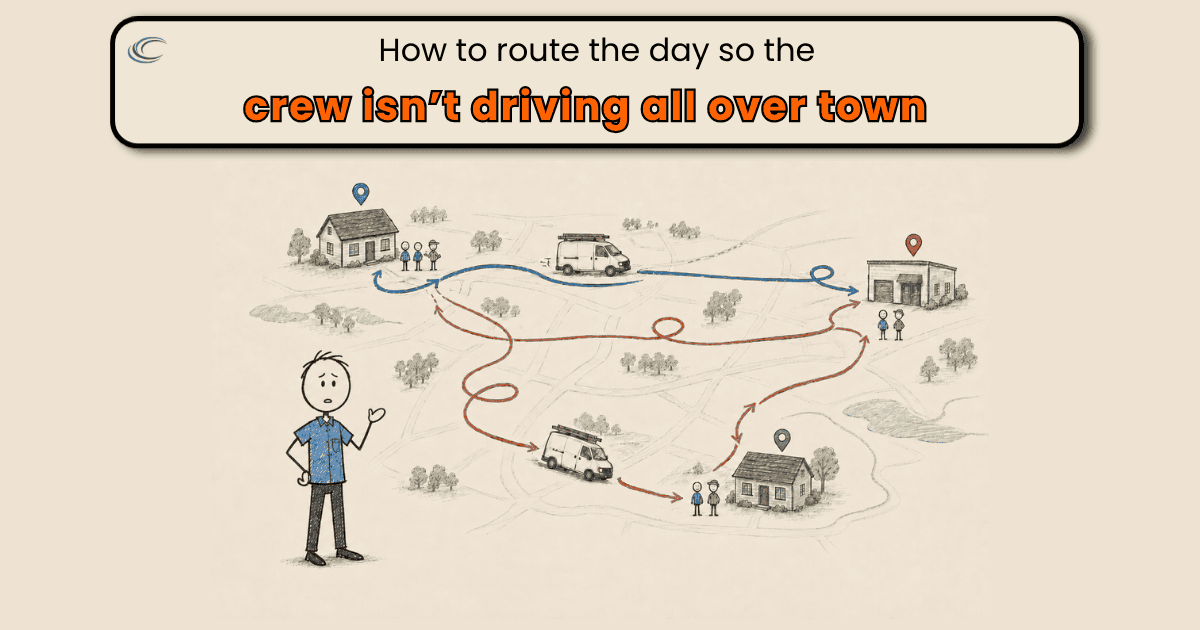
Why does the same crew cross town twice in a day?
Because nobody’s looking at where the jobs are when the day gets assigned. The board shows who’s available and what time the customer wants. It usually doesn’t show, in one view, where everything sits on a map. So the person building the day is solving for who can take this and whether they’ll make the window, which are real questions. Geography just isn’t one of the things the board makes them look at. When the tool doesn’t put the map in front of you, the day gets built without it, every time.
Why scheduling the apprentice better won’t fix it
This is usually where an owner starts: the apprentice is bouncing all over town, so his schedule must be the thing to tighten. But you can’t route the apprentice well by looking at the apprentice. He’s the flex hand on the board, the one moved to wherever there’s a gap or a simple add, so his day gets stitched together from whatever’s left after everyone else is set. Route by who’s free and he’s the one sent farthest, because free is exactly what he is. The only way his drive time gets better is if the whole day gets built by area first. Then the near work comes to him because he’s near, not because he was open.
Route by where, not by who’s free
The shift is small to say and it changes the whole day: the board gets built around location before it gets built around availability. Group the calls by area, sequence each guy’s day so the stops sit near each other, and hand a new call to whoever’s already close instead of whoever’s next on the list. That’s a way of running the board, not a piece of software, though a board that shows the jobs on a map instead of a flat list makes it a lot easier to do.
Two things have to hold for it to stick. The day has to get sequenced before the trucks roll, not assembled while they’re already moving, because once a guy’s out, every change costs a drive. And one person has to own the board with the authority to re-sequence when an emergency lands, so the far-side call gets handed to the crew that’s already on that side and the clean run stays clean. Bolt the emergency onto the nearest guy who makes sense on the map, not the first one who answers the phone.
Build the day around the map and the drive time comes down on its own. The crew isn’t crossing town twice because the board isn’t building the day that way anymore.
FAQ
Should I buy routing software or fix how we schedule first?
Software helps, but it doesn’t build the day for you. The change is running the board by area first and availability second. A board that shows jobs on a map makes it easier, but you can do it with zones and a whiteboard if the habit is there.
How do I keep one emergency call from blowing up the whole day?
Give one person the board and the authority to resequence when the emergency lands. Hand the call to whoever’s already near it on the map, not whoever answers the phone. That way one insert costs one drive, not three ruined routes.
How do I schedule so my apprentice isn’t driving all day?
You don’t fix it by looking at his schedule alone. He’s the flex hand, so he gets sent wherever there’s a gap. Build the whole day by area first and the near work comes to him because he’s near. His drive time drops because the day got routed well, not because you scheduled him differently.