
SHORT VERSION
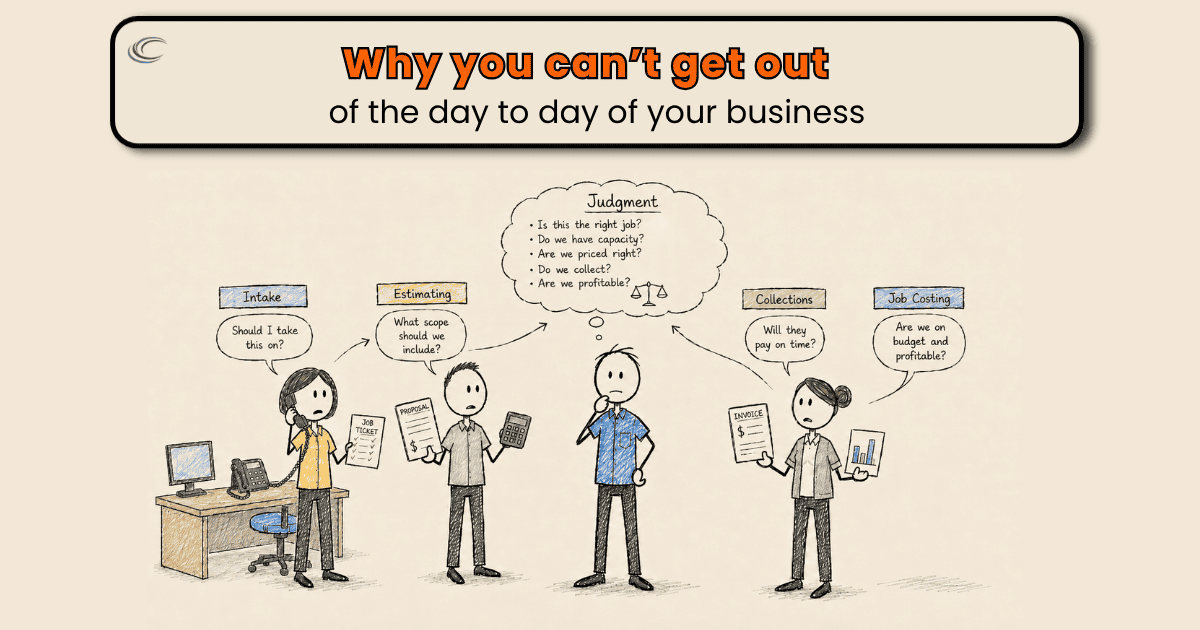
You can’t get out of the day to day because what’s left on your plate isn’t tasks, it’s judgment, and judgment only lives in your head. You handed off everything that came with instructions long ago. What’s still yours shows up at every stage, intake, estimating, authorization, collections, job costing, and at each one there’s a call only you can make, because nobody ever wrote down how you make it. The way out is one stage at a time: start where you get interrupted most, and get that judgment onto paper.
You can’t get out of the day to day because what’s left on your plate isn’t tasks anymore, it’s judgment, and judgment only lives in your head. You handed off everything that came with instructions years ago, and what stayed is the call only you can make, at every stage of the job, because nobody ever wrote down how you make it.
You already handed off the easy part
That’s why it still wears you out even though you’re doing less of the actual work. The phones, the scheduling, the ordering, the invoicing, you moved most of that off your plate a long time ago. What stayed is the part that needed you, and it never came with instructions. You didn’t fail to delegate. You delegated everything that had instructions, and what’s left never had any.
It isn’t one stage. It’s all of them.
Walk a single job through the shop and you show up at every handoff. The call comes in as “breaker keeps tripping,” and the one question that shapes the whole job, what brand the panel is, never gets asked, because only you know to ask it.
It’s there in estimating, where only you know a panel change on an older service eats a full morning, not the couple hours the number would suggest. It’s there on site, when your guy hits something out of scope and stops to call you, because he’s not sure what he’s cleared to commit to.
It’s there at the end too. The invoice sits, and only you know which customers to lean on and which ones always pay on the 30th. The job wraps, and you’re the only one who can look at it and tell whether it actually made money.
Same pattern every time. A call only you can make, at a stage where nobody wrote down how you make it.
Why none of it hands off
The easy read is that the office should step up, or your guys should lean on the software. But there’s nothing for them to read. At every one of those stages, the decision lives in your head and stays there. That’s not a training problem. It’s a system nobody built, because no day was ever slow enough to build it.
Every time you’ve tried to hand a piece of it off, this is what pulled it back. You handed over the task and not the judgment that drives it, so they were back at your door inside a week.
Get out one stage at a time
You don’t fix twelve stages at once. You’d never start, and that’s usually why owners don’t. Take the single place people interrupt you most and get that judgment out of your head first.
For a lot of shops it’s who takes which call. For yours it might be estimating, or what your guys are cleared to authorize on site, or which jobs are worth chasing money on. Pick that one.
Then write down the call you make there, the part that only lives in your head, in plain language the office can read. Not a job description. The actual decision, and how you make it. Once it’s on paper, it stops being a reason for someone to come find you.
Then the next stage. Then the next. The day to day doesn’t lift all at once. It lifts one written-down decision at a time, and the first one to write is the one you’re most tired of making.
FAQ
How do I get out of the day to day when everything runs through me?
You don’t pull it all out at once. Start with the one stage people interrupt you for most and get that judgment out of your head first. Write down the call you make there, plainly, where the office can read it. Then move to the next stage. One written decision at a time is how it actually lifts.
Why am I still worn out when I’ve already delegated most of the work?
Because you delegated the tasks that came with instructions. What’s left is judgment, at every stage of the job, and judgment can’t move to anyone until it’s written down. The tiredness is the weight of being the only copy.
Which stage should I start with?
The one people interrupt you for most. That’s the decision costing you the most time, and it’s usually the one you feel lift fastest once it’s on paper. For many shops it’s dispatch, but for yours it might be estimating, authorization, or collections.
Isn’t this just writing SOPs?
Sort of, but not the task kind. A task SOP lists the steps someone follows. This is writing down the judgment, the call only you can make, so someone else can start making it. That’s the part most owners skip, and it’s why the work keeps coming back to you.