
A dispatch process is who goes where, with enough time and the right notes, decided before the day starts and written down where the office can see it. A schedule that lives in your head or on a whiteboard skips the last two, which is why the week runs fine when you’re on top of it and comes apart the day you’re not.
The whiteboard isn’t broken, and neither is your memory. They both work most weeks. So the schedule never gets counted as a problem. It holds right up until the day you’re not there to hold it, and then it looks like ten small things going wrong at once instead of one thing that was never built.
Why do some weeks hold and others fall apart?
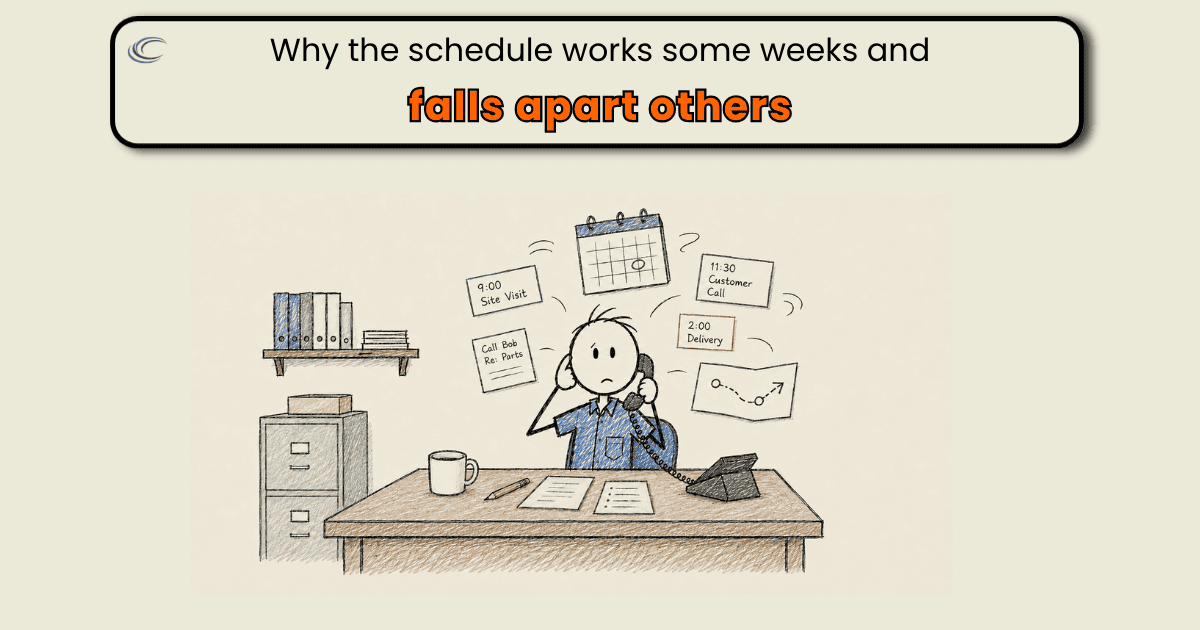
When the schedule lives in your head, only you can see the whole day. You know the panel swap needs two hands and a full morning, not an hour squeezed between two service calls. You know the call across the county can’t sit next to a job on the other side of town. The whole board is in your head, and it’s mostly right.
The trouble isn’t the calls you make. It’s that nobody else can make them, because nobody else can see what you see. The day you’re on a job with your phone off, or out for a week, the shop doesn’t dispatch. It waits for you.
Then there’s the information. The office took a good call. The customer said the panel’s in a finished basement behind built-in shelving, and the last electrician couldn’t get to it. That got said out loud. But when the job gets handed out of your head, there’s nowhere for that note to ride. Your guy finds it out standing in the basement.
And an emergency call lands at ten. Whoever picks it up moves the eleven o’clock to make room, and now the panel swap that needed the whole morning is behind, because the board they moved didn’t show that the morning was already spoken for.
None of that is a people problem. Your guys can’t act on information that never reached them, and nobody can protect a schedule they can’t see.
What has to be built
A dispatch process that runs without you. Not a cleaner whiteboard. A place the day lives outside your head, that the office can see and change while the work is moving.
1. One schedule the whole shop can see.
Every job on the day, who’s assigned, and where, in the software or on a shared board, not on your phone and not in your head. So when the ten o’clock emergency comes in, whoever handles it can see what’s already tight before they move anything.
2. The notes ride with the job.
Whatever the office learned on the call, access, job history, photos, what the customer already told them, attaches to the assignment. Your electrician opens the job and sees it. The knowledge stops dying in the gap between the phone and the truck.
3. A flag for what the job actually needs.
Before a job goes out, it’s marked for what it takes: a second person, a ladder or a lift, the right material, and the time it really needs. So the panel swap gets its morning instead of a one-hour slot with a service call stacked behind it.