
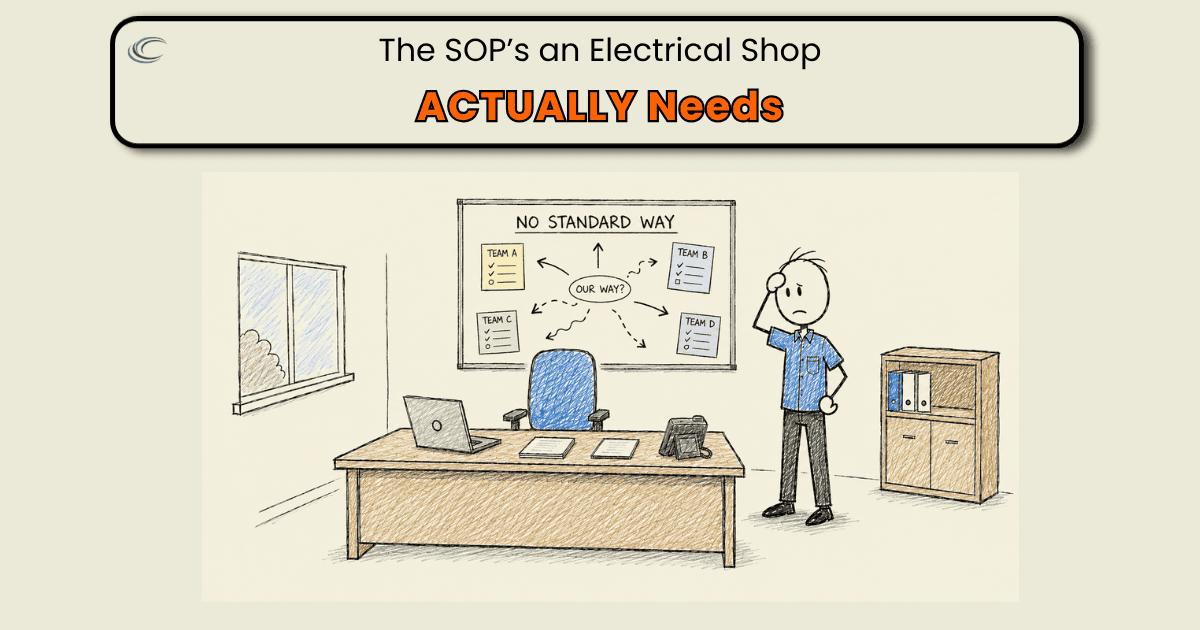
When there’s no standard way of doing things, every job runs on whoever’s holding it that day. The work still gets done. It just gets done a little differently every time, and that’s why the same problems keep coming back.
You don’t need a binder of two hundred SOPs to fix that. You need a standard for the handful of tasks that run differently depending on who’s doing them, and you need it living where the work actually happens.
Why does every job run a little differently?
The shop didn’t skip building a standard on purpose. It grew without one. Every person who came through figured out their own way to get the work done, and it worked well enough to keep going, so nobody stopped to write down the one way you’d actually want.
That’s not a discipline problem. It’s a standard that was never built. Your guys each came up with their own because you never handed them one.
Here’s where it shows up. A job gets closed out. One of your guys leaves photos, the material he used, and a note the office can bill from. The next guy closes the same kind of job with “fixed outlet.” Both of them think they did it right, because nobody ever defined what “done” has to contain. Now the office is interpreting, chasing the second guy for what he actually did, and the invoice sits another two days.
Then a new hire starts. He learns by riding along with whoever’s free that week, so he picks up that one person’s way, shortcuts and gaps included. He isn’t learning “our way.” There is no our way for him to learn. There’s whoever he happened to shadow.
And when someone with eight years leaves, his way goes with him. How he preps a panel change. How he walks a customer through the price. What he checks before he calls a job done. None of it was ever on paper, so it walks out the door the day he does.
What actually has to get built
You’re not documenting everything. Most of the work doesn’t need it. What needs a standard is the short list of tasks where the result changes depending on who’s holding the job.
1. Find the tasks that run differently every time.
Closeout. Intake. How a change gets priced and approved before the work happens. These are the ones where whose day it is decides how the job goes. Leave the rest alone.
2. Write down the one way, once.
Not a manual. For each of those few tasks, what has to be captured, in what order, before it counts as done. What a closed job contains. What the office collects before a call gets dispatched. Short enough to be obvious, specific enough that there’s only one answer.
3. Build it into where the work already happens.
A standard in a binder is a suggestion nobody opens. A required field on the intake, or a closeout template the job can’t be marked complete without, is the path the work already takes. Following it becomes easier than working around it. That’s the difference between a rule everyone has to remember and a system that just runs.
Do that for three or four tasks and you’ve built more of an “our way” than most shops your size ever get to. Not because your people finally started paying attention. Because for the first time there’s one way to point them at.