
A standard “our way” of doing things gets built one workflow at a time, not all at once. Start with the version your best crew already runs, and get everyone on that one.
Most owners hear “document your processes” and picture a binder nobody will ever open. That’s why it never gets done.
The place to start isn’t the whole business. It’s wherever the missing standard bites hardest, and for most shops that’s the end of a job.
Why does the same job get closed out five different ways?
Closing out a job means a set of things happen at the end of it.
The note gets written. The photos get taken. The material used gets recorded. The invoice goes out.
Whether all four happen depends on who ran the job. One of your guys writes a full note, records what he pulled off the truck, snaps the before and after, and marks it done. The next one writes “replaced receptacle” and rolls to the next call.
Both are good electricians. Neither is doing it wrong, because nobody ever said which close-out is the close-out.
The office feels it first. A thin note means somebody has to call and ask what actually happened on site. Material used but never recorded means truck stock walks off the books, and the job looks more profitable than it was.
Photos sitting on a personal phone aren’t on the job at all. And the invoice waits three days in the truck, because there’s no point in the process where the paperwork has to be finished before the job counts as done.
The note says “fixed outlet.” A callback comes in on that address a month later and nobody can tell from the record what was done the first time.
None of that is your crew not caring. It’s that “close out the job” means one thing to one guy and something else to the next, and the space between the two is where the information disappears.
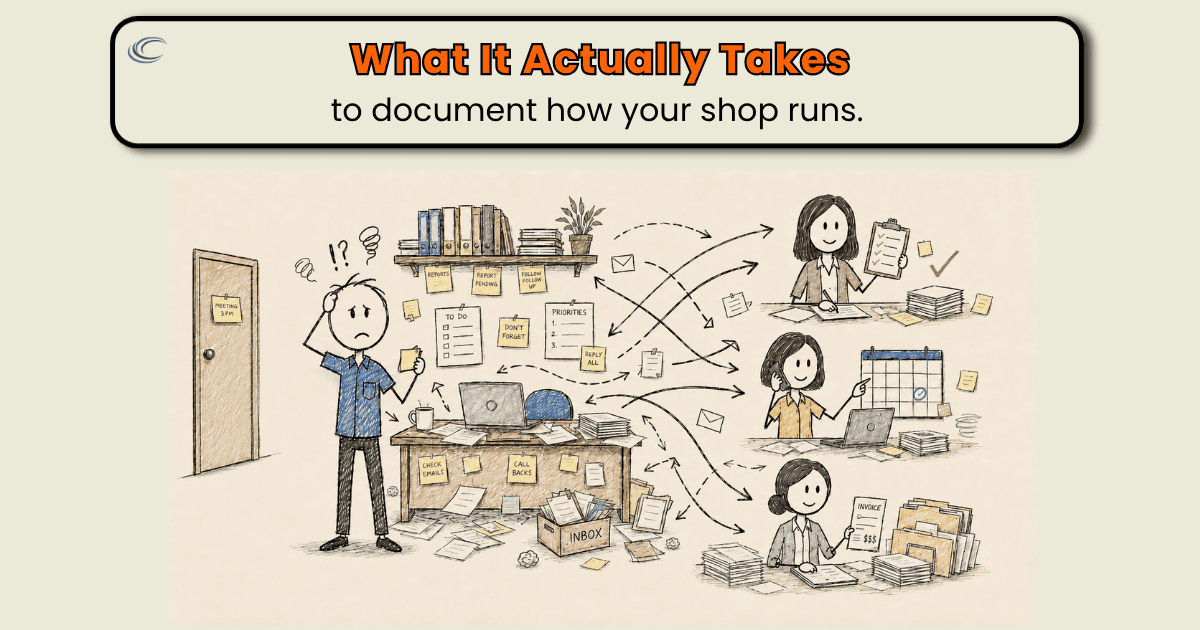
How one “our way” gets built
You don’t sit down and write the whole shop. You’d never finish it, and if you did, nobody would read it. You build one standard, prove it holds, then do the next one. Start with close-out.
1. Pick one workflow, not the whole shop.
Close-out of a service call is a good first one. It happens every day, everybody touches it, and when it’s inconsistent the office pays for it the same afternoon. One workflow you can define this week beats a manual you’ll be writing all year.
2. Write down the version that already works.
You already have a best close-out. It’s whatever your most reliable guy does without being told. Watch what he actually does, the note, the photos, the way he logs material, and write that down. You’re capturing the close-out that already works and making it the one everyone runs, so nothing new gets invented.
3. Put it where the job lives, not in a binder.
A standard in a document nobody opens isn’t a standard. It goes into the software as required fields on the job: the note, the material used, the photos, all attached before the job can be marked complete. When the job can’t close without them, following the standard isn’t something anyone has to remember. It’s just how the job closes.
Once close-out holds that way, you take the next workflow and build it the same. Intake next, maybe, or the handoff from the office to the field. The “our way” gets built one workflow at a time, and close-out is the one worth starting with.