
The field service software you bought and never really rolled out isn’t sitting unused because your people won’t touch it. It’s unused because the daily work still runs somewhere else, and the software only ever became a place to enter things twice.
Buying it and rolling it out are two different jobs. Onboarding set up your account, imported your customers, maybe built a price book, then handed you the keys and left. Nobody moved the actual work into it, so the work stayed where it always was.
Why does the board still live outside the software?
The tell is simple. The office is still running the board somewhere the software can’t see. A whiteboard. A group text. A spreadsheet the office has kept for eight years and trusts more than anything you paid for.
That isn’t stubbornness. Dispatch happens fast. The phone rings, a job has to land on somebody, and the fastest path wins every time. If assigning a job in the software takes six clicks and a text takes one, the text wins at 7am with three calls stacked up.
So the real board lives in the fast place, and the software becomes a copy the office updates when there’s a slow minute, which most days there isn’t. Now you’ve got two boards. One is real. One is the $2,000 to $5,000 a month you’re paying for the software to sit at twenty percent.
The call comes in as “half the house is out.” The office sends it to whoever’s closest. The panel brand and the gate code the CSR wrote down stay in the software, where the field never looks, because the day comes to your guy by text.
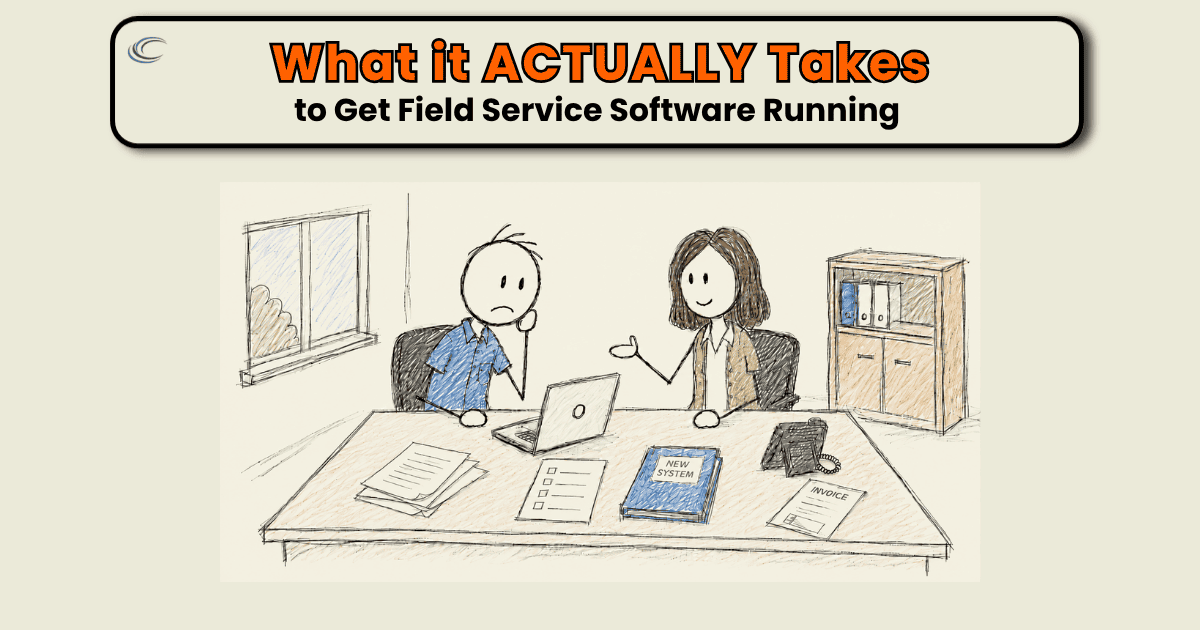
What actually gets it running
The software doesn’t get adopted by training harder, or by one more sit-down where everybody agrees to use it this time. It gets adopted when it’s the only place the work can travel. As long as a faster path exists, the faster path wins. Close it, and the software stops being optional.
Three things have to be true.
1. Every job is created in the software at intake.
Before dispatch ever touches it, the call exists in the system with the notes the office collected attached to it. If the job is born there, the board starts there, instead of on a sticky note somebody has to copy over later.
2. The assignment is made in the software.
Not on the whiteboard and entered after. In it. The moment a job lands on somebody, that move happens in the one place, so the schedule in the system is the schedule, not a picture of what it was two hours ago.
3. The field gets the day from the app and nowhere else.
This is the gate. If the only way one of your guys finds his next stop is by opening the app, the office has to put it there, because a text doesn’t reach him anymore. Close the parallel channel and the two boards collapse into one. The whiteboard can stay on the wall as a mirror. It just can’t be the source.