
If the extras keep getting done and never billed, the problem isn’t your guys forgetting to write them up. It’s that an extra has no required path from the moment it’s asked for to the moment it lands on the invoice, so it gets done and then it’s gone.
Where do the extras actually disappear?
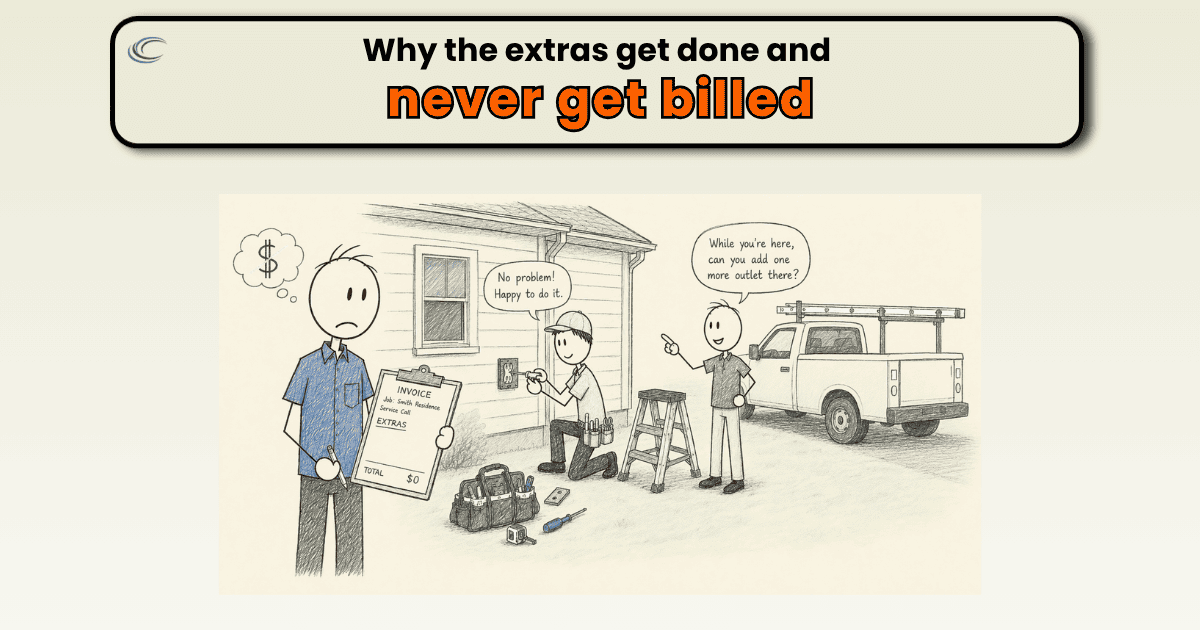
An extra almost never comes in as a change order. It comes in as a question in the field, while the work is moving. The homeowner catches your lead during trim-out and asks for a couple of can lights while you’re already in the ceiling. The GC says just add the two circuits and square up later, and your guy says yes, because saying no stops the job over something that takes an afternoon.
So the work gets done. Two more hours, the material off the truck, and nothing written down at the moment it was agreed to. The change lives in a conversation nobody recorded.
Final billing comes around, and someone in the office builds the invoice off the original scope, because the original scope is the only thing on paper. The extra isn’t on it. By the time anyone could bill it, there’s no proof it happened. It gets absorbed into the original labor budget, and the job looks like it ran long on hours instead of like it did more work.
The extra gets asked for in the ceiling, agreed to on the spot, and billed by someone else weeks later. Nothing carries it from one hand to the next. It can get agreed to and still never reach the invoice, and nobody dropped it.
What a change order process actually has to do
The fix isn’t reminding anyone to write extras down. It’s making the extra impossible to start until it’s captured. One required path, three points on it.
1. A capture step light enough to do from the ceiling.
Here’s where most of these gates die. If capturing an extra means a form, it won’t happen with a homeowner standing there and wire still to run. Your lead isn’t climbing down to fill out a change order over two can lights.
At the point of request, the capture is small. All it has to catch is that the extra exists: what was asked, on what job. A text to one number, a photo, a line dropped on the job record. Five seconds, from where he’s standing.
The gate holds because logging it is faster than remembering it, not because anyone got more disciplined. The full change order gets built later, off the ladder, once the wire’s run.
2. A price and a written yes.
A logged extra still needs a number and a yes attached before final billing can touch it. On a residential job that’s the homeowner’s written OK. On commercial it’s a change order against the not-to-exceed, or the GC’s sign-off. That turns “we’ll figure it out later” into something the invoice can stand on.
3. A line on the job, not a memory in someone’s head.
The captured, approved extra lands on the job as its own line, with its labor and material coded to it. Then final billing pulls it automatically, because it’s already on the record. The office reads a line that’s been there since the moment it was logged in the field, instead of reconstructing it from job notes and receipts.