
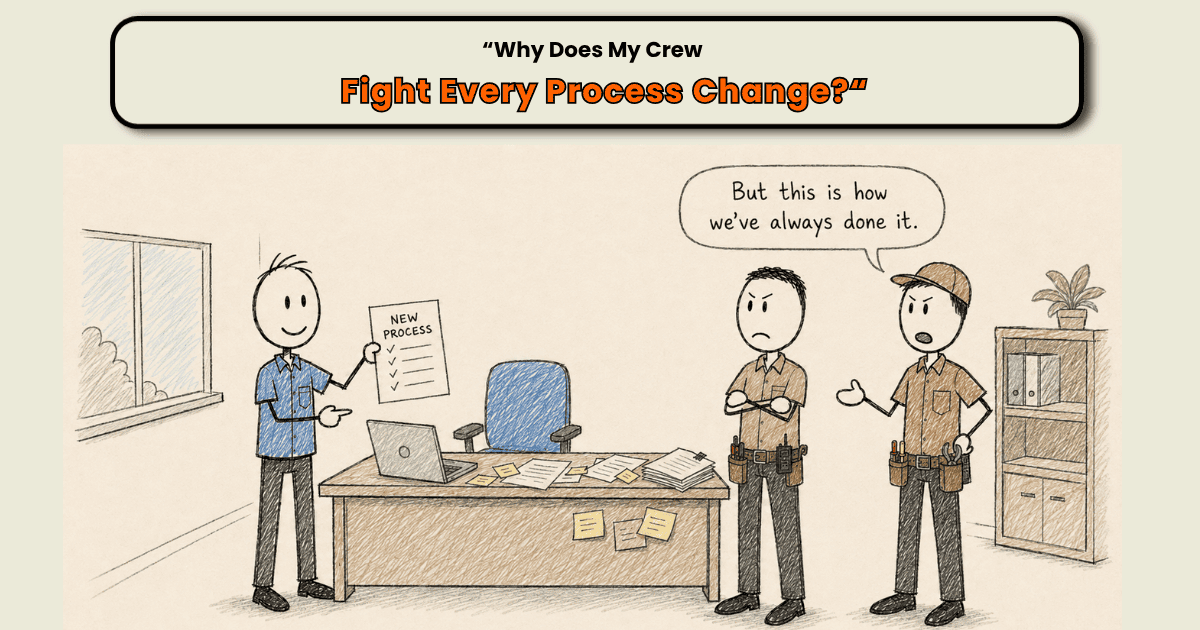
“This is how we’ve always done it.” You’ve heard it before. Maybe from a lead electrician. Maybe from the guy you thought was already on board. You build something better. You roll it out. A week later, it’s dead.
They’re not fighting you. They’re just doing whatever gets the job done by five o’clock. Right now, that’s still the old way.
Nobody’s trying to sabotage you. Someone’s standing at a job site, customer waiting, thirty seconds to make a call. The old habit wins that call. Every time. Because it’s faster than the thing you explained in a meeting three weeks ago.
Why does the old way keep winning?
Because it’s already built into their day. Nobody has to think about it. It’s just what their hands do.
The new way usually isn’t built into anything yet. It’s just an instruction. Somebody explained it once. Maybe taped a sheet by the time clock. Then everybody went back to work. The truck still has to roll. The customer’s still standing there. Nothing got easier. Only the announcement happened.
Say your dispatcher’s run the board off a paper log for six years. You give her a new field in the software. It’s better. It’s also three extra clicks, on a screen she doesn’t trust yet, in the middle of a call she’s trying to get off her plate. She writes it on the pad first. She’ll keep doing that until the pad’s gone, or the software’s faster than it.
Same with the lead electrician who’s texted job photos to the office for years. You ask him to upload them into the new system instead. It takes him longer than the text does. He’s back to texting by lunch.
Is this a training problem?
No. Training tells someone what to do, once, in a room, with nobody on the phone. It doesn’t touch what happens the fifteenth time they’re standing at a job with thirty seconds to decide. That’s not where training lives. That’s where habit lives.
Run more training on the same process and you just get more people who know the right answer and still do the old one anyway.
What actually makes a new process stick?
It has to win in the moment the decision gets made. Not correct on paper. Faster in the driveway.
That means the new step has to live inside whatever your crew’s already holding, not sit next to it. The dispatch field becomes the only place to log the job, not a second place next to the pad. The photo upload becomes part of the app they already have open, not a new app they have to remember. Take the old path away. Don’t just ask someone to pick the harder one every time they’re under pressure.
And somebody has to actually watch whether it’s happening. Not whether it got explained once. A process nobody’s tracking fades out quietly, one call at a time, until six weeks later it’s like the meeting never happened.
None of this shows up on a report. It’s just part of the same pile of friction most shops your size are already carrying. It just never gets labeled “the new process didn’t stick.”
Your dispatcher isn’t the problem. Neither’s your lead electrician. The pad and the text thread are still faster than what you built. Fix that, and nobody has to remember the new way. It just becomes the way the job gets done.