
It’s Thursday afternoon and the panel change on Elm Street just turned into a full service upgrade. Your best tech is already on another job, so you send Marcus; six months in, sharp, but nowhere near ready to run a job like this alone.
Why do you keep using guys who are green, just to cover the work?
Because there’s no line in your shop between “green” and “ready”; just a feeling, held in whoever trained him last. When coverage is needed today, whoever’s free gets sent, and hoping fills in for knowing.
The pattern looks the same every time
- A job needs someone experienced
- The experienced guys are already booked
- Someone less ready gets sent anyway
- It mostly holds. Until the job that doesn’t.
Nobody decided to run it this way. It’s just what happens when the schedule gets tight and there’s no other answer to reach for.
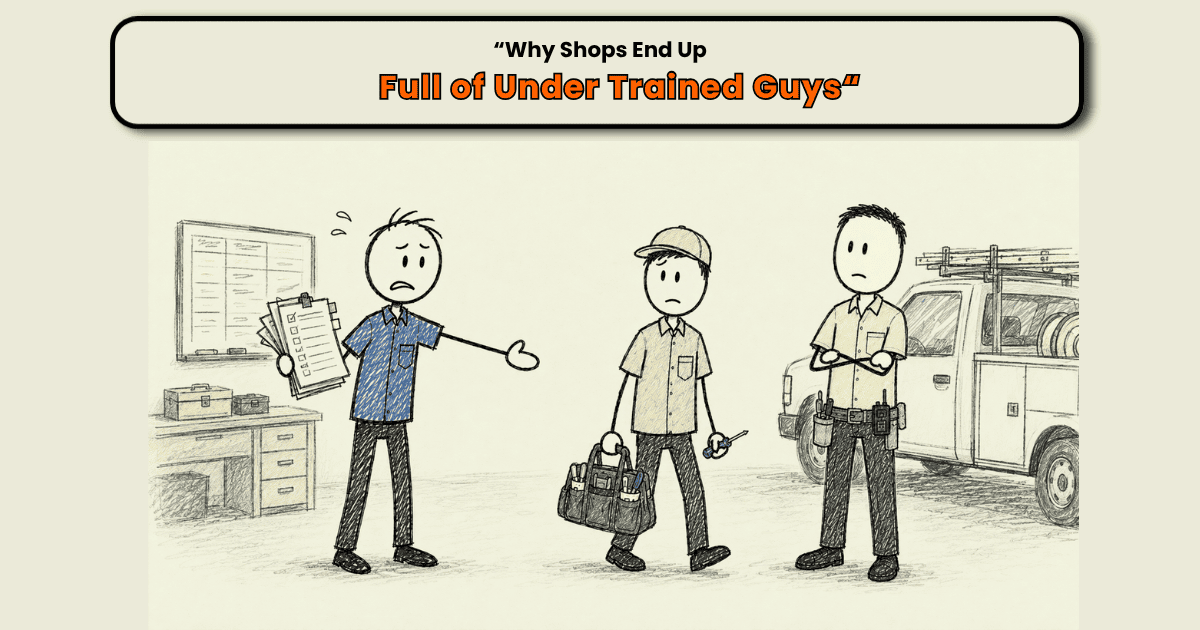
Growth doesn’t fix this. It multiplies it.
More work coming in means more coverage gaps. Faster growth means the ramp from green to ready needs to move faster too. Instead, it moves the same speed it always did or slower, because the people who’d normally do the training are the ones out covering jobs.
The cost that never shows up on a report
A redone panel or a callback on a job that should’ve gone right the first time runs $300-$800 once you count the truck roll, the parts, and the apology. A senior tech pulled off his own billable job to go fix someone else’s mistake is a full day of lost capacity, not just a repair. None of it shows up as a line item. It shows up as a slower month nobody can quite explain.
What’s actually missing
Nobody wrote down what “ready” means in your shop, so when the schedule got tight, ready became a guess. The senior techs know the difference between a guy who can run a service upgrade solo and one who still needs backup. That knowledge lives in their heads, not in a checklist, not in a training path, not anywhere the office can check before making the call.
What changes when it’s built
A defined path fixes it, a checklist for what a tech can handle solo at each stage, and what still needs backup. When coverage is tight, you check the list instead of guessing. Marcus still goes on the job. He just goes with backup, or with the piece of it he’s actually ready for, because you know exactly where he stands instead of hoping he’s further along than he is.
On Elm Street, the story doesn’t need a different ending. It just needs you to already know how far along Marcus really is, before the schedule forces the question.