
She calls about a GFI that tripped again. You bill her $55. Three days later there’s a one-star review calling you a scam.
That’s how a $55 warranty callback turns into a week of damage control. It almost always traces back to the same gap: no written line between what’s covered and what’s a new charge, so every electrician in the field draws that line differently. Put the boundary in writing once and the fight disappears along with the guesswork.
What Counts as Warranty Work on a Service Call?
The guy standing in her kitchen has to decide, right there, whether this GFI trip is a callback on work you already did or a new problem she should pay for. Nobody wrote down where that line sits, so he goes with his gut. Maybe he’s generous. Maybe he’s not. Either way, the customer only sees one thing: she got charged for something that felt like it should be free.
She’s not wrong to be annoyed. From where she’s standing, the answer looks random, because it is. The problem isn’t your guy’s judgment. The problem is that the judgment call belongs to a document, not a person, and the document doesn’t exist yet.
What Actually Counts as Warranty Work?
Most shops never sit down and define this. A few lines that need an answer before your crew is ever standing in a kitchen making the call:
- Same symptom, same component, inside 30 days: covered.
- Same symptom, different component: new charge, probably.
- Same panel, different circuit, six months later: new charge.
- Customer-caused damage, even if it looks like a repeat failure: new charge, explained plainly.
The exact lines are yours to set. What matters is that they get set once, in writing, instead of reset every time a different truck pulls up.
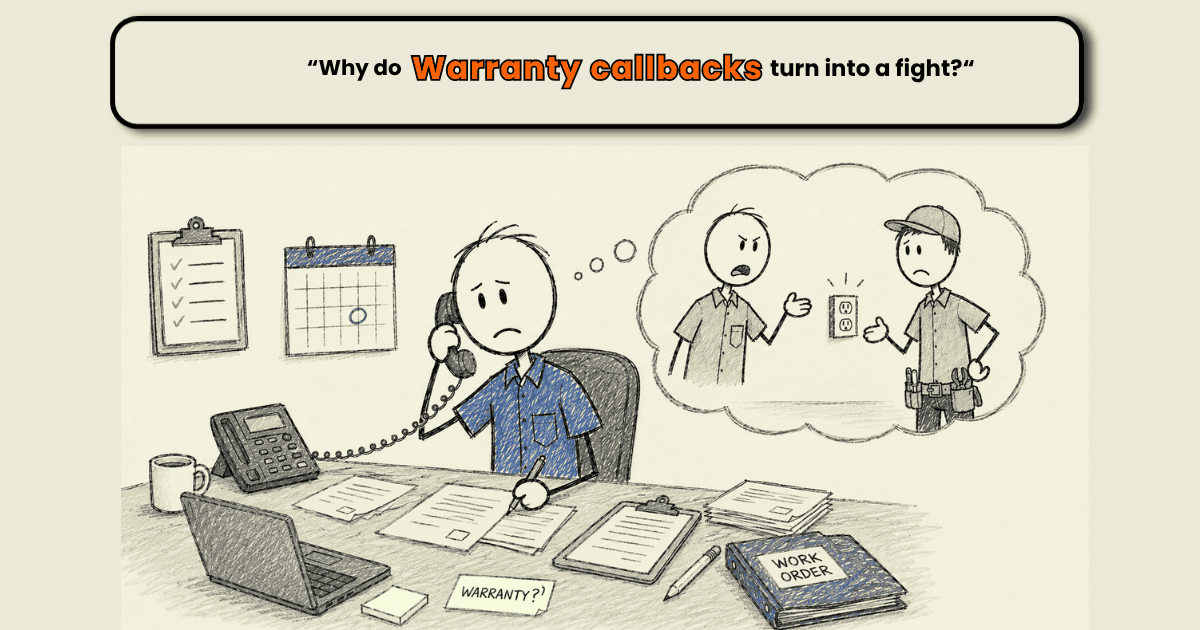
Why Does the Same Customer Get a Different Answer From a Different Tech?
Two guys, same callback, two different answers. Nothing was written down for either of them to follow, so they each answered from memory and instinct. That shows up on your Google reviews before it ever shows up on a P&L. A customer billed by one tech and comped by another doesn’t conclude your policy is nuanced. She concludes you don’t have one.
What Does a Written Warranty Policy Actually Need?
Short enough that a tech can read it standing in a driveway between jobs:
- A time window, tied to the specific repair, not the whole customer relationship
- A plain description of what “same issue” means, in the words your team already uses
- One line on what a tech does when a call is genuinely gray: who they call, not what they guess
- The same document, referenced the same way, on every truck
How Do You Put This in Writing Without a Legal Document?
This isn’t a contract rewrite. It’s one page, in the language your techs already use, kept wherever they already look before a callback, the job workorder, the truck binder, whatever that is for your shop. The goal is the guy’s can glance at it and answer with confidence.
Next time she calls about that GFI, the answer doesn’t depend on which truck shows up. It’s already decided. You wrote it down once, and now nobody has to make that call alone, including you.