
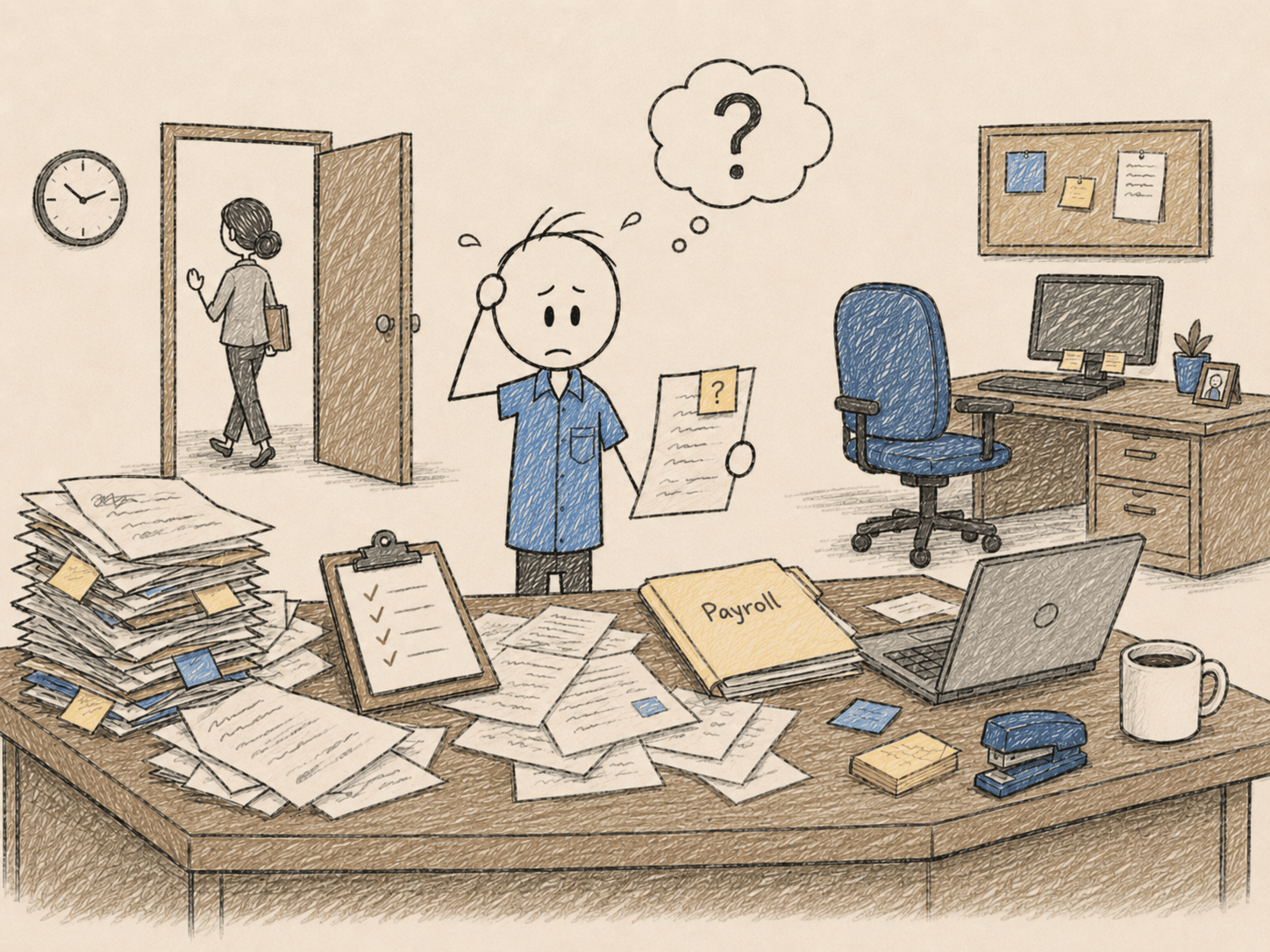
An employee left and nobody knows how they did the job. What now?
You work backward from what’s already written down. The last few payroll runs left a trail in your bank statements, tax filings, and pay stubs, and you can follow that trail to put the steps back in order. Then you write it down, so the next person can read it instead of guess.
How do you rebuild a payroll process from scratch?
Start with the records you already have. Your bank statement shows the dates and the amounts, so you know when payroll ran and what it cost. The tax filings show what got paid and to who. The pay stubs show the math on each check, down to the overtime and the deductions.
Then pick up the phone. Call the payroll company and call the bank. They keep their own records, and most of them will walk a new person through the login and the schedule. They do this all the time.
Write down each step as you find it. Go through two or three full runs that way and you’ll have the whole thing on paper. The same thing she carried in her head, where you can finally see it.
Handle the next pay date first
Don’t let the next run slip while you’re busy figuring out the old ones. The IRS charges a penalty for paying payroll taxes late, and it gets bigger the longer it sits. Get the next paycheck date handled first. Clean up the rest after.
Why did losing one person hurt this much?
The work lived in her head because it never lived anywhere else.
There was no written process. No shared folder. Nobody who’d ever sat next to her and watched. She wasn’t hiding any of it. There was just never a slow afternoon to stop and write down something that was already working fine. That’s not on her, and it’s not on you. It’s how almost every shop your size grows. You don’t stop to write the manual when the work keeps coming.
But a job nobody wrote down is a job that can walk out the door in two weeks. And payroll probably isn’t the only one. Think about how dispatch really runs. The one tech who knows that one big account. Which vendor gets paid first when money’s tight. A lot of your business is sitting in somebody’s head right now, working fine, until the day that person is gone.
What changes when the process is written down
| When it lives in one head | When it's written down | |
|---|---|---|
| Someone gives two weeks | A piece of the business walks out with them | The next person reads the steps and keeps the checks going |
| A new hire starts | Learns slowly by shadowing, if the right person has time | Follows the written steps from day one |
| Something goes wrong | Nobody's sure how it was supposed to run | You check the steps and find where it broke |
| Your afternoon | Answering questions only one person can answer | Spent on the work, not the lookup |
How do you keep this from happening with the next person?
Write the job down while somebody still knows it, before they're the only one who does.
Have the next person who runs payroll record themselves doing it one time, or just write the steps out plain as they go. Then test it. Could someone who's never touched payroll follow those steps and get the checks out? If they can, you're safe. If it only makes sense to the person who wrote it, it's still stuck in a head. Just a different one.
Then do the same for the next job you'd hate to lose. You don't have to write down the whole business this month. You just stop letting any one job live in only one place.
The checks will go out again. And the next time somebody gives their notice, it won't take a piece of the business with them. What they know will already be somewhere you can reach it.