
A request came in Monday. It’s Thursday and it’s still in your inbox, half-priced, waiting on a measurement nobody pulled. Friday it finally goes out. The customer booked someone else on Wednesday.
That’s not a one-off. That’s most weeks.
Why are we always behind on quotes?
Quotes pile up because every one of them runs back through you, and nothing was ever built to move a quote from the request to the customer without you in the middle of it.
You price it. You double-check the number. You hit send. So when the day fills up with everything else a day fills up with, the quotes wait. They don’t wait because you’re slow. They wait because there’s only one lane and you’re it.
Where does the backlog actually start?
It starts before anyone opens a quote.
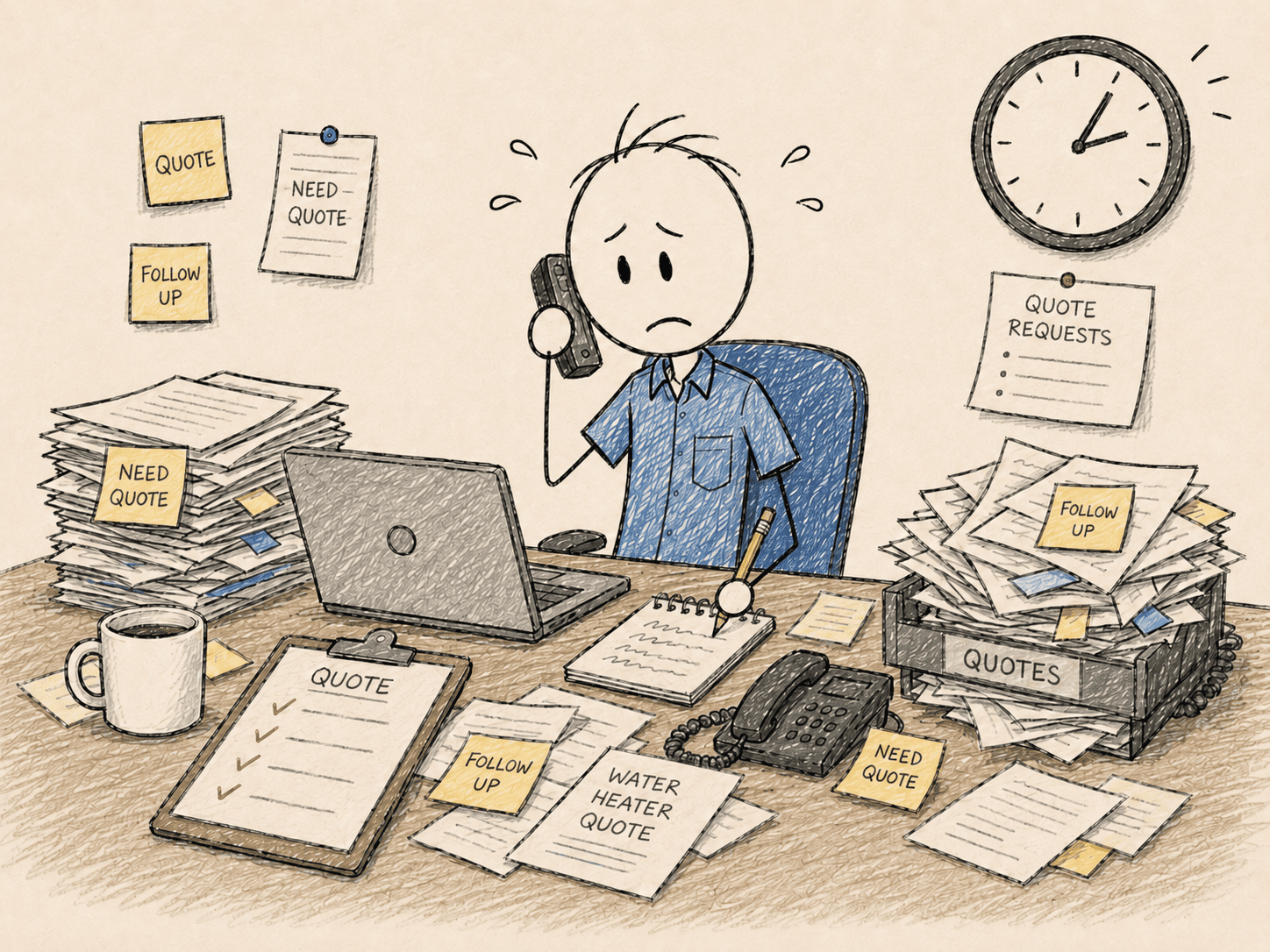
One request comes in by phone. Another by email. One through the website form. One a tech scrawled on the back of a work order and forgot to turn in. They land in four places and live in none. Before a single number gets priced, half the morning goes to figuring out what’s even waiting.
Then the pricing. Some of it needs a measurement from the field. Some needs a part number nobody pulled. Some needs you to remember what you charged the last guy for the same job. Every quote turns into its own little research project, and the research project sits until you have a clear hour. You rarely have a clear hour.
So the request from Monday is still open Thursday. Same problems. Different week.
What’s a slow quote actually costing you?
The customer who asked on Monday isn’t waiting on you. They asked two other shops the same day.
Whoever gets back first with a real number usually gets the job. A quote in their inbox the next morning tells them you’ve got it together. One that limps in Friday, if it shows up at all, tells them the opposite before they’ve read a line item.
Put a number on it. Say a handful of jobs a month slip because the quote went out too late to matter. At $4,000 to $15,000 a job, that’s somewhere in the six figures a year, gone. (Rough estimate. Your real number depends on your job sizes and how many you’re quoting.) None of it lands on a report. It just never becomes revenue.
How do you stop falling behind on quotes?
You build a quote process that doesn’t wait on you. The work moves from request to sent without you standing in the middle of every step. That means a few specific things:
- One place every request lands. Phone, email, form, field. All of it into a single list, so nothing is “somewhere in my inbox.”
- A template that prices the common jobs fast. Most of your quotes are variations on a handful of jobs. They shouldn’t get priced from scratch every time.
- A clear owner for each step. Who gathers the field info. Who prices it. Who sends it. Right now that’s all you. It doesn’t have to be.
- A trigger that moves it forward. A request that’s sat 24 hours without a number is a flag, not a maybe. The process pushes it along instead of waiting for someone to notice.
Built right, a quote goes from request to sent without ever needing a clear hour from you. The measurement gets pulled because pulling it is somebody’s job. The number comes off a template, not your memory. The send happens because the process says it’s time.
What does it look like when quotes stop piling up?
Quotes go out the day they come in. The pile by your desk isn’t there, because there’s no reason for it to be.
You stop being the bottleneck on your own revenue. The work you bid on gets bid on while the customer is still deciding, not after they’ve moved on. A request comes in Monday and it’s quoted by Monday afternoon, while the process runs and you’re out on a call.