
SHORT VERSION
The invoice waits because a finished job and a billable job are two different things in your shop, and nothing moves a job from one to the other on its own. Close the gap by making a job “closed” only when the invoice could go out from what’s attached to it, and give one person the standing job of turning billable work into invoices every day, not every third Friday.
If the invoice goes out weeks after the job is done, it’s not because anyone forgot. It’s because finishing the work and sending the bill are two separate events, and nothing in your shop moves a job from the first to the second on its own.
Done isn’t the same as billable
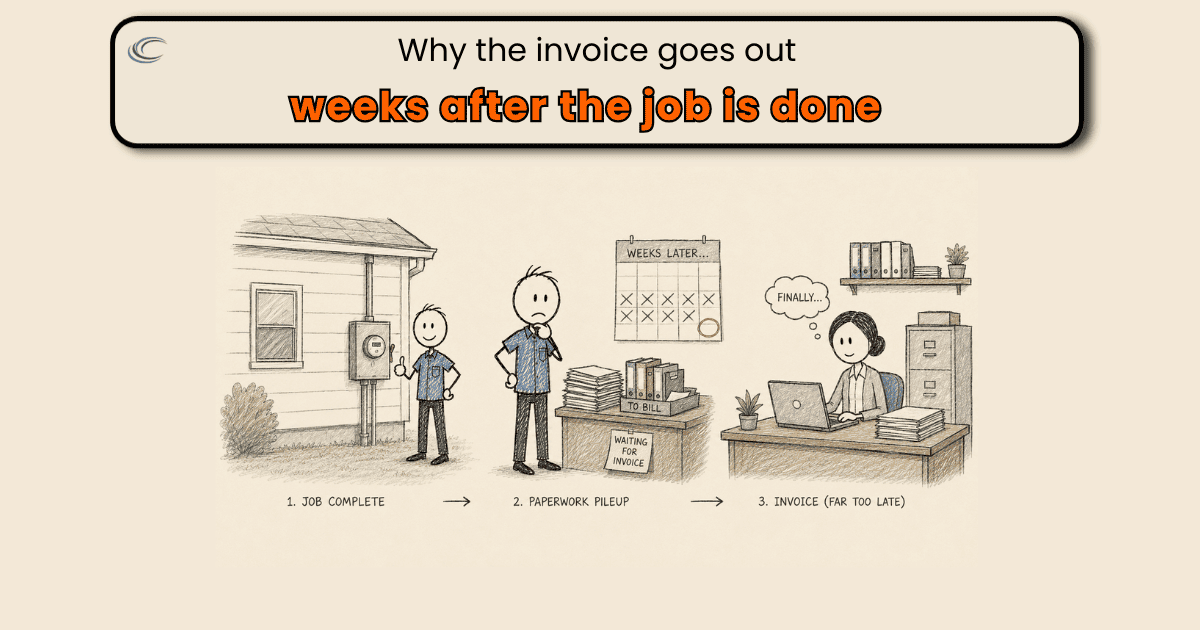
The work ends when your guy tests the circuit, packs up, and pulls away. In his head, that job is over. But the invoice needs a few things to exist: the final price, what material came off the truck, the customer’s signature, the permit charge if there was one. Until those are captured somewhere the office can reach, the job isn’t billable. It’s only finished.
So it sits in a state nobody’s tracking. Not still open, not yet billed, and not on anyone’s list. A job in a state nobody tracks is a job nobody owns. Nothing is counting the days it’s been sitting. It surfaces again when someone happens to notice it, or when the customer calls asking where the bill is.
Why do they pile up until month-end?
Ask whose actual job it is to turn today’s finished work into invoices today. In most shops the honest answer is nobody’s. It’s something that happens when whoever handles billing gets a clear stretch, and a clear stretch is rarely Tuesday morning. It’s the end of the week, or the end of the month.
Now they’re building weeks of invoices in one sitting. Any job missing a single piece gets set aside for later, which just drops it into the next pile. The backlog isn’t a discipline problem. It’s what happens when billing is a task somebody squeezes in, instead of a step the work has to pass through.
What it costs while it sits
Every waiting job is money you already earned. You covered the labor. You covered the material. The work is finished. The only thing between you and the cash is an invoice nobody has built yet.
Sit on it three weeks, and you’ve handed the customer three free weeks before your payment terms even start counting. On a slow commercial account, that stacks on top of the net 30 or net 60 you were already going to wait out. The job made money in the field and it’s still sitting in a drawer.
Make “done” mean “billable”
A reminder to bill faster won’t fix this. What fixes it is closing the gap between the two states, so a job can’t finish without becoming billable at the same moment.
Build one rule: a job isn’t closed until the invoice could be generated from what’s attached to it. You already measure work this way with inspections. A rough-in that’s run but hasn’t passed isn’t finished, and every hand on the crew knows it. Billing works the same way once you decide it does. A job that’s worked but can’t be invoiced isn’t closed, it’s just done.
For service calls, that mostly means the invoice gets built in the field, before your guy pulls away. The price, the material, and the signature are all in one place and never fresher. On projects it’s slower, because change orders and progress billing have to reconcile first, but the rule holds: the job closes when it’s billable, not when the last device goes in.
Then one person owns the billable jobs and clears them on a set day, every day. Not the whole backlog. Just the ones that came in today. When billable is its own short list with an owner and a daily cadence, nothing gets three weeks deep, because nothing sits long enough to.
FAQ
How many days after a job should the invoice go out?
For service work, same day is the target, and it’s realistic when the invoice gets built in the field before your guy leaves. Projects run slower because change orders and progress billing have to reconcile first. The number to watch isn’t a benchmark, it’s whether a finished job has anywhere to sit unbilled. If it does, it will.
Should the invoice get built in the field or back at the office?
In the field, for service calls. That’s when the price, the material, and the signature are all in one place and freshest. The wider the gap between finishing the work and building the bill, the more has to be pieced back together later, and that piecing-back is what turns a two-minute invoice into a month-end backlog.
Why do invoices pile up until the end of the month?
Because turning finished jobs into invoices usually isn’t anyone’s defined daily job, so it falls to whoever gets a free stretch, which tends to be month-end. Give the billable jobs one owner who clears them on a set day, every day, and the pile never builds in the first place.