
SHORT VERSION
The invoice goes out weeks after the job is done because the job closes before it’s billable. The work ends on site, but the record the office needs to invoice it, the findings, the material used, the extras, the sign-off, never gets built at the truck, so the office reconstructs it days later before anything can go out. The fix is to make “done” mean billable: the job doesn’t get marked complete until it carries everything the office needs to invoice it without asking a question.
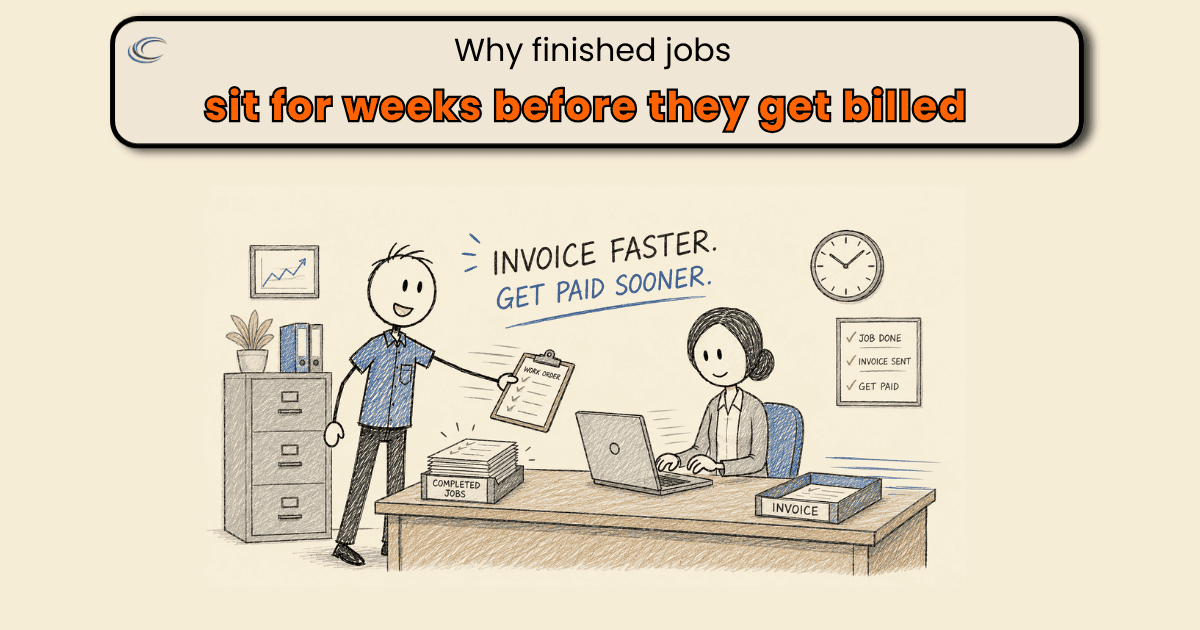
The invoice goes out weeks after the job is done because a finished job and a billable job are two different things, and nothing at close-out turns one into the other. The work ends on site. The record the office needs to bill it gets pieced back together days later, from notes that were never built to bill from.
Where the billable record goes missing
On most calls, “done” means the work works and the customer’s happy. Your guy tests the circuit, packs up, and clears the call. That’s a finished job. It is not yet a billable one.
Billable means the office has everything it needs to send the invoice without asking anyone a question. What the complaint was. What was found. What got done. What material went in, including whatever came off truck stock. Any extra work added on site, and whether there’s an approved price on it. On service work, whether the payment was already collected, because it was supposed to be.
None of that is hard to capture. It’s just not required before the job clears, so it doesn’t get captured.
The call closes as “replaced outlet.” Two devices and a GFCI came off the truck, and there’s no point in the close that asks what material went in before the job clears, so it walks out unrecorded. Thursday, the office is trying to build an invoice out of “replaced outlet.” They text one of your guys, who’s three jobs away by now, and the bill waits on him to answer. Run that across a week of calls and billing is always a few days behind the work.
What the lag actually costs
On service work it costs twice. The invoice is late, and the money that was supposed to be collected on site never was, so now you’re chasing payment on a job that should have been paid the day it closed.
On bigger jobs it’s the change orders. The extras got done, nobody reconciled them into the final bill, and the whole invoice sits while someone reconstructs what was added and whether it was approved.
Make “done” mean billable
Right now the job clears when the work works. Change what “done” means. A job isn’t closed until it carries what the office needs to invoice it, and it doesn’t get marked complete without those pieces.
The record gets built at the truck, the moment the job ends, while the electrician still knows exactly what went in. Not reconstructed at a desk three days later from a two-word note. That means the close has to require the billable pieces before it lets the job through: the findings, the work performed, the material used, any extras with a price, the photos, the sign-off, and on service work, the payment.
In field service software, that’s a close-out screen the job can’t clear until those fields are filled. On paper, it’s a close-out sheet that rides back with the work order and isn’t optional. Either way the rule is the same. The job can’t be called done until it’s ready to bill.
Build that, and the invoice goes out the day the job closes. The thing that used to hold it up already happened, on site, while the work was fresh.
FAQ
Should I just tell the office to invoice faster?
Speed isn’t the bottleneck. The office can’t send an invoice it can’t stand behind, and on most late bills it’s waiting on pieces that never left the field: what got done, what material went in, whether there were extras. Fix the close-out so that record exists the day the job ends, and faster takes care of itself.
Why does truck stock never make it onto the invoice?
Because nothing in the close asks for material-used before the job clears. The devices go in, the job gets marked done, and the material walks out unrecorded. It isn’t a memory problem. The record was never required at the point it was easy to capture. Build material-used into the close-out and it stops leaking.
Should the invoice be written in the field or back at the office?
The billable record gets built in the field, at the moment the job closes, while the electrician still knows what went in. Whoever hits send can still be the office. The difference is they’re sending a complete record instead of rebuilding one from a two-word note three days later.
Why is final billing on my bigger jobs always weeks behind?
Usually the change orders. Extra work got done, nobody reconciled it into the bill as it happened, and now the whole invoice waits while someone reconstructs what was added and whether it was approved. Capture extras with a price at the moment they’re authorized, not at final billing, and the bill goes out on time.