
You Bid It in March. The Wire Went Up in June.
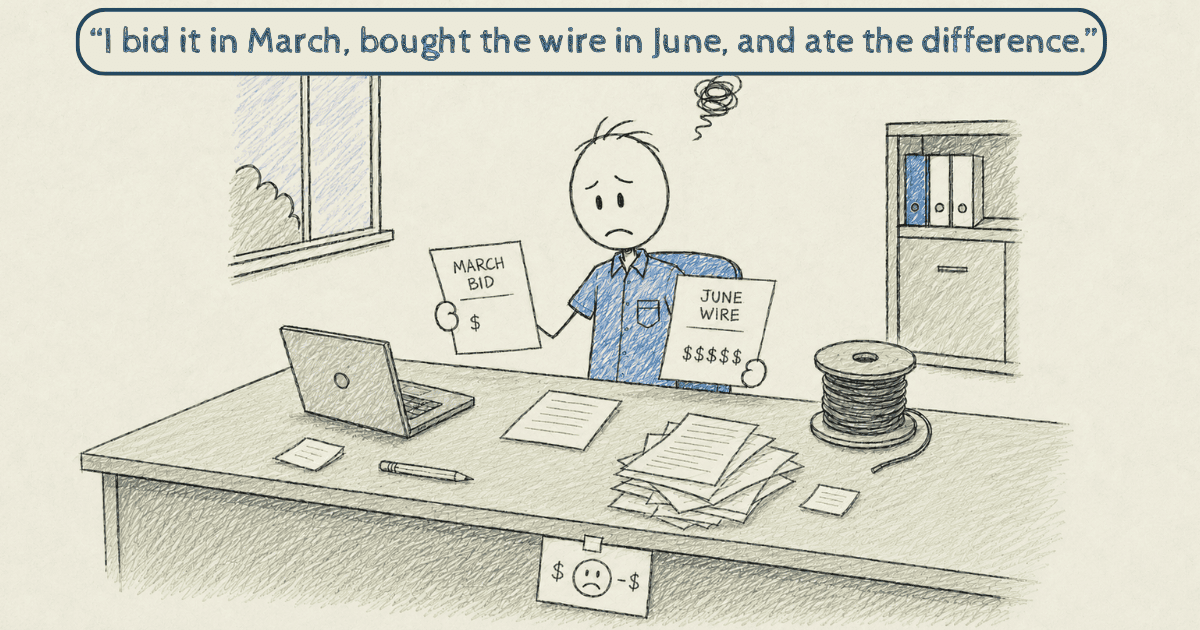
A fixed bid works fine until time passes. You bid the job in March. The materials cost more by the time you bought them. Somewhere between the signature and the supply run, the number stopped being true.
Why did the materials cost more than what you bid?
A fixed bid sets one number on the day you send it. The materials get bought later: sometimes a week later, sometimes three months later, depending on the job’s start date and how backed up the crew is. The price you built the bid on and the price you pay at the supply house are two different moments in time.
Nobody made a pricing mistake. The bid just never had a way to check whether the number was still true by the time the crew bought materials.
How much does a price swing like this actually cost you?
Wire and copper-based materials can move 10 to 20 percent in a matter of months, sometimes more, depending on what’s happening with supply. On a job with $15,000 in material, a 15 percent swing is over $2,000 gone before the crew shows up. Run that across a dozen jobs a year and it starts looking like the season where nobody can explain where the margin went.
It shows up as margin that gets a little thinner every quarter, spread across jobs that all looked fine on paper.
Is this a bidding problem, or something underneath it?
Most owners look at this and blame the estimate. The estimate was fine. What’s missing is a mechanism that accounts for the time between the promise and the purchase. That gap never got built into the bidding process. Not because anyone got careless. Because when jobs moved faster and the business was smaller, the gap barely mattered. It still runs that way now, on jobs three times the size.
Does this mean fixed-price bids don’t work?
A fixed bid can hold up fine, as long as it accounts for the time between quoting the job and buying the materials. An escalation clause. A shorter quote window. Or just a contingency built into the number for material costs, so a price move doesn’t come straight out of margin. None of that means bidding differently. It means building time into a number that currently ignores it.
The receipt from the supply house doesn’t match the number on the bid. It never had to, nobody built the bid to survive the time between the two.