
SHORT VERSION
If you’re slammed and still short on cash, you don’t have a revenue problem. You have a lag problem. The money is weeks behind the work because the invoice is, and on terms a late invoice is late twice, since Net 30 doesn’t start until it goes out. The fix is to stop treating billing as a separate task done later, and make the invoice part of finishing the job: paid on site for service work, deposits and progress billing on projects.
When you’re slammed and always short on cash, the money isn’t missing. It’s weeks behind the work, because your cash flow moves at the speed of your billing, and a slammed week is when the billing slips first.
Where does the cash actually get stuck?
Not in the work. The crew is producing. Jobs are getting done. The bottleneck is the trip from finished work to money in the account, and that trip runs through one thing: the invoice.
On a slow week that trip is short. Somebody has time to sit down, and the invoice goes out the same day. On a slammed week there’s no time to sit down, so the invoice becomes a thing that happens “later.”
The job wraps at 4:40, the next call is already on the board, and the billing is now a note to deal with back at the office. Back at the office, three more from that same day are stacked up ahead of it.
The problem underneath isn’t that anyone forgot. It’s that billing was never built into finishing a job. It’s a separate task that waits for someone to have time.
And a busy week is exactly the week nobody has time. So the money waits for the work to slow down, which is the one thing it never does when you’re growing.
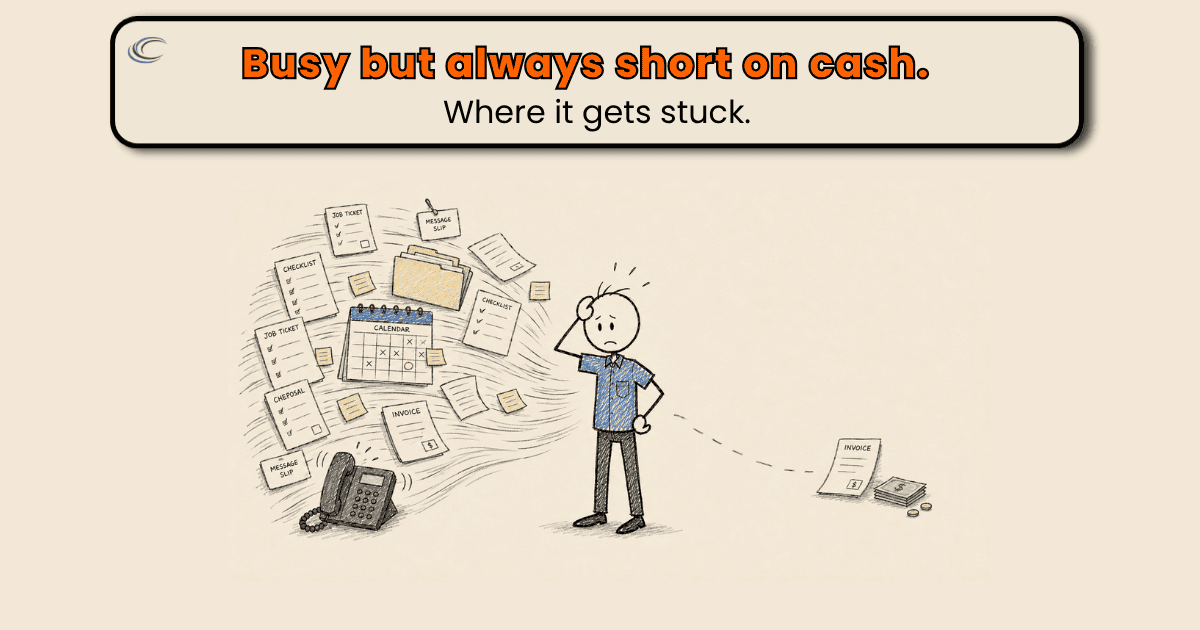
A late invoice is late twice.
This is where the lag costs you twice. Most of what you bill goes out on terms, and Net 30 doesn’t start counting from the day the work got done. It starts from the day the invoice went out.
So a slow invoice drags the whole payment clock back with it. Close a job on the 3rd, get the invoice out on the 10th, and Net 30 now runs to the 9th of next month.
The work took a day. The money took five weeks. That’s the invoice, not the customer.
Make the invoice part of the job.
The move isn’t to bill faster by pushing harder on a task that loses to a busy day every time. It’s to stop letting the invoice be a separate task at all.
On service work, that means the invoice gets built and paid before the truck leaves the driveway, on site, as the last step of the job. Take a breaker-keeps-tripping call: you find the bad breaker, swap it, test the circuit, and the card runs on the phone standing at the panel, before the truck rolls. The software you already pay for does this now.
The invoice gets written on the phone, the customer pays on the phone, and the job isn’t called done until that’s happened. No paperwork riding back to the office, and no Net 30 clock to wait out, because the money’s already in. That’s a step in the work, not a habit anyone has to remember.
On bigger project work, you stop waiting until the end to see the money. Take a service upgrade: you’re ordering the panel and meter-main from the supply house before an electrician sets foot on the job. A deposit before it starts covers that gear instead of you floating it, and progress billing at set points brings the rest in as the work moves.
You’re not funding the whole job on your own cash and hoping the final invoice goes out on time. The money comes in with the work.
And for anything that does go out on terms, one rule holds the rest together: the invoice goes out the day the work is called done, not the day someone finds time. Net 30 is already thirty days of waiting. Every day the invoice sits adds to it, for nothing.
FAQ
Why am I busy but always short on cash?
Because cash flow follows billing, not work. The jobs are done, but the invoices are running days or weeks behind, and on Net 30 the payment clock doesn’t even start until the invoice goes out. The work is ahead. The money is behind. Close that gap and the cash catches up without a single new job.
Should I make customers pay before the electrician leaves?
On service work, yes. Payment collected on site, as the last step of the job, means there’s no invoice to chase and no Net 30 clock to wait out. The software you already run can build the invoice and take the card right there on the phone.
Should I take deposits on residential jobs?
On anything bigger than a same-day service call, deposits and progress billing keep you from floating the whole job on your own cash. You get money in as the work moves instead of waiting weeks for one invoice at the end. Customers expect it, and it’s the difference between funding the job yourself and not.
How do I get invoices out faster when we’re slammed?
Stop making it a separate task. If the invoice is something that happens “later” at a desk, a busy week will always push it, because a busy week has no later. Build it into the job so the work isn’t called done until the invoice exists. Then it can’t slip when things get buried.