
SHORT VERSION
A busy shop loses money on jobs when nothing compares what a job actually cost against what it was bid, until the job is already closed and the money is spent. The electrical work is usually fine. What’s missing is job costing: a job number that every cost binds to while the work is happening, and a profit check before a job closes. Without both, the leaks stay invisible and the same kinds of jobs keep losing money.
You can lose money on a job you did well, on time, for a happy customer. It usually isn’t the electrical work, it’s that nothing sets what the job actually cost next to what you bid it at until the job is already closed and the money’s gone.
Where the money actually leaks
The loss almost never happens in one big, obvious place. It happens in small ones that each looked fine on the day.
The bid came in a little light and nothing flagged it. A change order got done on a handshake. A job took three trips to the supply house that nobody logged. A few hours landed on the wrong job, because the timesheet runs by the week, not the job.
Each one is invisible on its own. The work got done and the customer paid, same as always. Nothing on that day told you the job lost money.
Here’s one that happens every week. The homeowner asks for two more circuits while your guy is already there, and he does it, because it’s real work and the job doesn’t stop for paperwork. It’s real material and real hours.
And it never makes it onto the invoice, because there’s no step that turns a yes in a driveway into a line on the bill. That’s not your guy failing to do paperwork. There’s nowhere for the change to go.
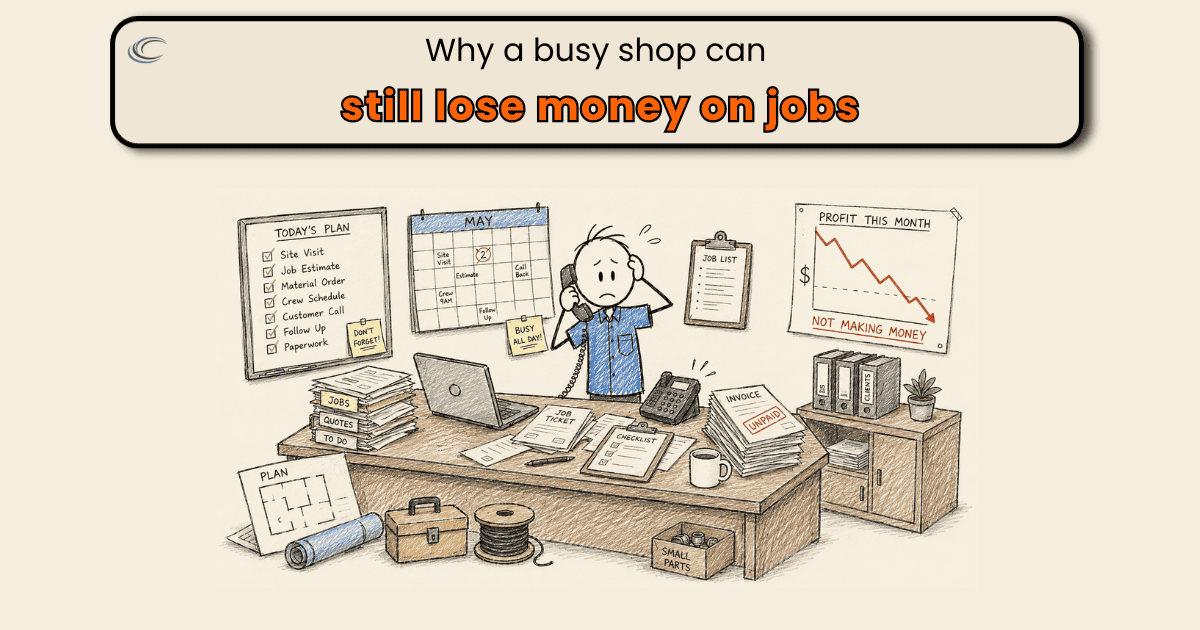
Why does a busy shop still lose money?
Put all those small leaks together and they show up as one thing: a P&L that came in flat after a year that never let up.
You can’t trace it back because nothing ever put the actual cost of a job next to the bid. The estimate went out, the job ran, the invoice went out, and nobody ever laid the real hours and material against what the job was priced at.
That comparison isn’t anyone’s job, because there’s no step that requires it and no job number holding the pieces together.
The receipts are sitting in a truck. The hours got logged by the week instead of by the job, and the change order never left somebody’s memory. You can’t compare costs to a bid when the costs were never tied to the job in the first place.
You can’t cost a job you didn’t tag
Job costing is really two moves. One at the start of a job, and one before you close it.
At the start, every job gets a number, and every cost binds to it the moment it happens. The supply-house receipt. The hours. The change order.
Not reconstructed from memory later, because by then nobody can say which of the four jobs that week the box of fixtures was for. If a cost doesn’t carry a job number when it’s spent, it’s gone, and you’re guessing.
Before the job closes, someone sets the actual cost next to the bid. Hours against estimated hours. Material against what was in the number. Change orders against what got billed.
That comparison is the whole point of job costing. It’s the one thing that tells you whether the job made money, and it’s the step nearly every shop skips.
It gets skipped because there’s no gate. A job closes when the work is done and the customer’s happy, not when the numbers are reconciled. Put the profit check in front of the close, and it stops being optional.
Do it on every job, not just the ones that felt off. The ones that felt fine are where the quiet losses hide.
FAQ
Why is my shop busy but not making money?
Busy and profitable aren’t the same thing. If nothing checks each job’s real cost against what it was bid, you can run flat out all year and never see which jobs paid and which ones got covered by the ones that did. That’s a job costing gap, not a volume problem.
How do I know if a job actually made money?
You set the actual cost next to the bid before you close the job. Real hours against estimated hours, real material against what was in the number, change orders against what got billed. If you can’t do that, the costs were never tied to the job while the work was happening, and that’s the thing to fix first.
Do I need job costing software to do this?
Software helps, but it doesn’t create the habit of tagging every cost to a job while the work happens. Plenty of shops own the software and still can’t cost a job, because receipts and hours never carry a job number. Get the capture right first, then the software has something real to work with.
How do I stop losing money on change orders?
Tie the change to the job the moment it’s approved, so it lands in both the bill and the job’s cost record. Most change orders don’t get lost because someone forgot. They get lost because there’s no step that catches a yes in a driveway and attaches it to the job, so it never shows up when you check whether the job made money.