
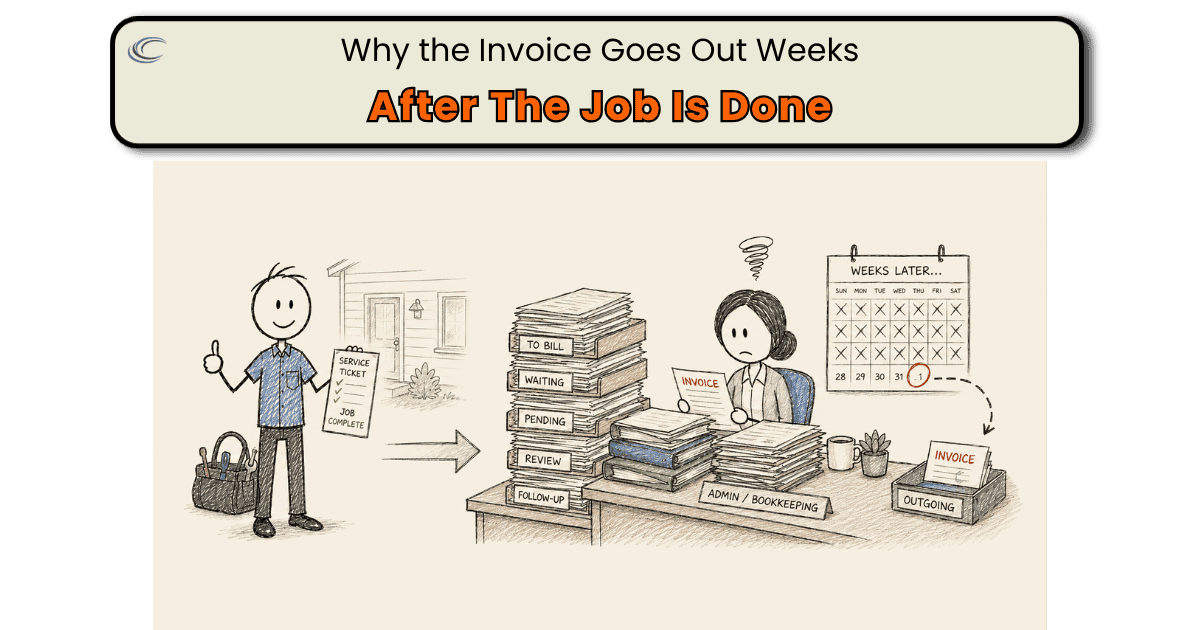
The invoice goes out weeks after the job is finished because the office can’t bill from what comes back from the field. What was done, what material went in, what the customer agreed to pay: most of it is still in the truck or in someone’s head when the job closes, so billing waits until it can be pieced together.
That gap is the whole problem. When the job closes, the office is handed a finished job and no invoice, and it has to build one from scratch every time.
Why does the invoice go out weeks late?
An invoice is built from a handful of things: the complaint, what got found, what got done, the material that went in, the price the customer okayed, the sign-off. When a job wraps in the field, most of that never lands anywhere you can bill from. It’s on a phone, in a text, on a signed sheet in the truck, or nowhere but somebody’s memory.
The service call wraps Thursday afternoon. The customer signed on a phone, the two GFCIs that went in came off truck stock with no step that logs them against the job, and the price quoted at the door lives in the electrician’s head. None of that is wrong. It’s just not billable yet.
So the office waits. Not because anyone’s dragging, but because there’s no step in finishing the job that produces a billable record, so someone has to rebuild one. That rebuild means chasing the material list, confirming what was actually authorized, matching the supply-house receipt to the job. It competes with the phones ringing and next week’s schedule, so it slides. A week, then two.
And the bill that finally goes out is often light. The truck-stock material nobody logged doesn’t make it onto the invoice, so you bill for less than you actually did. The longer it sits, the fuzzier it gets, and the harder it is to collect once the customer has moved on too.
What finishing the job has to hand the office
The fix is to make the invoice exist the moment the job ends, so there’s nothing left to reconstruct.
1. The invoice gets built where the work happens.
The billable pieces get captured in the field, at completion: work performed, material used, the amount authorized, the signature. In the field software, the completed work order becomes the invoice. The line items are already on it, because they went on when the work did, not three weeks later from memory.
2. A job isn’t closed until it’s billable.
This is the gate that makes the first step hold. The completion screen requires the fields the invoice needs. If the material, the amount, and the sign-off aren’t there, the job isn’t marked done. “Complete” and “ready to bill” become the same thing, so a finished job can’t sit in a state where the office has to fill in the blanks.
3. The invoice goes out on a clock, not when someone gets to it.
Once it’s already built, the office just looks it over and sends it, same day or the next morning. Nothing waits, because there’s nothing left to assemble.