
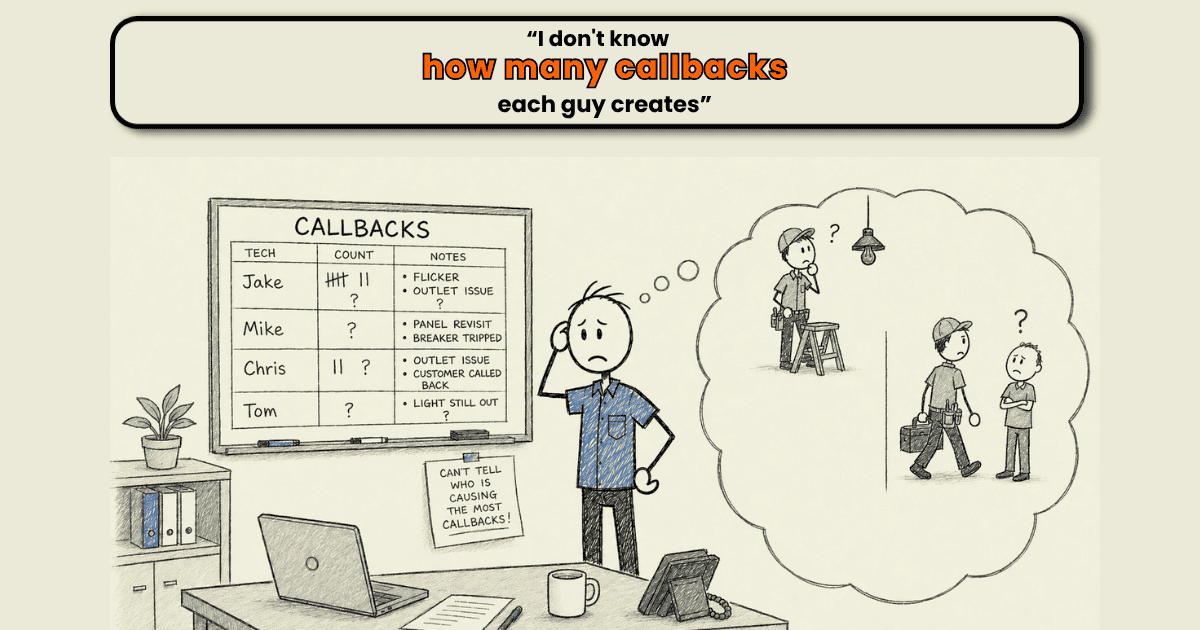
Ask five techs why a job got a callback and you’ll get five different answers. Ask which tech generates the most callbacks, and you won’t get an answer at all — because nobody’s ever written it down.
If you don’t know how many callbacks each of your guys generates, you’re not tracking the thing that’s actually costing you money. You’re tracking whether the job got done, whether the invoice got paid, maybe whether a customer complained loud enough to reach you. None of that tells you which tech’s work keeps coming back.
Rushing the last step. Skipping a check because the next job’s already waiting. A shortcut that works nine times out of ten. Habits like that turn into callbacks for one tech and not for another. Nobody’s connected the dots, because nobody’s counting.
What tracking callbacks by tech actually looks like
It’s simple to set up, and almost nobody does it. Every callback gets logged against the original job, and the original job has a tech’s name on it. Six months of that, and you have a number next to every name on your crew.
You don’t need software for this. A spreadsheet with job number, tech, and callback reason works just as well. The number matters more than the tool that produces it.
Once the number exists, patterns show up fast. Maybe one tech’s callbacks trace back to the same step on the same kind of job, every time. Maybe they’re spread evenly across the crew and the real issue is a process gap, not a person. You can’t tell which until you have the number.
Why this stays invisible in most shops
Callbacks feel random in the moment. A customer calls, a tech gets sent back out, everyone moves on to the next job. Nobody sits down at the end of the month and counts. The pattern never gets a chance to show itself, it just keeps happening, spread across enough weeks and enough jobs that it never looks like one thing.
A callback usually means a truck roll that doesn’t get billed, plus the job the tech didn’t get to instead. At $150–$250 in lost time and opportunity per callback, twenty extra callbacks a year from one tech is $3,000–$5,000 sitting in a column nobody’s added up. Multiply that across a crew and the number gets uncomfortable fast and it’s still invisible on the P&L, because it never shows up as its own line.
| What most shops track | What they don’t |
|---|---|
| Job completed, invoiced, paid | Callback rate per tech |
| Overall callback count for the month | Callback reason by job type |
| Customer complaints that reach the owner | Which tech generated which callback |
What changes once you have the number
Once callbacks are tracked by tech, the conversation changes. Instead of a general sense that callbacks are up this month, you can point to a specific step on a specific job type and fix it for one tech, or for the whole crew if it turns out everyone’s making the same shortcut.
It stops being personal, too. You’re not guessing about who’s good based on who’s likable or who complains the loudest anymore. The number does the talking, and it points at the work, not the person.
Ask your crew that same question in six months. This time you’ll have an answer, because you’re the one who started writing it down.